
Weird Wednesdays: Homoti
This screening was part of the Alamo Drafthouse’s Weird Wednesday series. For upcoming shows, click here.

Allow me to begin with an admission: I am not a gay alien nor have I visited Turkey of the early 1980s, therefore I may not be the best person equipped to write this review. Yet the endeavor of personal growth is a continuous cycle of acknowledging one’s own blind spots and opening one’s mind to new ideas and experiences. Fortunately, movies are purpose-built for that task. It’s in that spirit I proceed with today’s review of Homoti, presented during a recent Weird Wednesday screening at Alamo Drafthouse.
At first blush Homoti is clearly a Turkish riff on E.T. the Extraterrestrial. It’s critical to acknowledge that both of those films were released in Turkey at a very pivotal time. The country was in the midst of a cultural upheaval. Even before that Turkey had become notorious for turning out their own unique copies of western properties from Star Trek to Superman. However, with the arrival of the 1980s, Turkey’s right-wing government was attempting to control the media and the culture and they started where most do: by portraying queer folks as deviants and outcasts.
If you want to know more about the intersection of Homoti, queer theory, and Turkey’s socioeconomic status in the 1980s — I strongly recommend taking a moment to read this explainer courtesy of an online comic that I will link here.

So now that we’re all caught up, what actually happens in Homoti? Let’s begin with our protagonist, Ali, played by Writer/Director/Producer Müjdat Gezen, is a journalist for his local newspaper. He is coded as a hip, happening guy. He’s single, he wears leather jackets and rides around on a cool red trike motorcycle.
Ali’s journalistic focus seems to be what we would describe today as ‘clickbait.’ We open with Ali on assignment. It’s a dynamic opening sequence which gives him an excuse to ride around in a helicopter chasing a whale decoy. All in hope of attracting a real whale to the harbor.
Ali’s boss, Altan, wants to pivot from headlines such as ‘One Weird Trick to Attract Whales’ to ones more like ‘You Won’t Believe These Turkish UFO Pictures.’ He sends Ali out to find pictures of UFOs. If there are no real UFOs around, he’ll just have to toss some frisbees and get the photos the old fashioned way: faking ‘em! Just don’t tell UFOologist Art Bell.
Wouldn’t you know it? The minute Ali goes out to the woods to fake some UFO pictures, he encounters a real deal honest-to-god UFO. Coincidences don’t get more coincidental.
The UFO is piloted by a single entity, the titular star of the picture, the one and only Homoti.
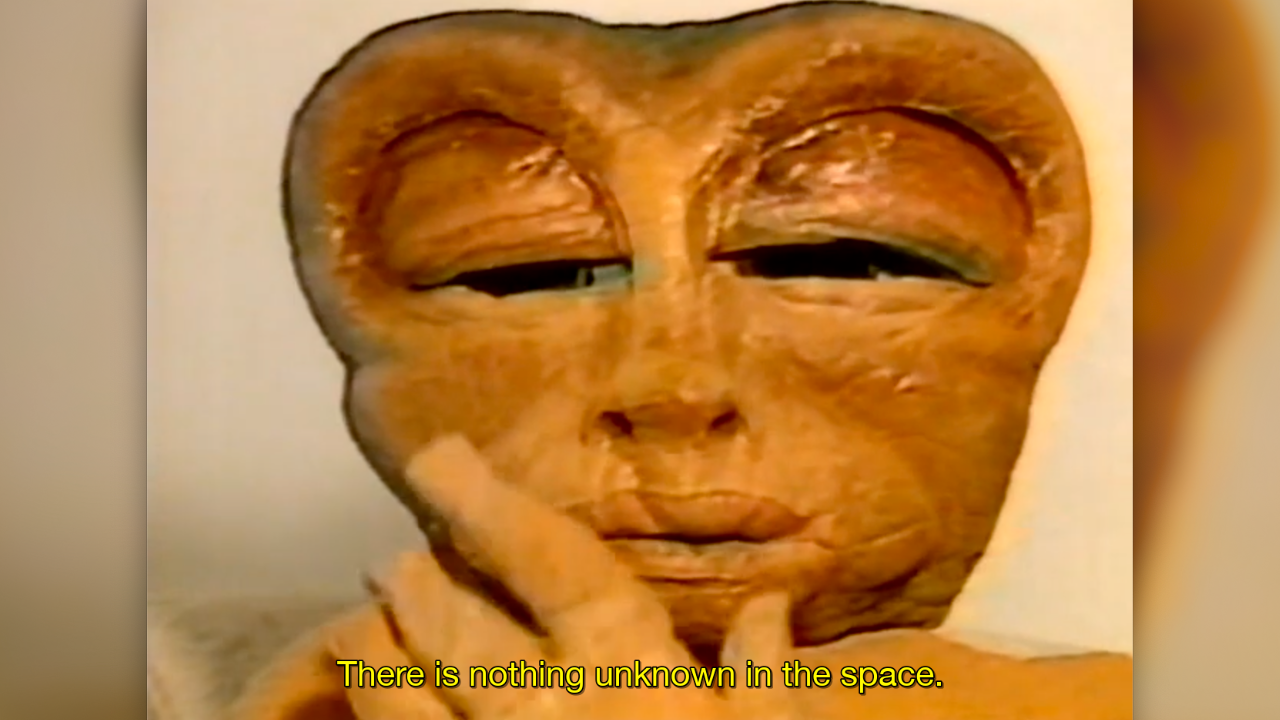
Let’s pause here to note that as a shot-on-VHS Turksploitation film of the early 1980s, the photography and visual effects are sub-standard. Although I find the video and sound effects when Homoti uses his powers to be charming in a lo-fi, 8-bit video game kind of way.
The fact that this movie has gathered an audience beyond its original time and place should tell you that there is more going on with Homoti than simple video effects and a shoddy-looking Papier-mâché alien.
Homoti is from a planet called Ubun or Homon (depending on the subtitle file you are reading.) Sadly, Homoti is fleeing Homon because of persecution from a dictatorship that has ruined his home. Relatable.
The core conflict is that Ali needs to produce a UFO story for his editor and a real UFO miraculously landed in his lap. However, Homoti is a refugee and he needs to keep his presence a secret. If Earth media finds out he’s on our planet, word will get back to Homon and Homoti does not want that kind of trouble.
Ali also has some human cohorts, there’s Hatce, Ali’s housekeeper. She hangs around his place and makes everyone tea. Hatce is presented as comic relief, she does some jokes with the shopkeeper that don’t really translate well. The way those scenes arrive seemingly at random would suggest they only exist to allow the film to cut away to other scenes.
Hatce has a gay-coded friend by the name of Haydar. While there is some ambiguity with regard to Ali and Hatce’s orientation, there is no question where Haydar is concerned. He is frightened of Homoti at first, but they become fast friends. Homoti comes from a planet where they speak every language, and love is love regardless of gender or orientation. Must be nice.
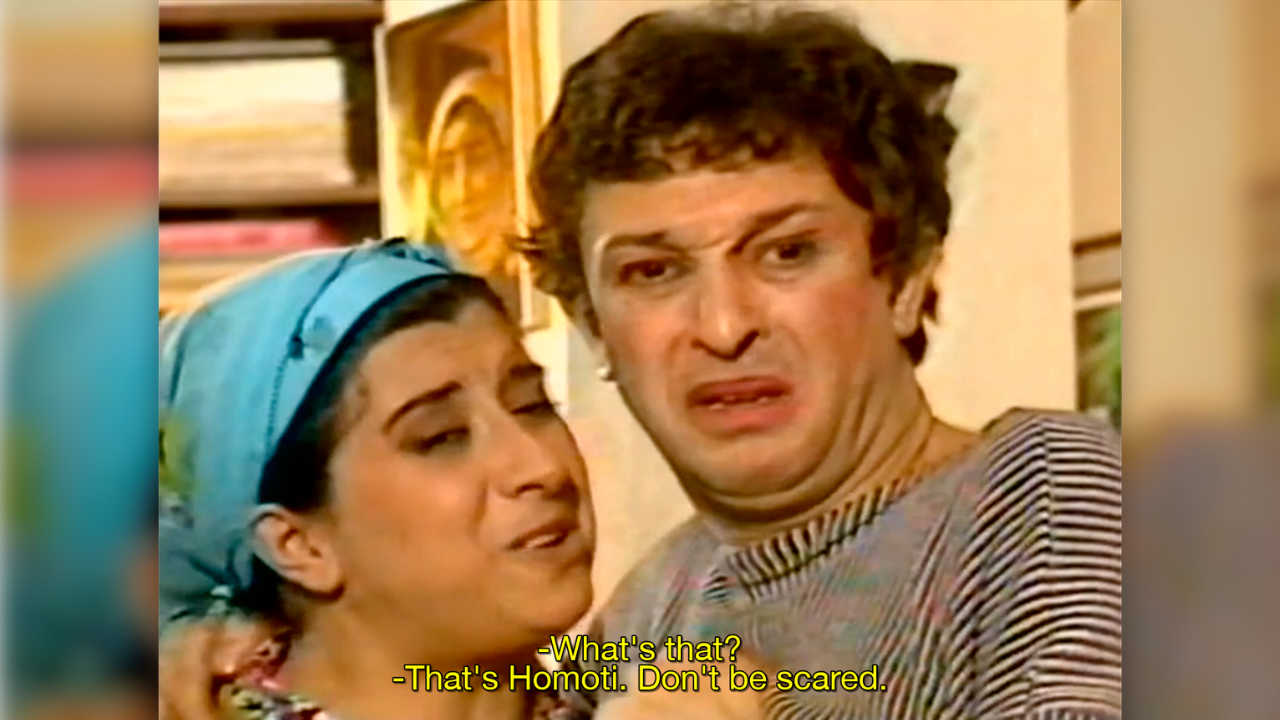
Another complication comes with the introduction of a love interest. Ali’s boss teams him with a Turkish Lois Lane-type named Aysegul. She is very invested in teaching Ali about journalistic integrity; she also seems to be his hetero love interest by default.
On the other side of the journalistic spectrum is the antagonist, Kadir, Ali’s rival at the newspaper. Kadir is suspicious that Ali is up to something, when he goes to confront Ali at home, he finds Homoti instead and drags him back to his apartment for interrogation. Kadir has no problem pursuing fame and his own self interest, so obviously he finds himself on the receiving end of the alien’s omnipotent power set. Some may find it petty. I call it justice, Homoti style.
Once Homoti arrives on the scene, the sequence of events becomes less important. Homoti hangs out in Ali’s apartment for the majority of the runtime. Hatce reads his tea leaves, he complains about his crush on Ali to Haydar. They watch Jaws. There’s a very funny scene where Homoti and Hatce get drunk on champagne and he starts pawing at her face. The scene is cringeworthy alt comedy at its very best.
Homoti uses his christmas-light-powered space phone to facetime with his brother back on Homon and his cousin E.T. (Yes, the title character from E.T. the Extraterrestrial.) Allow that last bit to sink in a bit.
In 1999’s Star Wars: The Phantom Menace, it’s established that the E.T. species exist in the Star Wars universe. Therefore Homoti could appear in The Mandalorian and Grogu. Wouldn’t that be something?
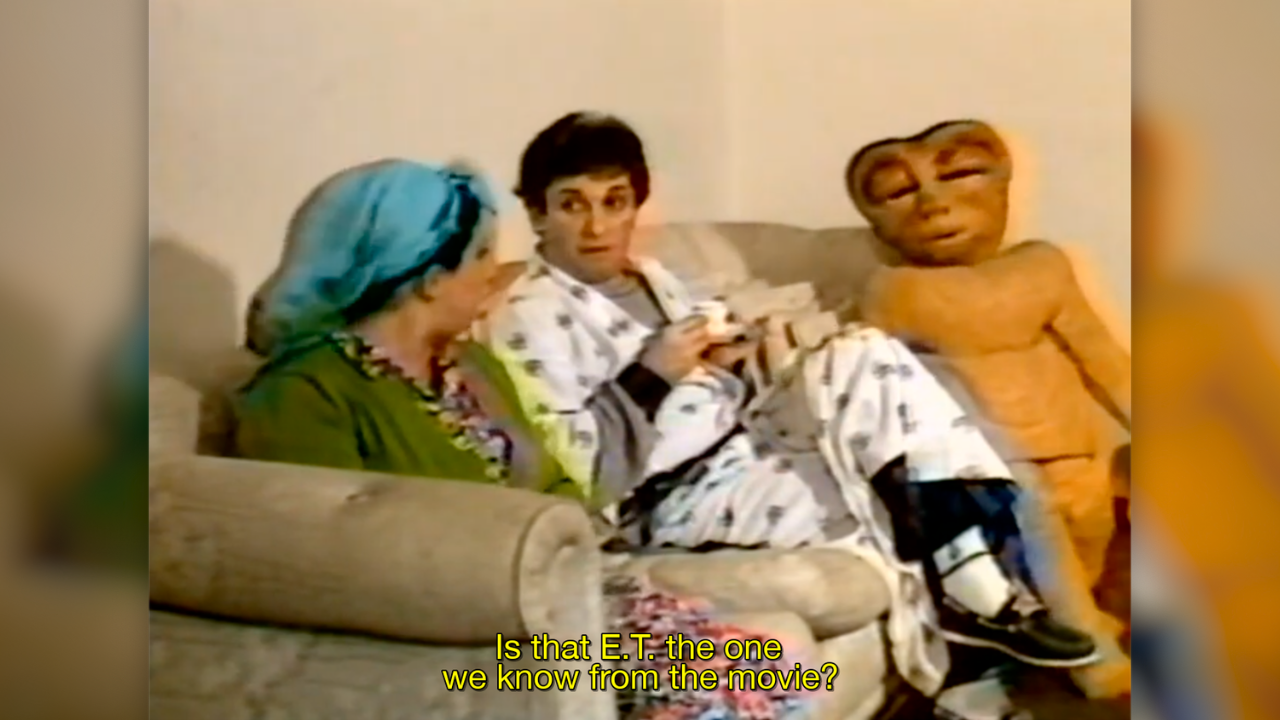
The E.T. reveal is one of the funnier meta gags, while the writing says a lot about the mindset of the typical indie filmmaker, regardless of the country they are in. It reminds me of the teen that blows up the Star Wars sign in Laserblast, or the kid at the beginning of Philadelphia Experiment II asking who would win, Predator or Robocop? While indie films are the smallest part of the continuum, as long as they find an audience they can be part of the same cultural conversation as their blockbuster siblings.

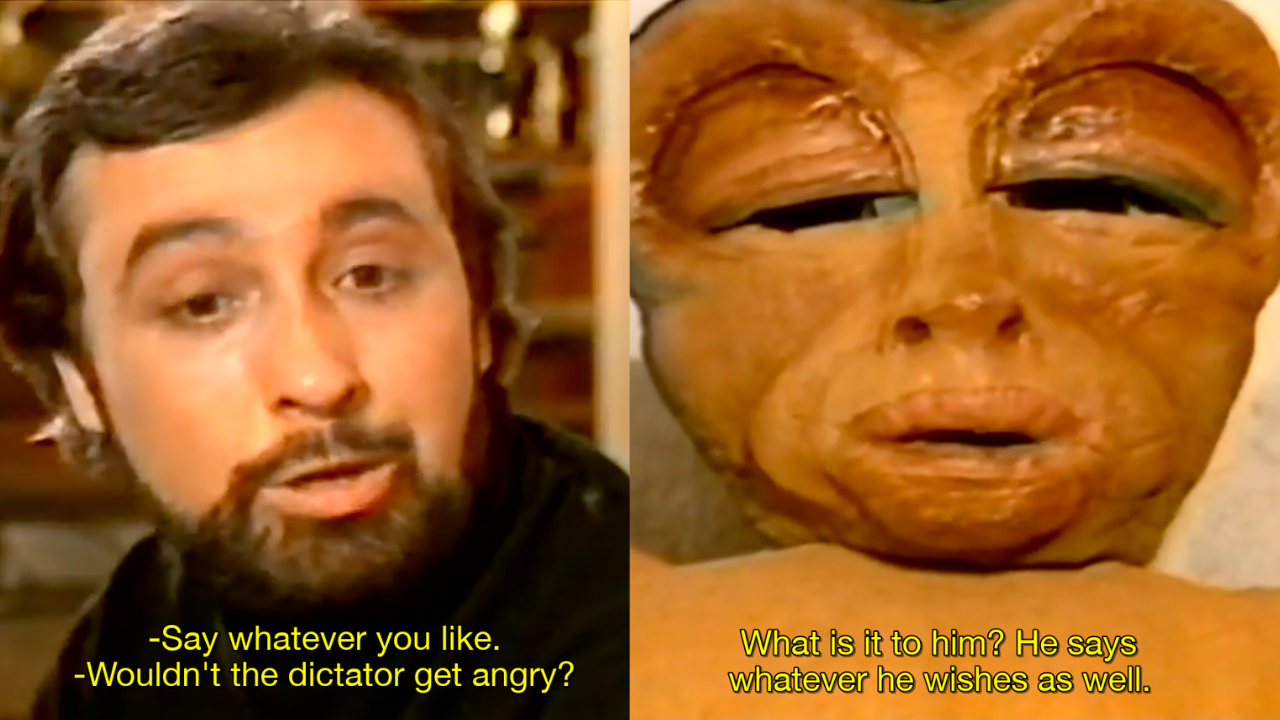
This is where Homoti’s real power lies, much like its titular alien, this movie has slipped through the cracks. It successfully eluded the very government that would have otherwise censored it. While Homoti does utilize supporting characters for comedy, it doesn’t seek to demonize its queer characters. Homoti’s humor never feels like it’s punching down. This is an important distinction. Homoti has thrived in a hostile environment and arrived at a place where it speaks its truth to power in all its blurry VHS glory. That’s about as punk rock as it gets.
I’m here in my capacity to review Homoti as a film first. I freely admit the film’s importance as a cultural artifact is going to help it in my overall estimation. Let me also clarify: I’m not claiming Homoti as a secret work of genius. I wouldn’t go that far. The performances are fine, on a technical level it’s janky as hell. You can see the seams in Homoti’s suit in most shots.
Some story points are contradictory. How can Homoti be from a utopian planet but also on the run from a dictator? Why does Aysegul care about journalistic integrity, or care about Ali at all for that matter? The story doesn’t even come close to addressing those questions. Is it not that strong a script to begin with, or is there something lost in the translation? I guess it must be a little of both. Yet it provides the story a dreamlike sense of magical realism — purely by coincidence.
Also by coincidence this movie relies upon science fiction’s greatest strength as a genre: the ability to build metaphors for real world issues. While there are no solutions presented for the issues at hand, it is welcome to see openly queer characters expressing themselves freely. Even if those characters are couched in a sci-fi plot. With luck, that expression may find purchase far beyond its time and place of origin. In summary, Homoti’s story is not a call to action, nor a cry for help. This movie is simply stating the obvious: ‘I’m here, I’m Homoti, get used to it.’
If you enjoyed this article, please consider becoming a patron of Hyperreal Film Journal for as low as $3 a month!
Collin Cannaday is an Austin author, screenwriter, essayist, humorist, satirist and dramatist. He currently co-hosts the Are You Karate Kidding Me?! podcast recapping the Karate Kid movies and Cobra Kai. Subscribe on your podcatcher of choice. Follow him on Letterboxd: @ccann or on Bluesky: @collincannaday.com