
The Dream You Never Wake Up From: How The Drama and Nope Expose Our Troubling Relationship with Spectacle
I: Performative by Nature
The opening credits of The Drama (2026) are superimposed over a couple rehearsing their wedding dance to Shira Small’s “I Want To Lay With You.” This is how the central relationship between Emma (Zendaya) and Charlie (Robert Pattinson) is introduced. Once the dance is complete, Emma critiques the ritual as performative only to be told by an annoyed dance instructor that weddings are “performative by nature.” This is the first of many scenes that chip away at the idea of a wedding as an aspirational spectacle.
As Charlie edits his wedding speech while running it by his friend Mike, the exercise becomes cinematic shorthand for showing how their romance was constructed — and notably, only in his mind. Charlie’s treatment of Emma always feels like something constructed in which she herself is the spectacle being projected upon. We never hear her wedding speech.
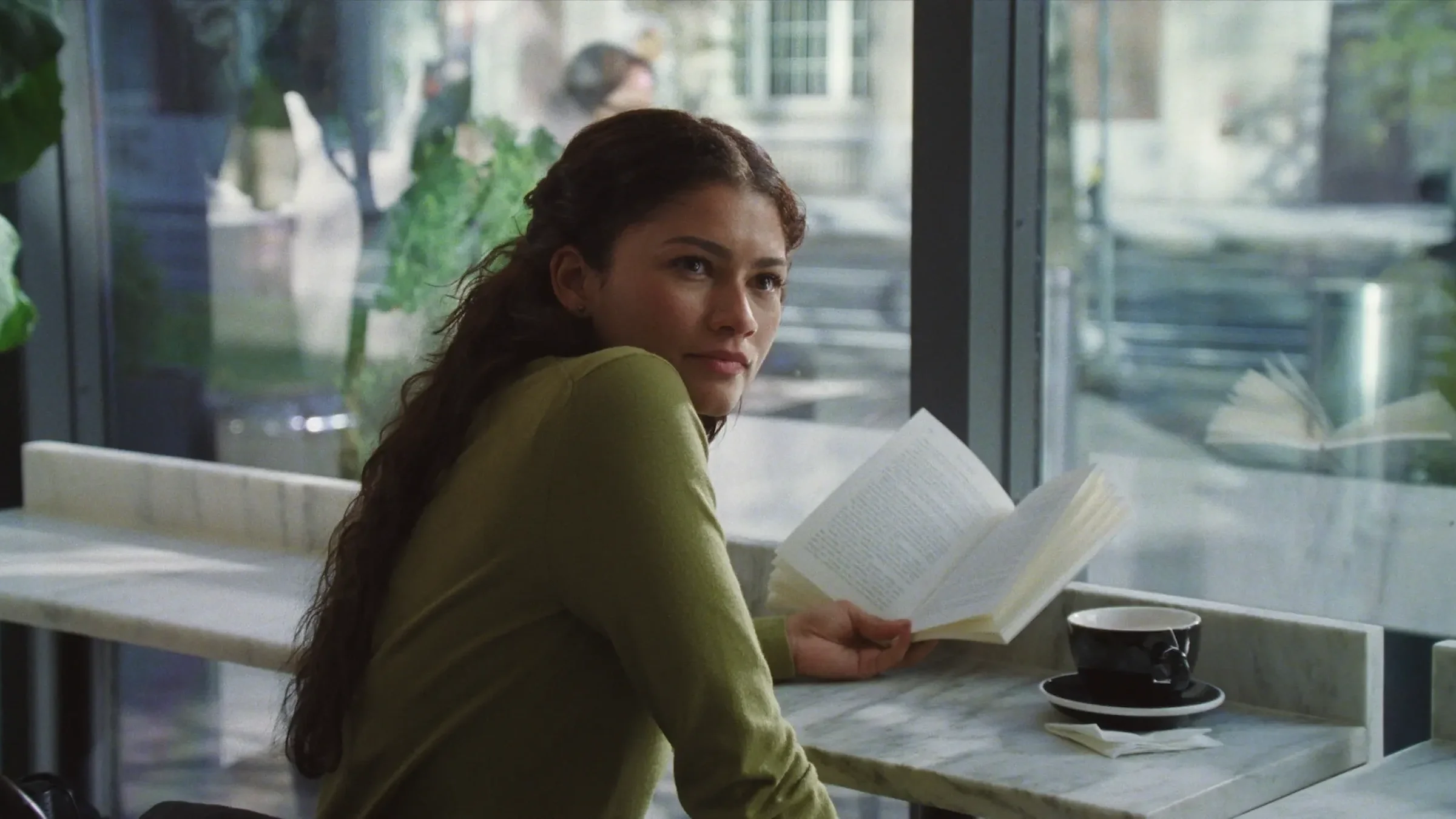
The film shifts focus to another kind of spectacle entirely when a pre-wedding food and wine tasting with Mike and his partner Rachel — the best man and maid of honor — leads to the ill-advised prompt “What’s the worst thing you’ve ever done?” Suspense builds as secrets are revealed. Mike used a former girlfriend as a human shield when they were attacked by a dog; Rachel is shockingly nonchalant as she tells a childhood story about locking her neighbor in an RV in the woods; Charlie basically gets away with skipping a story about his supposed cyber-bullying of a former classmate. Then it’s Emma’s turn.
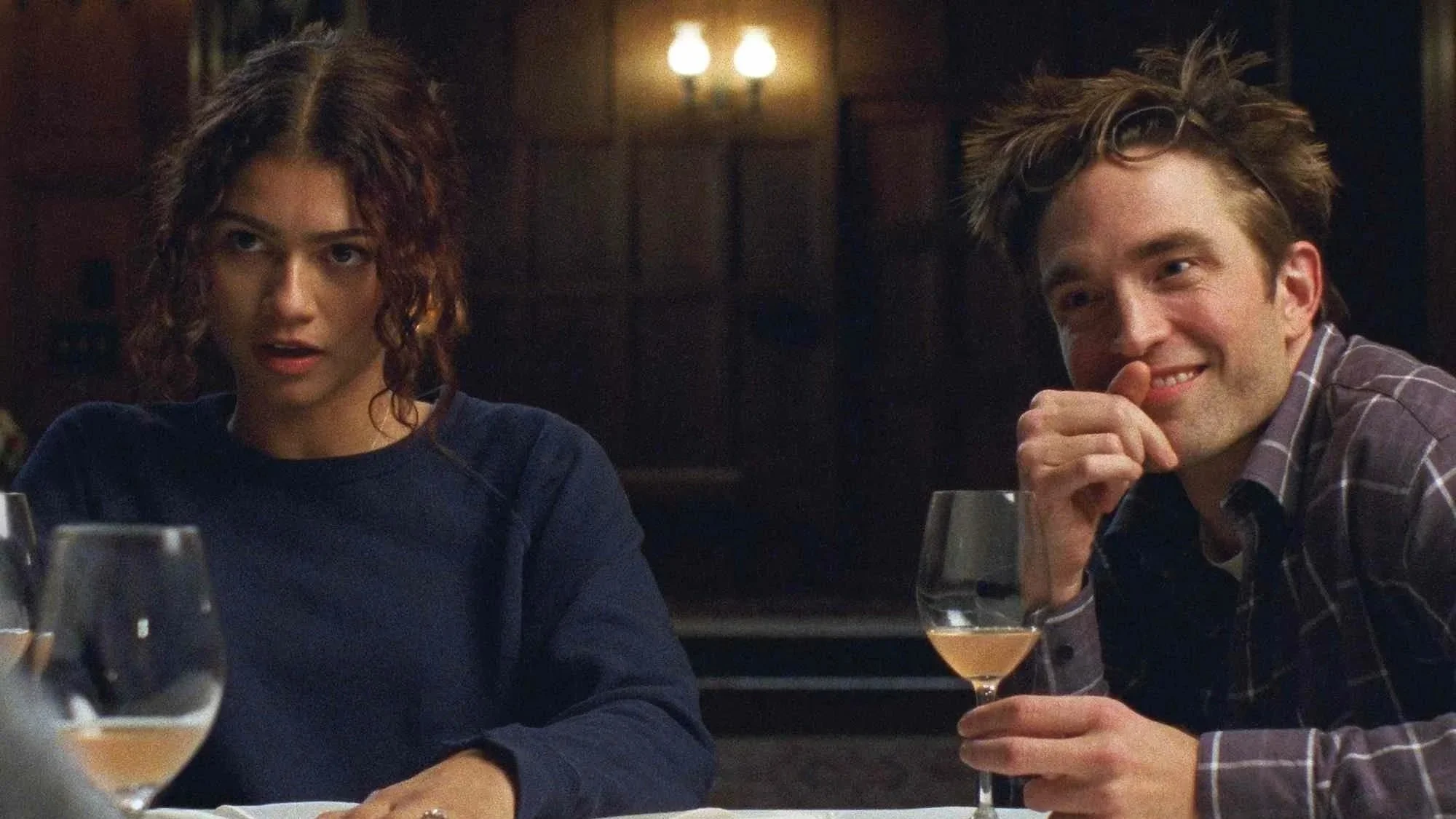
Zendaya’s reaction shots do an excellent job of conveying Emma’s investment in each story. Compelled by alcohol, tiredness, and a desire to match the vulnerability of her peers, she confesses that she planned but didn’t go through with a mass shooting at her school when she was a teenager living in Louisiana. The entire table goes from uncomfortable laughter to silence and then to shock and outrage (most notably from Rachel) followed by Emma projectile vomiting to bring dinner to an abrupt halt.
II: I Will Make You a Spectacle
When Emma ceases to be an aspirational spectacle and becomes a grotesque one, Charlie starts deleting parts of the wedding speech he was previously excited about. At first, he surgically excises statements about Emma’s kindness and empathy as he combs through his Google doc. Then, he begins to delete the speech altogether.
Even though Charlie seems to genuinely care about Emma on some level, he cares even about their relationship as a public performance. His curated proximity to what’s considered desirable (e.g. marrying someone who looks like Zendaya) has been compromised.
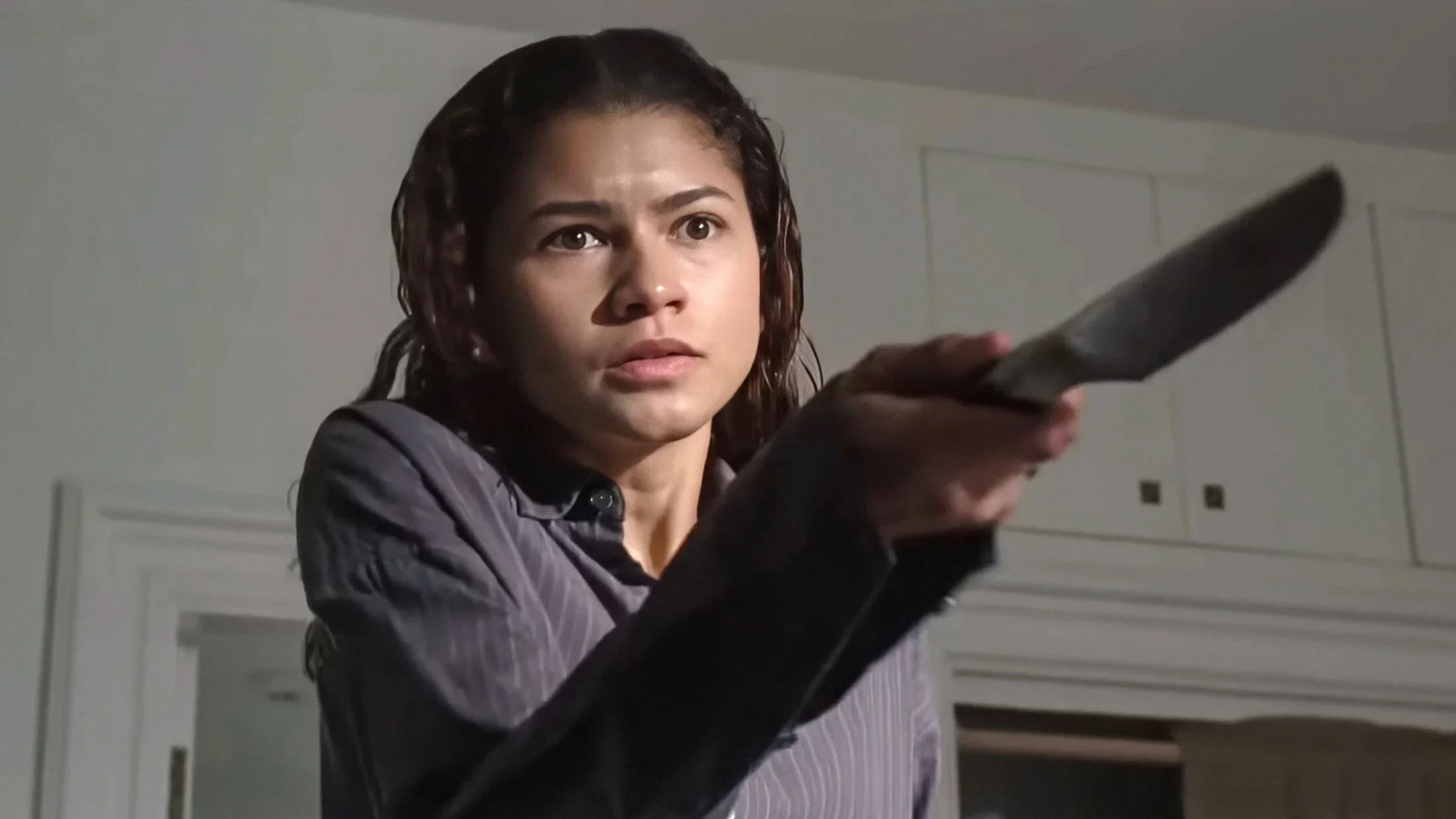
Later, Charlie has a cartoonishly startled reaction to Emma absentmindedly holding a knife as she approaches him from the kitchen. She asks if he actually thought she was coming into the room to stab him and even jokingly pantomimes it. It soon becomes clear to Emma that certain behaviors will no longer be afforded any grace. Shortly after the knife scene, we see flashes of Emma as both a teen and an adult holding a rifle during a practice photoshoot. This is Charlie’s new image of her, one that renders him unable to smile or pose naturally. The photographer even says, “Try to act like you’re standing next to the love of your life.”
The most overtly hostile reaction comes from Rachel (one of very few female friends Emma is shown to have). She yells at Emma, talks behind her back, and even goes out of her way to involve her cousin Sam who is in a wheelchair because of a shooting. She says she needs to get permission from Sam to be maid of honor given the circumstances, but she’s really just doubling down on her own curated image of a good person. Rachel’s worst thing, which she actually did, is nowhere near as appalling as this thought crime she can project all of her shame and anger onto. It’s virtue signaling in service of self-absolution.
Charlie uses his invented car accident trauma narrative for Emma — attributing her dark thoughts to a car crash she witnessed at ten in which a neighbor died — to keep Rachel at bay and the wedding on track. One spectacle is explained away to preserve another. It’s notable that Mike, who has a more measured reaction to Emma, is Black. Emma is also half Black and both she and Mike have white partners who get to act out via rage, virtue signaling, and privileged, surface-level discomfort. At one point, Rachel clumsily suggests that Mike grew up in “violent” surroundings. He says that his father was a cop and that’s the only reason he was anywhere near guns. Rachel is easily able to frame her own partner as being familiar with violent surroundings simply because of what she can reduce his identity to if she so chooses.
Emma’s race and gender make what she almost did a particularly bold provocation given that, statistically, it’s a white man like Charlie who would go down that path.The film does call out that he is a British person witnessing a disturbingly American phenomenon, but he still fits the profile. The violence Emma felt drawn to as a way out of an isolated, mentally tormented teenage existence (possibly related to being a Black girl in the South) was an aspirational spectacle in her lowest moments. She even says the appeal was tied to the aesthetics and how she felt seeing an image of herself holding a gun on her webcam.
Charlie and Rachel refuse to acknowledge that young Emma changed course after a shooting in which a classmate was killed. She abandoned her plan and became a gun control activist instead because she simply wanted to belong and found more camaraderie among the anti-gun group at her school. Spectacle and aesthetics come into play there as well – she beams in a flashback when someone assigns her to be the face of their cause.
When I first saw The Drama, it was in a full theater that became notably tense after Emma’s confession. The issue it conjures feels larger than anything a person can confront in real time, and we don’t have channels to even begin remedying it, even though we are looking at it constantly. Commodified images have made witnessing spectacle our flawed way of coping with tragedy.
III: Bad Miracles
“I will cast abominable filth at you,
Make you vile,
And make you a spectacle.”
-Nahum 3:6
This quote is the first thing we see in Jordan Peele’s Nope (2022). It references public humiliation as divine retribution and comes from the Book of Nahum, a religious text about idolatry and exploitation leading to ultimate destruction. The words appear on a black screen accompanied by an audio clip of a sitcom called Gordy’s Home being filmed in front of a live studio audience. There is laughter at first, and then a loud pop followed by muffled sounds, just like the ones traveling into Emma’s deaf ear at the beginning of The Drama.
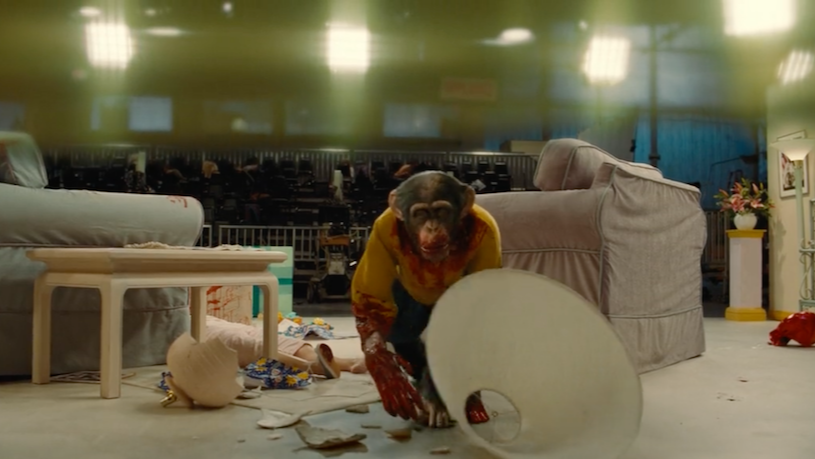
The sounds are a horrifying combination of bludgeons, screams, and cries for help. The first image we see afterward is a chimp (playing the titular Gordy) with blood on his mouth, patrolling the sitcom set and pawing at mangled and lifeless – or nearly lifeless – bodies. The POV is from someone hiding under a table and witnessing the horror. The chimp gives that onlooker as well as the audience the briefest glimpse before a sudden fade-to-black and the movie beginning in earnest. Just like the first moments of The Drama, this is another opening that establishes unease and unsettling terror before exploring how spectacle destroys us.
We’re introduced to a family running a business in Agua Dulce, California called Haywood Hollywood Horses. Their trained horses and hands-on expertise are used for productions of films and commercials. This is especially meaningful because they are a part of a long (and too often erased) history of Black contributions to cinema’s origins. After their dad dies in a strange accident, Otis, Jr. or “OJ” (Daniel Kaluuya) and Emerald or “Em” (Keke Palmer) struggle to keep the business going. The loss is amplified by their ongoing marginalization as a Black-owned business on the literal outskirts of the film industry in California.
OJ and Em soon come to learn that a mysterious alien presence – profoundly labeled by OJ as a “bad miracle” representing horror, wonder, and opportunity – is looming above the Haywood ranch. They enlist an angsty electronics store employee and a brooding cinematographer to capture potentially lucrative video evidence.
The larger themes of Nope come into even sharper focus when we learn that Ricky “Jupe” Park — a Korean American man who starred in the sitcom Gordy’s Home as a child actor and survived the chimp attack — is now running a Western-themed park called Jupiter’s Claim and offering up Haywood’s horses to the alien in front of audiences to profit from the spectacle himself. Haywood has been selling the horses to Jupe to stay afloat. Due to OJ’s closeness with the horses, we learn their names: Ghost, Lucky, Clover, and Jean Jacket – the name ultimately given to the alien.
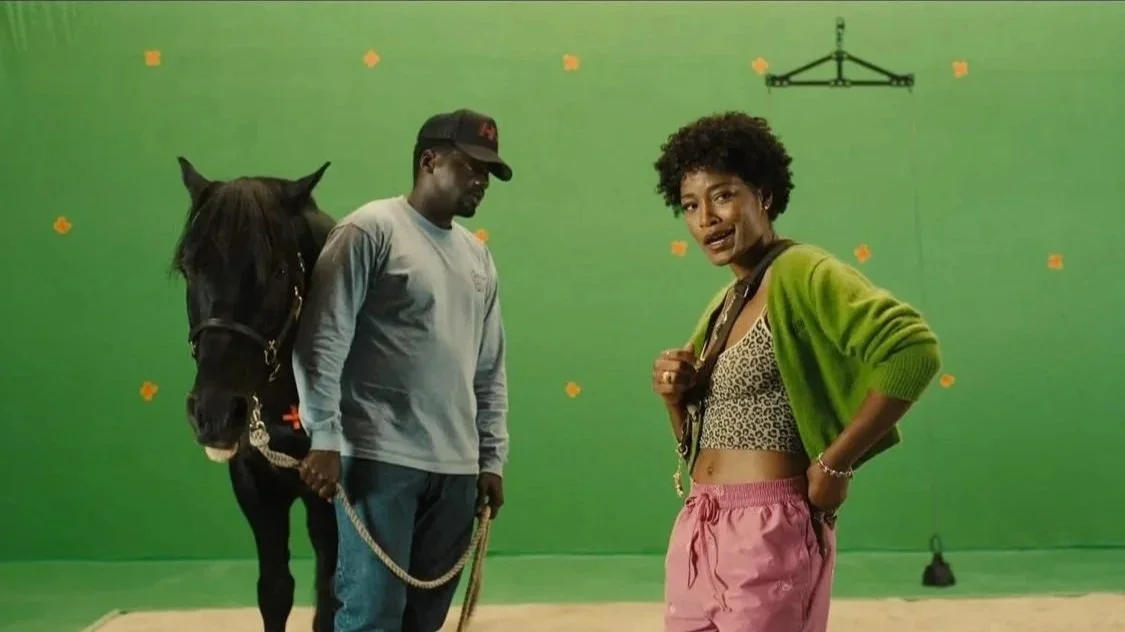
Haywood Ranch and Jupiter’s Claim share an ecosystem reliant on spectacle and performance. That ecosystem directly informs each character’s goals and actions. After a thrilling nighttime sequence that unveils the alien in its UFO-shaped yet animalistic form, Emerald says she’s seen “a lotta shit” online that suggests an Oprah image of it could get them $100K or more. Angel, who works at the electronics store and helps them set up cameras, cites Ancient Aliens and conspiracy theories about why they’re now called “UAPs” instead of UFOs. He’s seeking visual confirmation of his fears but also his warped worldview. Antlers Holst, the enigmatic cinematographer, shows up in pursuit of his visual white whale but also warns Emerald that what they’re all chasing is “the dream you never wake up from.” One by one, our protagonists reveal themselves to be ruled by the image.
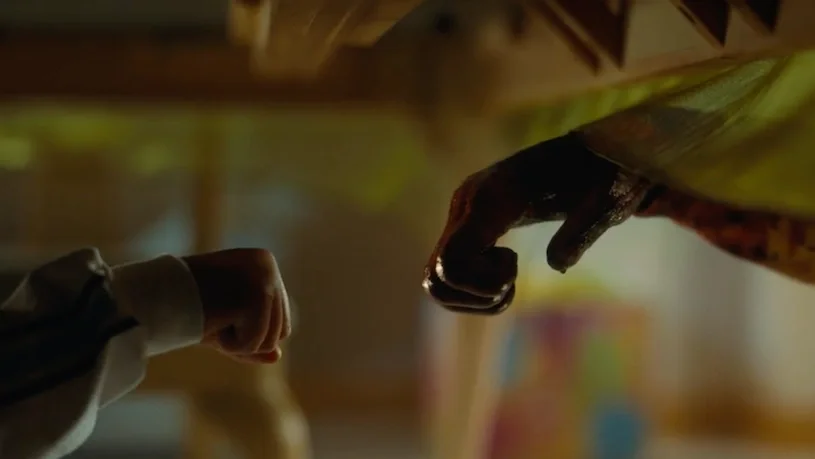
About halfway through, the film cuts back to its jarring opening setup to show us the Gordy’s Home massacre in gruesome detail. Jupe recounts fondly that he and Gordy did the first “exploding fist bump” when Em asks about a black-and-white photo depicting that moment. This visual recurs in flashback when a blood-soaked Gordy reaches out to a petrified Jupe under a table to recreate that gesture of connection amid the carnage. Before they make contact, Gordy is shot and killed right in front of Jupe. A charming image is converted into something haunting that he can’t escape. After recounting those 6 minutes and 13 seconds of the unspeakable, he says the “Network tried to bury it but it was a spectacle. People are just obsessed.”
When Jupe performs his rehearsed monologue in a red cowboy costume and hams it up for the crowd, he quietly whispers to himself, “You’re chosen.” He feels as though he was baptized by a violent spectacle and therefore anointed as someone who can now exploit his own spectacle. He foolishly believes he can sustain a symbiotic dynamic with this alien species he dubs “The Viewers” by offering up Haywood's horses as food. This time, instead of going for the horse, an aggravated Jean Jacket descends upon Jupiter’s Claim ahead of schedule to exact vengeance by devouring Jupe and his entire audience. It’s almost as though the divine payback referenced in the quote from the Book of Nahum is being enacted upon eager witnesses by the subject of the spectacle itself. The alien is a potent metaphor for destructive spectacle because it compels people to look up into the sky – sometimes even using a cloud as camouflage – before descending to fully draw them into their own destruction.
IV: Witnessed
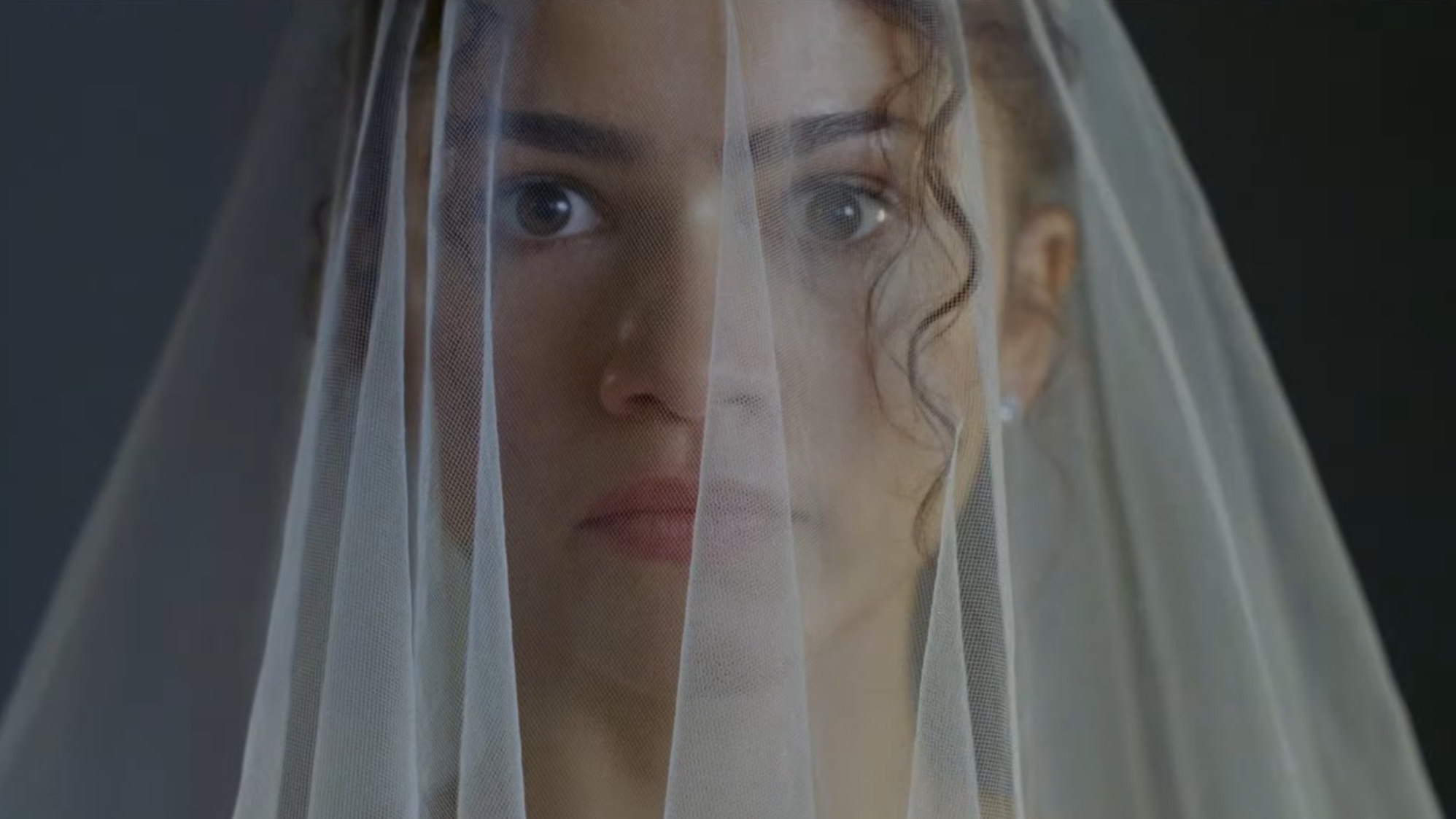
Once they become spectacles, Emma and Jean Jacket are dealt with by the other characters from a defensive posture until they have a way to contain or contextualize the unknown. Both characters’ final forms reveal them at their most aesthetically potent, emotionally exposed, and trapped by the ideas of those gazing upon them.
Despite the entire reception hall at her wedding oriented around her, Emma only registers glaring eyes and whispering mouths. As she imagines the worst ideas about her on everyone’s lips, the only thing keeping her from breaking is the idea that she’s being ushered into companionship with her true love. The facade quickly begins to fracture as Charlie becomes less reliable and each camera flash capturing the wreckage makes the wedding photographer feel as predatory as Jean Jacket. Eventually, no one can look away from the chaos. As toasts go awry and new transgressions come to the surface – including a revelation that Charlie broke down and kissed his coworker Misha – things feel increasingly claustrophobic, yet propulsive and almost freeing. Things escalate to the point of physical violence when Misha’s boyfriend Blake comes over to beat Charlie up.
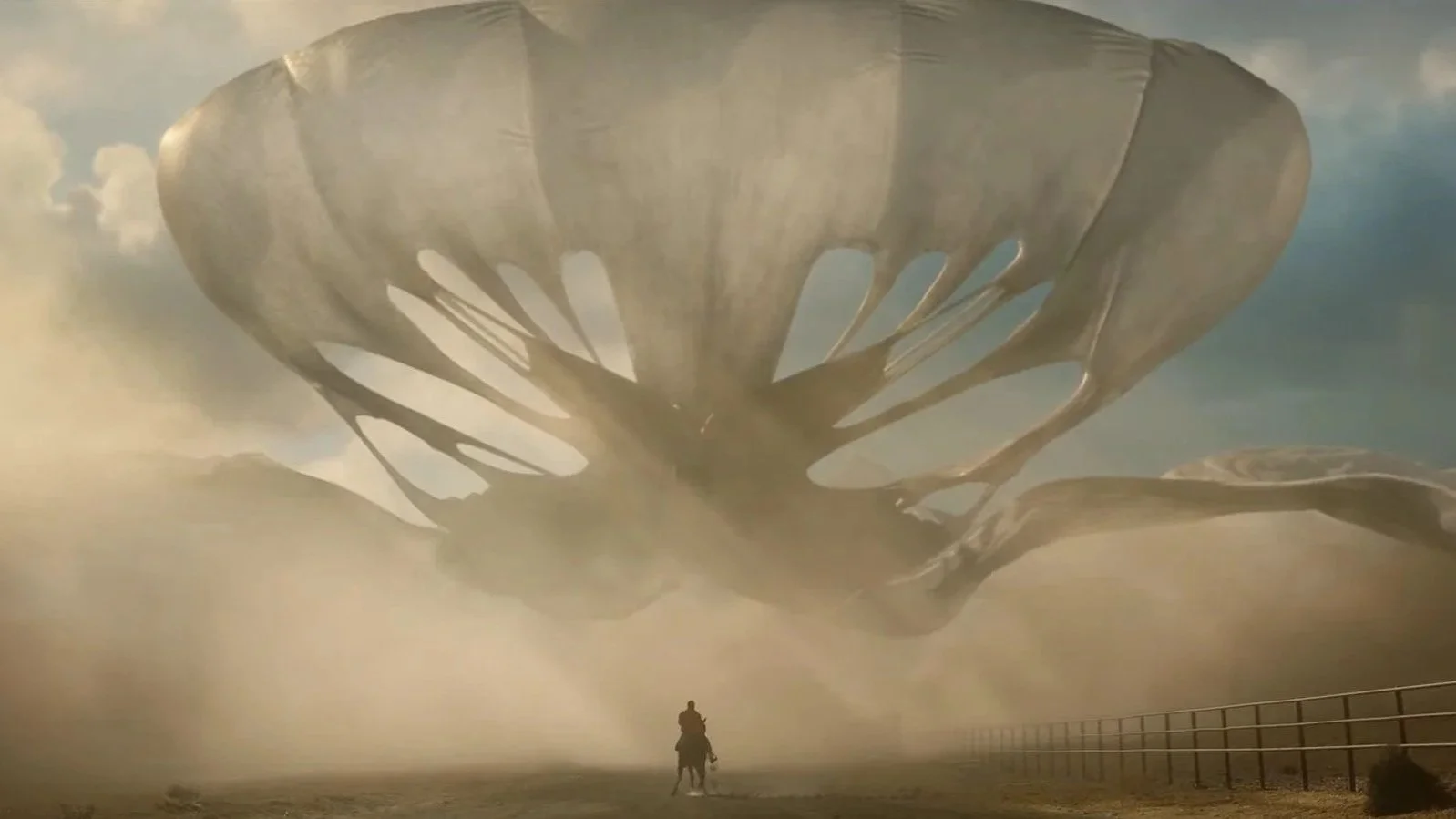
Jean Jacket is also the center of attention in the third act of its story, as it’s led into the open to be captured using a non-digital film camera. Its defensive mode makes its shape more expansive and its color palette more visually captivating. Antlers Holst ultimately says, “We don’t deserve greatness” as he succumbs to Jean Jacket’s magnetism at golden hour and sacrifices both himself and his camera to the act of containing the impossible within a frame. As Emerald prepares to make her final stand against Jean Jacket, she closes her eyes tightly and repeatedly whispers, “Don’t look.” The idea that one must look away from Jean Jacket to counteract its dominance brings the idea of spectacle as danger full circle.
It’s a brilliant touch that the final shot of Nope is a Polaroid-like printout of Jean Jacket’s final form generated by a non-electronic, coin-operated device at the bottom of what’s called the Winking Well in Jupiter’s Claim. If Em so chooses, she could still exploit that image because no one could refute it. If it were digital, people could claim it was a deepfake, generated by AI, or digitally altered in some other way. By the time she acquires the image, she has conquered Jean Jacket by risking all she has, including, as far as she knows, OJ’s life. Would fame and wealth make it worth it? Jordan Peele leaves us to wrestle with that question after telling a story using a medium which relies entirely on spectacle experienced communally. When Jean Jacket becomes as aesthetically glorious as Emma on her wedding day, it draws a crowd we see approaching Jupiter’s Claim at the end of the movie. Em has hard evidence, but could she claim first dibs after the moths are already drawn to the flame?
The final scene of The Drama places the exhausted, disheveled, and beaten down couple (literally beaten in Charlie’s case) in the booth of the diner they said they'd go to after their wedding. Emma is silent at first and then she proceeds with her most notable do-over. She acts like she and Charlie are meeting again and the implication is that they will start over once more. It’s implied that the scales are somehow even since Charlie made a spectacle of himself and fully succumbed to his worst impulses. Emma’s constant forgiveness could be read as either romantic or intentional optimism after considering something more destructive. The film’s final provocation may be in asking us why we always want the “happy ending” of the couple working things out, if this is the couple.
Cinema itself hinges on the delivery of spectacle and it’s therefore inclined toward giving us a grand conclusion followed by a soft landing before we leave the theater. Just like Nope gives us a thrilling finale and a printed image that means our heroes “succeeded,” The Drama gives us the messiest wedding possible while leaving us with an image of the happy couple in their wedding clothes ready to start their new life. They’re completely disheveled and all of their other relationships are in shambles, but they are ultimately still together. The picture-perfect lie never loses its appeal, and it’s ultimately up to us to understand why spectacle feels more comforting than the truth.
If you enjoyed this article, please consider becoming a patron of Hyperreal Film Journal for as low as $3 a month!
Nick Bachan is a writer and illustrator based in Texas. His essays, cartoons, and stories explore how people engage with emotions, history, pop culture, and one another.
@nickbachan on Twitter // https://nickbachan.com/