
SXSW '26: DreamQuil
Alex Prager’s directorial debut DreamQuil, which had its world premiere at the 2026 SXSW Film & TV Festival, is a study of contrasts. Indoors, the characters populate rooms filled with oversaturated primary colors; outside, a thick smog coats the cityscape, preventing anyone from walking outside without a mask. There are robots and there are humans, with the line between the two becoming blurrier. And at its core is the dichotomy Elizabeth Banks’s protagonist finds herself caught between—that of motherhood and womanhood. But while DreamQuil raises interesting ideas, it fails to make meaning from its muddled plot.
Carol, DreamQuil’s main character and one of two portrayed by Banks, isn’t particularly happy. She’s a real estate agent who can’t make partner at her firm; a wife whose husband, Gary (John C. Reilly in a very We Need to Talk about Kevin role), is more focused on her faults than her wants and needs; and a mother who’d rather her son didn’t call her mom. Instead of laboring away at any of these thankless jobs, Carol prefers to engage in VR sex dreams and stay out late for drinks with her best friend Rebecca (Sofia Boutella).
Banks is a powerhouse onscreen, bringing equal depth to Carol’s tough, why-can’t-I-have-it-all personality and her vulnerability as her homelife grows more strained. With the air outside too polluted to breathe, her cramped city apartment heightens tensions in her marriage as Gary gives her ultimatums to recommit to their family and move out of the city. While she initially scoffs at the non-stop tailored ads she gets for DreamQuil, a digital wellness retreat that CEO Margo Case (Kathryn Newton) swears will resolve all the problems of a modern woman, when Rebecca swears that it saved her own marriage, Carol decides to take the plunge.
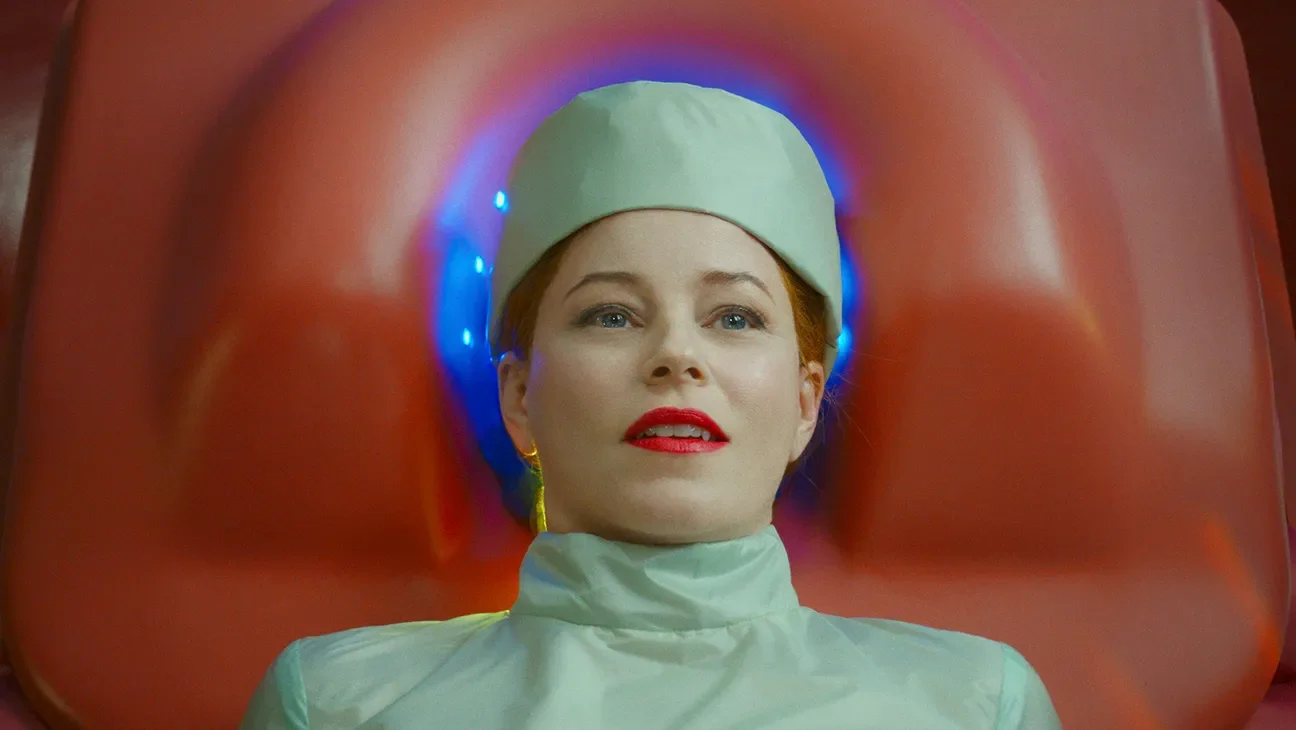
It’s a dishy premise, and one that’s well-served by Prager’s elaborate worldbuilding. The film has a retrofuturist aesthetic, with Carol as the 1950s housewife, always in a dress, surrounded by virtual reality technology and post-apocalyptic skies. Everything is wonderfully detailed and thought-out, from the maximalist set decoration to the miniature cityscape, Carol’s bright red lip and the ovular pod used for the virtual reality that takes up most of her free time. A preference for practical effects, rather than CGI, makes the future world feel more tactile and vivid. And those personalized ads, with Newton’s faux-feminist pitch and tech maven gravitas, ground the movie in an exaggeration of contemporary anxieties.
Unfortunately, there’s little follow-through on any of the many ideas brought up throughout the movie. After Carol undergoes the DreamQuil treatment, administered by a very Nurse Ratched-esque Juliette Lewis, she returns home to find everything perfect—her marriage steadier, her house in order, and accolades secured at her job—all thanks to Carol 2, the replicant robot sent to live in her stead during the DreamQuil retreat. Carol’s unease with what seems to be a better version of herself grows, and the film shifts from satire to psychological thriller as Carol 2 threatens to steal her life.
This isn’t new territory, but to her credit Prager subverts the plot just as it grows predictable. As DreamQuil twists on, though, it becomes more difficult to parse what Prager intends to say about Carol’s struggle for autonomy. Even as Banks delivers a striking performance, her character arc is lessened by an increasingly murky storyline. The end result is a tonally confused and mostly incoherent movie buckling under the weight of its ideas—and even a strong lead and distinctive visuals can’t rescue DreamQuil from that.
If you enjoyed this article, please consider becoming a patron of Hyperreal Film Journal for as low as $3 a month!
Alix is the editor-in-chief for Hyperreal Film Journal. You can find her on Letterboxd and IG at @alixfm.