
Life Cannot Be Like the Movies: New York, New York
I’ve always had an attraction to movies that feel like they can never happen again. Of course, film production is a herculean effort, no matter the scope or circumstance. But sometimes, certain films feel born from a particular moment, whether it be personal, sociological, or economical.
Martin Scorsese’s 1977 Valentine (or breakup note?) to musicals New York, New York is one of those movies. Not only was the film coming off the success of Taxi Driver, but also was made in the height of Scorsese's addiction to cocaine. There was also no finished script when shooting began, causing stars Liza Minnelli (whom Scorsese had an affair with on set) and Robert De Niro improvise, all in the middle of these MGM style sets built by Boris Leven. The result is a film at war with itself: a stylized fantasy with vivid colors and artificial backgrounds budding heads with a spiky, melancholic drama about an abusive relationship. And not to mention, it didn’t make money. Scorsese would never again make a film this unwieldy again, the last time he’d not be fully in control. And that is what makes New York, New York so special.
As the poster says, “The war was over and the world was falling in love again.” It’s V-DAY in 1945, and veteran/saxophone player Jimmy Doyle (Robert De Niro) walks into a bustling celebration at a New York night club, where he’s on the prowl to get laid. After failing to procure a woman, he sets his sights on a USO singer named Francine Evans (Liza Minnelli), who outright rejects his advances. But Jimmy isn’t one to give up and keeps pestering Francine until squirming his way into her life.
From the start, the film is testing the audience as Jimmy is less of a romantic lead and more a bug you cannot excise. He annoys you and probably disturbs you as well. In this opening chunk, Jimmy displays a knack for conjuring chaos. When confronted with unpaid hotel bills, he lashes out and pretends to have lost his leg in the war, playing the role of the down-beaten war veteran. Francine has no problem identifying the red flags, and yet, after being roped into coming to his audition, she’s taken away with his talents as a saxophone player. In response to the accusation of Jimmy being a pain in the ass, she replies with “but he’s good.”
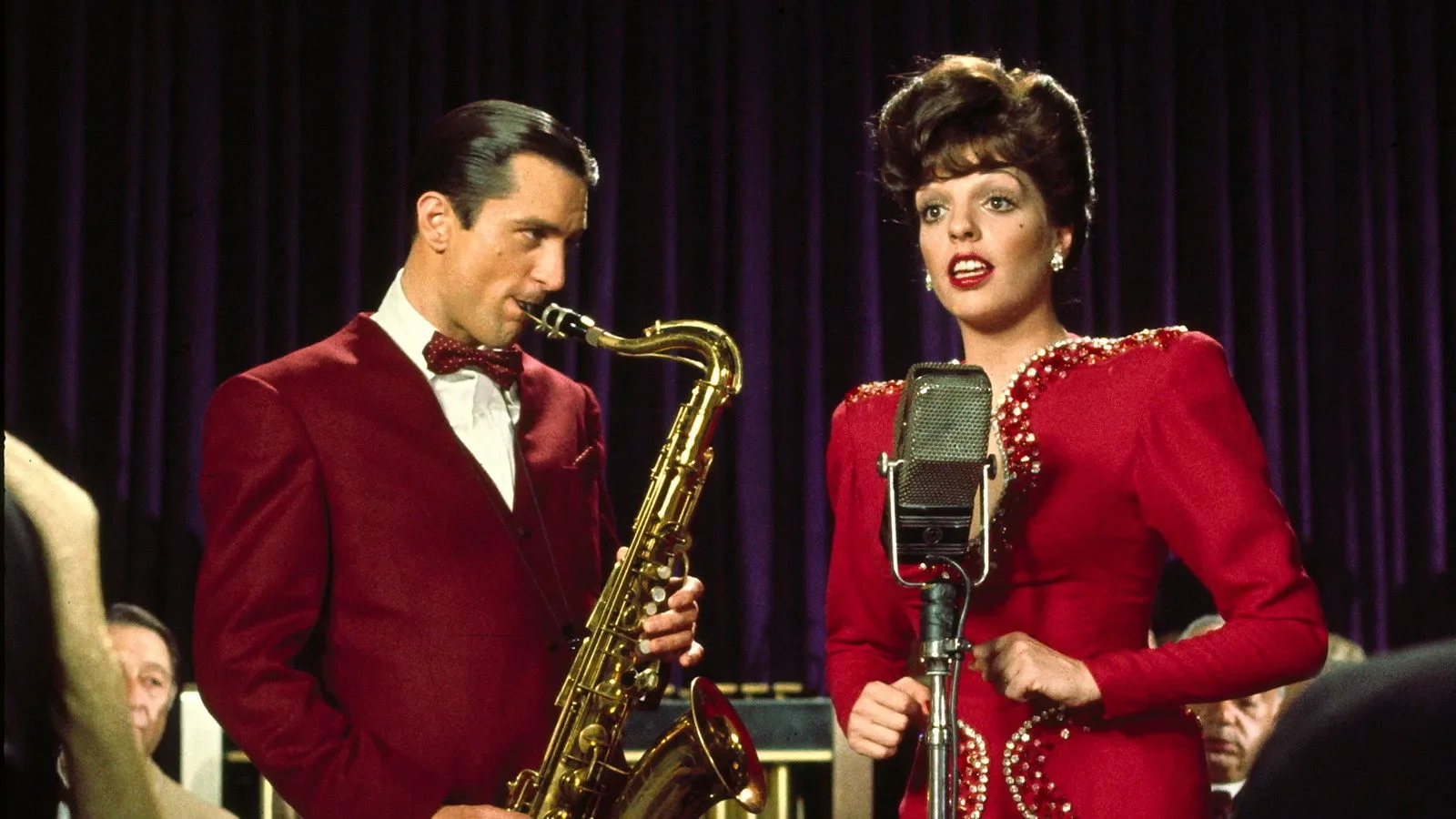
The romantic tangle of Jimmy and Francine is a sour point. As their careers blossom, the two fall in love and she becomes pregnant. Despite this, Jimmy becomes a more reckless character. His verbal abuses become harder to take. After Francine gives birth to a son she names Jimmy, he refuses to see the baby. In the commentary track on the Blu-ray, Scorsese speaks to how the relationship was a reaction to old musicals. In his eyes, when they hinted at darkness, the story would find a way to “cop out.”
In contrast to his previous films like Mean Streets, Scorsese sought to make an artificial film. In plenty of scenes, the backgrounds are delightfully fake and painted; this is perhaps most clear in the scene where Francine and Jimmy reunite, where the dividing line between the real trees on set and those not are stark, along with the unnatural sunshine. Whenever the characters are driving, it’s obvious the outside is being rear-projected. This is a conscious juxtaposition to the gritty emotions of the characters. In a post modern fashion, Scorsese is yanking the darkness present in the musicals he grew up with into the spotlight.
For the film, Scorsese tapped legendary songwriting team Joseph Kander and Fred Ebb, who worked on original broadway productions of Cabaret and Chicago. While the title song is the longest lasting, and became a signature song for Frank Sinatra, the number “But the World Goes ‘Round’” is probably the best and most heartbreaking. It comes after the end of Jimmy’s and Francine’s relationship. She is surrounded by instruments in the recording studio, distant in the frame. As she begins singing, the world becomes dark, and we push in; all the while, what’s left is Francine under a spotlight. “But sometimes your dreams get broken into pieces, but that doesn’t matter at all…” she sings. “Take it from me, there’s still going to be a summer, a winter, a spring, and a fall.” It expresses an honest reality that no matter how big our feelings are, the world will keep spinning. The song and Minnelli’s performance of it are eerily reminiscent of “The Man That Got Away” from George Cukor’s A Star Is Born, which starred her mother Judy Garland. Both are these sad, but powerful ballads dripping with emotion that tap into similar feelings of desperation.
Liza Minnelli is a connecting figure for New York, New York. She is the daughter of Vincente Minnelli, the iconic director of several MGM musicals and dramas. He was a key influence on the way Scorsese shot the film with cinematographer László Kovács, favoring action and emotion to play out in wides, instead of close ups. In the commentary, Scorsese directly cites Minnelli’s film The Bad and The Beautiful for the intense, bitter tone of the film.
On the other hand, Scorsese takes great inspiration from the previously mentioned A Star is Born with Judy Garland. The two plots are a mirror to each other. In the 1954 film, Garland plays Esther Blodgett, an actress/singer who begins a relationship with fading Hollywood actor Norman Maine (James Mason). The story plays out akin to a Greek Tragedy within the studio system, as Esther burns bright, Norman suffers a different fate. His stardom dwindles. Norman isn’t anywhere near as abusive as Jimmy, however, his alcoholism becomes a problem as Esther starts to feel the effects of it. In the most powerful scene of the film, Esther tearfully breaks down and proclaims how she hates his broken promises and failures to become sober, but she also hates herself, and feels she too has failed.
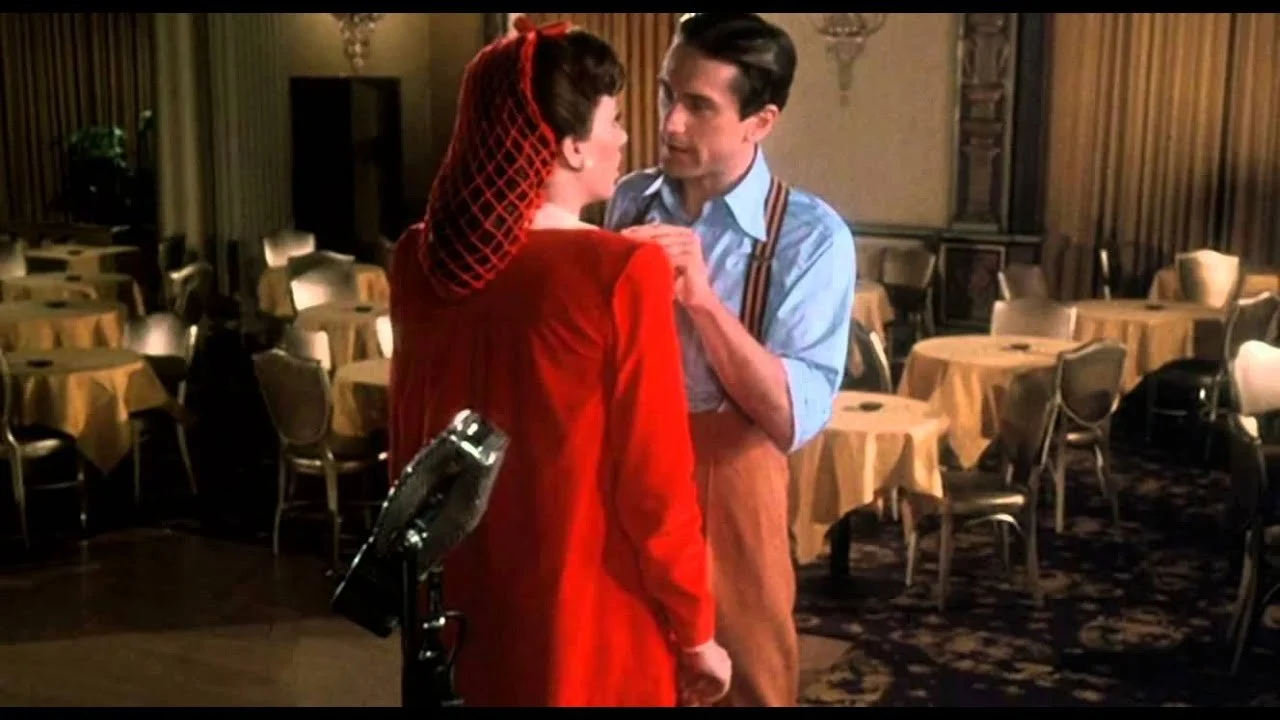
Esther’s breakdown is reflected in New York, New York’s most intense sequence. After Jimmy is thrown out of a club, he and Francine have an argument that is borderline unwatchable in how raw it feels, as if Scorsese is cutting directly into your nerves. “You don’t care!” Francine bellows in the back of the car, a response to Jimmy asking “Did I tell you to have that baby!” Both scenes are dripping in pathetic, human anger and sadness.
A Star is Born plays like a prototype of New York, New York in how George Cukor (My Fair Lady, The Philadelphia Story) is able to capture this profound sadness and pity within the confines of the Hollywood Musical. Scorsese’s main goal was to try to push that as hard as possible, to the point of alienating an audience craving a more traditional musical.
The original assembly cut for New York, New York was over four hours. The original editor Irving Lerner died in the midst of production and famous Star Wars editor Marcia Lucas was brought in to cut the film down. As described by Scorsese, the studio wanted to be shorter and after repeated pressure, cut the Happy Endings sequence, an homage to “Born in a Trunk” from A Star is Born. In the over ten minute dream ballet, the first thing shot in the production, Francine experiences the type of romance that has been alluding to her the whole film. She falls in love and is showered with great, fabulous success.
It’s granular and vibrant, recalling the greatest works of the Hollywood musical, a style of filmmaking that had died out in the modern day of 1977. Since then, Scorsese has never done anything fully like it. The sequence concludes with Jimmy sitting in a movie theater watching what the audience has just witnessed. It’s an obvious counter balance to what we’ve experienced. And I cannot imagine how the film would be without it; the sequence would be later restored in future releases.
The purpose of “Happy Endings” is two fold. First, it gives the audience a taste of what they want, a happy ending, or as Jimmy calls it “sappy endings.” It allows you to fantasize about a world where everything could’ve worked out. Second, it underlines how this relationship was doomed from the start. The most vital line of the number is “Happy endings, as far as I can see, are only for the stars, not in the stars for me.” I guess life can’t be like the movies.
New York, New York isn’t a stiff, failed curio. It’s a film that is alive, chaotic and bursting with visual and thematic ideas. It might not be as diamond cut as Scorsese's conical masterpieces, it more than deserves attention, and arguably, recognition as one of his most ambitious works.
If you enjoyed this article, please consider becoming a patron of Hyperreal Film Journal for as low as $3 a month!
Hayden Claborn is a film writer based in Austin, TX. He began writing about cinema in high school and was the film critic for his college newspaper. He loves a variety of genres, but his main area of interest is horror films and can talk your ear off about the greatness of Judy Garland. Depending on what day you ask, he’d say his favorite movie is either The Exorcist or The Apartment, with his favorite filmmakers being James Cameron and David Lynch. He goes by He/They pronouns.