
Weird Wednesdays: After Last Season
This screening was part of the Alamo Drafthouse’s Weird Wednesday series. For upcoming shows, click here.
On the fringes of film culture, a project as sincerely strange and strangely sincere as After Last Season is a rare occurrence. With a barely-comprehensible storyline, an unknown director, and a collection of filmworkers who seem to be operating the tools of their trade for the first time, contemporary audiences kept their distance, skeptical that something produced so haphazardly could be the product of an earnest, legitimate enterprise. Only a few years removed from The Room’s ascension from midnight movie to cult status, the few folks who saw After Last Season theorized that it couldn’t be what it seemed. Some allegedly theorized that it was a viral marketing stunt by Spike Jonze, an independent auteur that was diving into the marketable children’s-book-adaptation, Where The Wild Things Are. Others floated that it was an example of a film-as-money-laundering scheme, an accusation previously lobbed at The Room’s director Tommy Wiseau. From the get-go, there was a refusal to engage with the film for what it is, and this reputation follows After Last Season as it gets discovered again and again.
Rumors and speculations about odd independent cinema are an industry of their own within film fandom, allowing something dismissed or critically panned to continue to find audiences, usually those drawn to its “you have to see it to believe it” allure. If you are in Austin, Texas and seeing something like After Last Season, a film that was requested destroyed by its own distributor, chances are you are at a Weird Wednesday screening down at the Alamo Drafthouse South Lamar. Introduced by programmer Laird Jimenez and guest programmer Bryan Connelly, I was joined by a handful of curious film fans to see this film screened theatrically in one of the few cities it premiered in back in 2009.
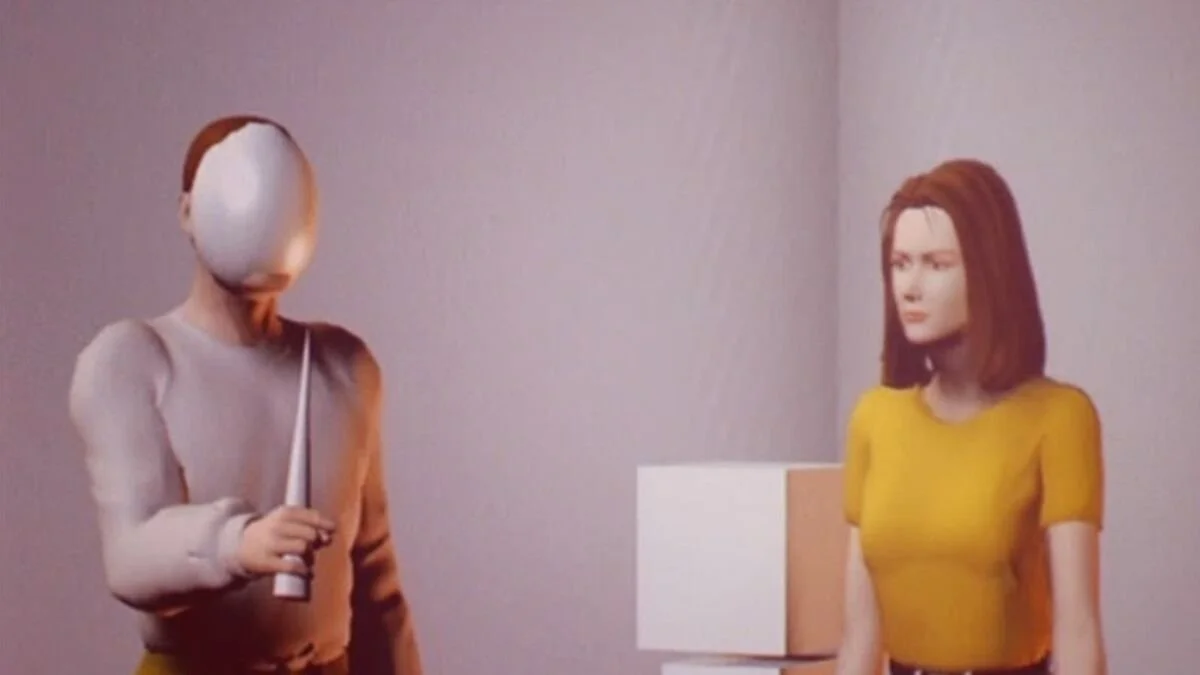
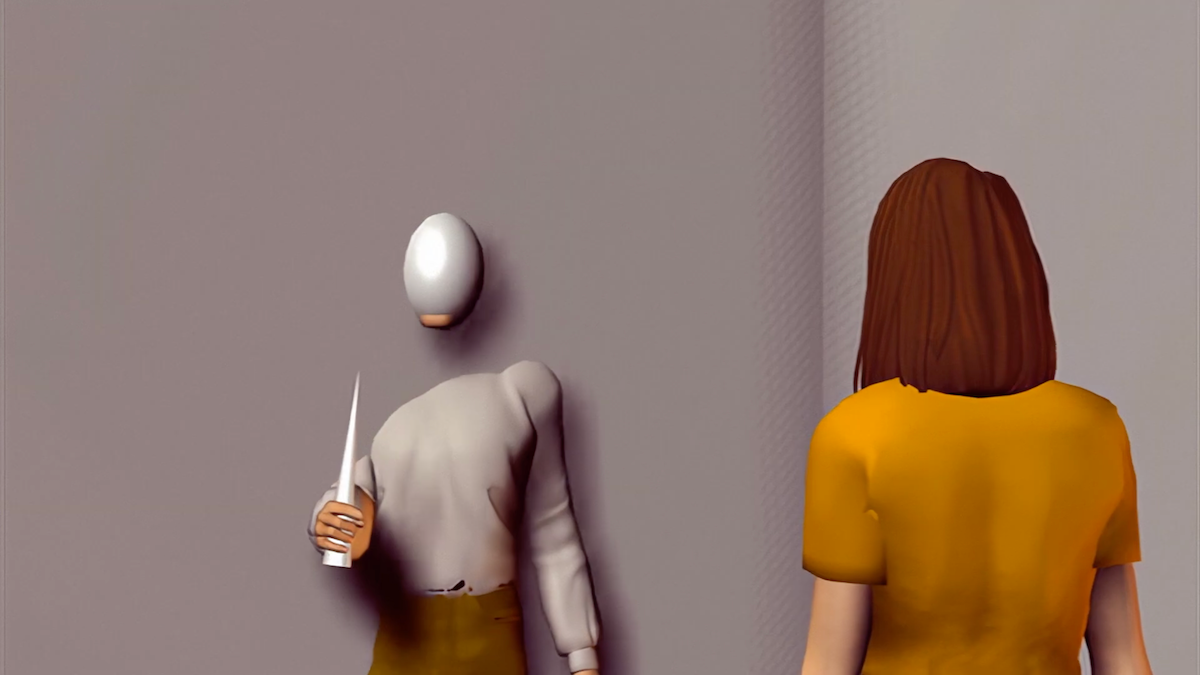
The film is set in a small community around a university medical hospital. A serial killer is wreaking havoc on the lives of those at the college, and two students, Matthew and Sarah, meet up to help each other with their assignments, as the semester begins. The core of the film is Matthew’s assignment: a computer-chip-based brainwaves-into-images system that Matthew uses to visualize Sarah’s thoughts in his own mind in order to figure out where the serial killer is. Taking up the middle third of the 90-minute runtime, the audience experiences a series of simplistic CGI renderings of shapes and humanoids in revealing locations that allow Matthew and Sarah to track down the invisible murderer who happens to be headed right for them. The resulting scuffle between them and the killer appears to spell the end for Matthew and Sarah until Matthew wakes up from what was ultimately a horrifying dream.
This basic plot provides an understandable-to-an-extent line of logic throughout the entirety of After Last Season, but it is not nearly the entire story. Most of the film is filled with what feel like non-scenes: establishing shots of places seemingly unrelated to the current events of the film, or scenes with a variety of characters engaging in small talk, most sharing one scene and then disappearing. Taken piece by piece, there is an absurd humor in these moments, as meandering as they are uneventful, but when considered as a cohesive package, an avant garde sensibility arises. The conversations are things you would never hear in a “proper film”: people discussing where things are, what parts of town people are traveling through, and the quality of daytrip attractions in the area. The mis-en-scene of the location shots disorient, showing objects strewn around rooms nonsensically, signs that ask more questions than they answer, and durations that are too long to reveal anymore information or too short to process what you just saw.
As a collection of conversations and cutaways, the film reiterates certain ideas over and over: the spatial relationship between people and objects, the presence of invisible entities and perspectives, and the day-to-day effects of changing relationships. The technical know-how behind the framing of the shots, the directing of the actors, the scoring of the music, and the rhythm of the editing all feel non-existent, but After Last Season never behaves like a normal film. It is a logical extension to the lo-fi narrative work seen in Lynch’s Inland Empire without the decades of film industry knowledge supporting it.
The film culminates with the introduction of a character that has been in the film the whole time without a single direct address to his presence. Following the chip-dream sequence, the real, visible killer shows up and attempts to attack Matthew and Sarah before he is stopped by an invisible entity, but it’s not the one from the dream. This entity is Craig, the ghost of a student that has been floating around campus, suggested by the only handheld camera work in the entire film. After Craig stops the killer and saves Matthew and Sarah, the story jumps forward in time to Craig’s mom welcoming a friend over to her house. Once inside, Craig’s mom only talks about the house: where things are, what she plans to do with the house, the history of the house… that is until she reaches her dresser with two picture frames on top of it, rotated backwards so that they are facing away from the people in the room and the camera’s perspective. What initially feels like another example of the film’s insistence on placing objects in an absurd fashion reveals a tenderness that cinema is especially proficient at showing without telling. The pictures, of Craig and his mom and their family, are placed facing the wall to indicate Craig’s mom’s relationship with her grief, as she is still mourning his passing. Even when she picks up the photograph and briefly shows it to her friend, the camera doesn’t cut to a reverse shot to show the image of her son, honoring her choice not to share her son’s visage with the world. This final scene is After Last Season’s most poignant and well-articulated attempt at expressing its meaning cinematically and helped me understand the beauty that the film was reaching for.
Throughout a mostly absurd 90 minutes, the strange, dreamy qualities of the film over time start to form connections in the mind of the viewer. Elements that seem to be the result of technical mishandling of equipment or a lack of traditional cinematic skills become increasingly fascinating as the film moves along, and you start to notice the rhyme and reason of the film’s oddness. One’s reaction to After Last Season might be to laugh at first, as the lines between good and bad start to blur, but I found my laughter turned into curiosity and, searching through the confusion rather than being just tickled by it, I found the artistry of the film. In the world of strange film culture, the mechanical expression of filmic ideas can too commonly lead to judgments and mockery of a film’s themes and ideas. If things are too hard for an audience to notice, they must not exist. However, I believe an openness to letting something move at its own pace, deliver its own ideas, and use the technology at its disposal in its own unique way is vital for expanding our minds and our palettes for how we experience cinema. While it is easy to poke fun at something like this, and I will be the first to admit I found many parts of this film to be hilariously absurd, it is also possible to let a film like After Last Season show up in the form that it has taken and see what it has to say.
If you enjoyed this article, please consider becoming a patron of Hyperreal Film Journal for as low as $3 a month!
This is Dylan Samuel. If you see him, say “hello.”