
Weird Wednesdays: Legend of the Stardust Brothers
This screening was part of the Alamo Drafthouse’s Weird Wednesday series. For upcoming shows, click here.
We find these truths to be self-evident: Sex, drugs, and rock and roll.
Especially if you’re the kind of rock-and-roller who finds themselves at a Weird Wednesday screening of the 1985 Japanese rock musical, The Legend of the Stardust Brothers.
It’s impossible to start this review without acknowledging the long shadow that MTV cast across the pop culture landscape of the 1980s and beyond. It’s easy to forget, in the intervening years, the art of the music video has declined so severely that ‘why doesn’t MTV play videos anymore?’ became a punchline. Then, eventually, the very idea that someone might care if MTV stopped playing music videos became the joke.
The Legend of the Stardust Brothers delights in the golden age of the music video. The perfect tone one might expect from filmmakers looking to prove they can make the same kind of anarchic rock-and-roll musical that could draw attention away from the western entertainment that was entrancing young people all over the world.
This movie is also based on a 1980 concept album also called “The Legend of the Stardust Brothers.” An album intended as the soundtrack of a ‘Rocky Horror’ style musical about a fictional rock band. The film pulls all its songs from that album, plus a few new ones composed specifically for this production.
The film opens in a mysterious Japanese club. Filmed in a black and white noir style, yet it has an outside-of-time quality as Japanese robots serve drinks to eccentric patrons. When The Stardust Brothers are introduced the scene virtually explodes in color. They are clad in silver lamé jumpsuits like B-movie aliens, and their routine seems to be Ziggy Stardust by the way of Japanese City Pop. We know they are rocking hard because, as the brothers interact with the black and white club, they remain in color as though this is Club Pleasantville.
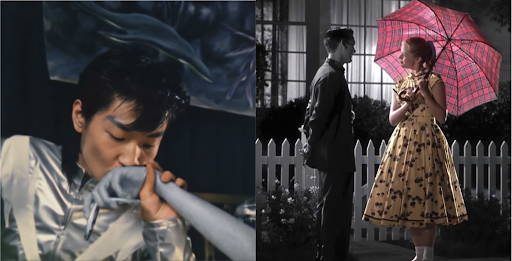
Fig 1. Kan from Stardust Brothers, 1985 (Left) vs. Pleasantville,1998 (Right)
The opening sequence delivers the headline loud and clear: Subtlety doesn’t live here. Kan and Shingo’s personalities are too big for the film to contain. Faces will mug. Fourth walls will be broken. The brothers live in a technicolor expressionist version of reality where rock music is the most important thing in the world (and it is! Simply not in the literal way it’s presented here.)
In this universe everyone arrives costumed appropriately and stage-ready. The band always knows the backing track. All the main characters possess the singular desire to ‘make it’ and become a rock star. None of the cast spare a thought to falling into the gears of the capitalist nightmare that make those same desires aspirational.
The monochrome crowd is stunned and the brothers switch to audience banter. They introduce themselves and as they begin to tell their epic tale, we flash back to their humble rock-and-roll origins.
In the beginning, the brothers led completely different bands that represented a two musical subgenres in the zeitgeist of the early eighties: Kan with a band called ‘London Boots’ who play good old-fashioned punk rock, although it’s through the lens of Japanese culture so it’s a little more clean and polished than one might expect. Shingo is with a new-wave combo known as Super Cars (not to be confused with the regular ‘The Cars.’) They are each approached by a mysterious music label known as Atomic Promotions.
They arrive at the Atomic Promotions offices separately. That’s when they meet the company president Minami. Anime fans will immediately notice that Miniami’s office and his whole style evokes anime characters like Gendo Ikari from Neon Genesis Evangelion. Then things get complicated: He has no use for Super Cars or London Boots, he only wants Shingo and Kan in order to create a new pop duo. And they shall be known as ‘The Stardust Brothers!’
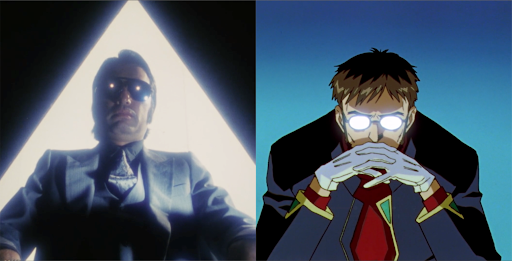
Fig 2. Minami from Stardust Brothers, 1985 (Left) vs. Ikari from Neon Genesis Evangelion,1995 (Right)
Things go great at first. Immediately outside Minami’s office they find their first fan Marimo. She also dreams of becoming a pop idol, but she’s satisfied to be The Stardust Brother’s official number one fan and president of their fan club… for now. Shingo and Kan are a typical odd couple. As the punk rocker Kan is a little more free spirited and sensitive, while Shingo, is portrayed as something of a more high-strung workaholic type.
The rise to fame is about as quick and painless as can be expected when one has the backing of a multimedia conglomerate with nearly endless resources. Instead of a standard montage, this sequence passes in multiple music video segments. There are no breaks for traditional dialog. The story and character development is turned completely over to the music and visuals. For instance the song ‘Monitor,’ a dance number about climbing the charts flows directly into the more somber ‘Ballad of Past Years.’ The music video shows our protagonists looking melancholy, presumably about the alienation they feel surrounding their newfound fame. The song ‘Marimo’s Feelings’ is about… you guessed it! Marimo’s feelings!
Just when things seem to be going well, fortunes begin to turn. The brothers succumb to the stereotypical rock-and-roll lifestyle. Particularly Shingo, who falls prey to drug abuse in a fantastical expressionist segment involving an anime sequence and a costumed j-horror set piece that would make Keita Amemiya proud.
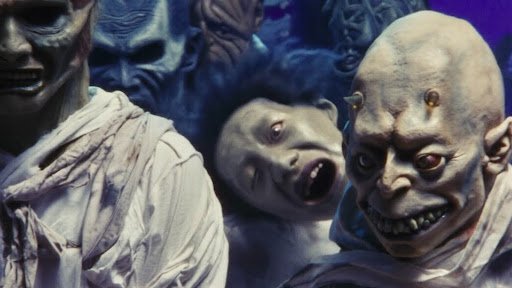
Fig 3. Zombie-like demon sequence from The Legend of the Stardust Brothers
This genre-blending freakout is the reason Shingo fails to appear for a big show. Kan convinces Marimo to perform and crushes it. When Shingo arrives he is so high he strips to his underwear and writhes on stage like a maniac.
Following the disastrous show, the record company wants a new star with a cleaner image so they sign the son of a popular politician, Kaoru. He is even more of a synth-pop androgynous type than either of the brothers, very David Bowie-coded.
Marimo’s idol career has begun to take flight as well. Soon the Brothers are out on the street with no prospects and only each other to rely on. Meanwhile, Kaoru schemes to create a scandal between himself and Marimo, boosting his own popularity. The Stardust Brothers vow to start over and become pop stars again the old fashioned way, working their way up from the bottom. Marimo agrees to help because much like in real life, performers can be fans and vice versa. The brothers begin their comeback in a club with an open roof which means that during a rain shower the entire space is drenched. It’s a powerful visual metaphor, even though it must be hell for service.
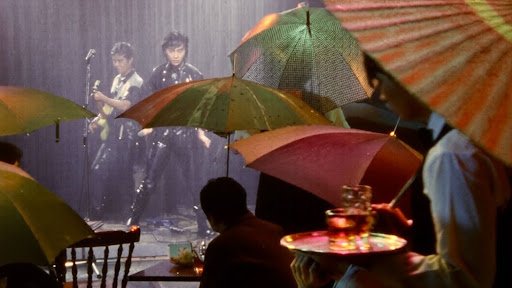
Fig 4. The Stardust Brothers play an open roof club during a rainstorm. This would be an OSHA violation anywhere else.
This leads to a madcap climax when Kaoru looks to corner Marimo to satisfy his scheme, The Stardust Brothers arrive to rescue her in their Stardust-mobile. The car chase starts as something akin to Cannonball Run and shifts to A Hard Days Night as it becomes a foot chase through the streets of eighties Tokyo.
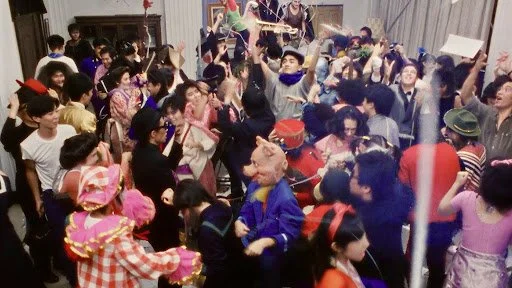
Everyone converges at Kaoru’s mansion where his father is revealed to be Hitler. Yup. In a film full of odd references, that was the most surprising of surprises. Then there’s a final chaotic fracas designed to provide the most anarchy the budget would allow. Everyone moshes and breaks stuff, geishas and schoolgirls, salarymen and samurai alike. The spell is broken when in the confusion, Kauro shoots at Shingo but hits Minami instead. In another surreal twist, he shuffles to his feet and performs a final song while climbing a stairway to heaven. Much like a scene out of Sid and Nancy, a year later.
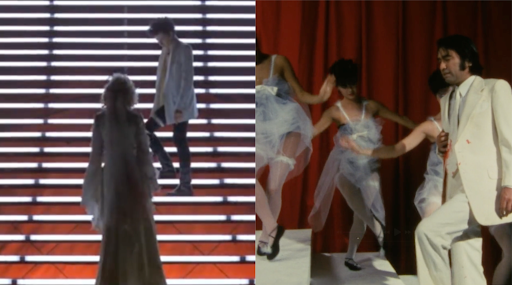
Fig 5. Sid and Nancy, 1986 (Left) vs. The Legend of the Stardust Brothers, 1985 (Right)
In the final sequence we flash forward to rejoin the monochrome club from the opening sequence. The Stardust Brothers perform one last time and are both shot dead by a member of the otherwise indifferent audience. A meta ending to a very meta film.
In conclusion, I feel this movie defies traditional evaluation. This movie is closer to a visual album, a linked series of music videos like Daft Punk’s Interstella 5555. So today I’ll rate it on the three axes of sex, drugs, and rock and roll. Does it have sex? Not explicitly, but there is sexuality in play: queer expression, gender bending, and androgyny that rock and roll culture would feel stagnant without. I feel that implies sex does happen in this world, even if none of the main characters get together. So I’ll count it. Are there drugs? Oh you bet!
Does it rock? For all its aspirations towards elaborate set pieces and music video maximalism, there’s also a certain scrappy quality to this movie. Cast members were clearly looking to crack each other up in any sequence where they weren’t lipsynching their hearts out. This is a film that leaves the outtakes in. In my estimation, that does indeed rock.
While the story is basic, the execution is endearingly elaborate. While it certainly checks all the boxes one might expect as a product of Japanese culture, The Legend of the Stardust Brothers feels universal. More than brothers, they are the heroes with a thousand faces: the rock band: the movie.
If you enjoyed this article, please consider becoming a patron of Hyperreal Film Journal for as low as $3 a month!
Collin Cannaday is an Austin author, screenwriter, essayist, humorist, satirist and dramatist. He currently co-hosts the Are You Karate Kidding Me?! podcast recapping the Karate Kid movies and Cobra Kai. Subscribe on your podcatcher of choice. Follow him on Letterboxd: @ccann or on Bluesky: @collincannaday.com