
Weird Wednesdays: Never Talk to Strangers
This screening was part of the Alamo Drafthouse’s Weird Wednesday series. For upcoming shows, click here.
If the 1990s erotic thriller was a genre built on perspiration and suspicion, Never Talk to Strangers opens by lighting a cigarette and announcing, without irony, that sex is overrated.
That line comes from a character played by Harry Dean Stanton (yes, that voice, that face), portraying a man wanted for murder and rape. It’s the kind of opening monologue that feels less like dialogue and more like a thesis statement tossed into a dark room. Before we even meet the central couple, the film frames sex not as a conquest for pleasure or love, but as a means to start a philosophy lecture on the human drive.
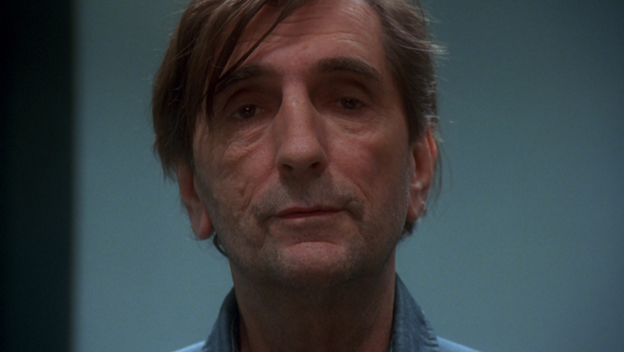
Just gotta take your Ex out of Sex babe, be left with just the S. Eh?
Then, as if to balance the existential dread, Dennis Miller enters stage left and delivers perhaps the most blunt line in the entire movie. In the middle of a conversation where he’s trying to get a second night stand with our main actress he blurts out, “I just wanna fuck!”
No metaphor. No poetry. Just pure, unfiltered impulse. It’s a jarring tonal counterpoint, one character dismisses sex as overrated, and it's followed up by an HBO late night talk show host reducing it to a mission statement. When we meet our protagonist Antonio, he says he’s from PORTO RICO, not Puerto Rico. And if you didn't already know, Antonio Banderas, the actor playing the role, a Spaniard, should know better than to keep this type of accented talk alongside the character’s true to the heart Caribbean eccentricities. The movie lives in the tension between these poles for its runtime.
And then there’s the music. The score lingers in the background like what can only be described as “creepy Hallmark movie music.” I would judge it as being a blend of some scores like The Exorcist and The Notebook. The audience gets the same tonal palette almost the entire way through. It’s soft, vaguely sentimental, and slightly ominous. The kind of soundtrack that suggests someone might either confess their love or commit a felony in the next five minutes. It rarely escalates; it just lingers. Unsettlingly polite. But that is exactly what this movie needs with how all over the place it is. Which makes the divide in audience reaction even more fascinating.
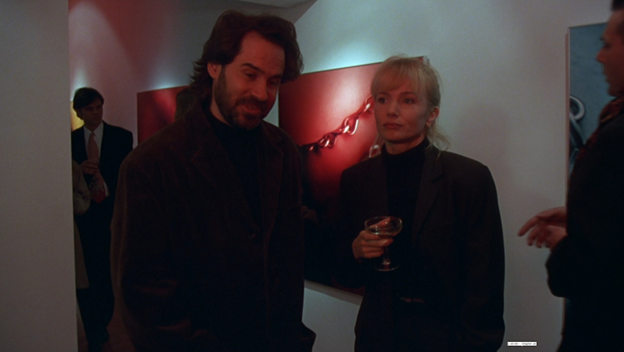
Perhaps you would be interested in some horizontal hokey pokey?
On one side: viewers might see an overwrought ’90s thriller weighed down by repetitive scoring, melodramatic suspicion, and a script that sometimes confuses ambiguity with depth. The host that introduced the 35mm showing I watched was seeing it along these lines. This of course is after we all watched banger trailers for classic bad girl films such as The Cats, Bad Girls Go To Hell, and The Fat Black Pussycat.
On the other side: viewers may recognize that the film isn’t really about sex at all, it’s about power, projection, and the psychological gymnastics we perform when desire enters the room.
Or one could simply say it’s between those that have a sex life and those that have a “sex life”.
The intimacy between Banderas and De Mornay isn’t staged like parody. Some may think it’s hammy, and that’s because, out of the moment, all kink play can seem corny like that. With that being said, it doesn’t feel like a perfume commercial. It feels intentional, adult, and slightly dangerous. It’s not glossy fantasy, but more like a negotiation where nobody fully trusts the contract. The movie assumes the audience of the time (and hopefully the future) understands that attraction isn’t always clean, safe, or narratively convenient. This is analogous to how it isn’t convenient for the our leading lady to be facing Nam-esque PTSD flashbacks from carnival clowns because of what turns out to be the ultimate daddy-daughter issues of all time. Which is why the reception likely splits between people who see sex as a plot device and people who recognize it as an emotional accelerant.
Viewers could argue the film overplays its hand. The pacing wobbles at times and the score refuses to evolve like it’s a broken record titled, "Tension Music”. The mystery occasionally feels withheld rather than constructed. But when it leans into the psychological tug-of-war resulting in professional boundaries dissolving under private tension, it works.
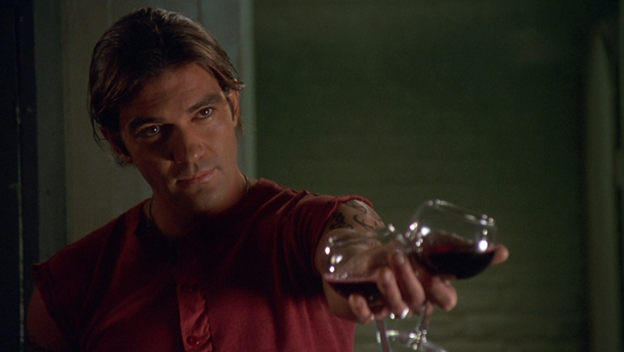
Neil Diamond or UB40? Either way we’re having red red wine.
Never Talk to Strangers may not be the crown jewel of the erotic thriller era, but it’s a fascinating artifact. It’s a movie where one man declares sex meaningless, another demands it outright, and the two leads circle each other like chess players who know the board is rigged to result in someone getting their ass cheeks bitten somehow.
And somewhere underneath that steady hum of soft-focus suspense music, the film quietly asks: Is sex overrated? Or is it simply misunderstood by the people pretending they’re above it?
If you enjoyed this article, please consider becoming a patron of Hyperreal Film Journal for as low as $3 a month!
Jesse is a retired Navy veteran and Texas State Alumnus with a Degree in Digital Media Innovation and minor in Theater. In a past life he was a red shirt on the Enterprise doing nuclear power and propulsion plant reactor operations and maintenance. He currently resides in Austin helping to repair physical media players and doing communications work with We Luv Video along with veterans advocacy work as Senior Vice Commander with a local DAV chapter. He has co-hosted The Texas Hemp Show and hosted Lonestar Collective which has won 2 statewide fan favorite awards for best online production in the hemp industry. If he’s not out catching a flick he’s possibly hanging out with his family or playing on guitar with his son.