
The Odyssey: The Bronze Age Oppenheimer is Epic Blockbuster Filmmaking at its Finest
The Trojan War does not occupy much space in Homer’s Odyssey. The first line of the epic references it, but almost as an afterthought: “Tell me, O muse, of that ingenious hero who travelled far and wide after he had sacked the famous town of Troy.” Beyond characters speaking of the war in broad strokes, only one part of the poem recalls Odysseus’ infamous ruse with the Trojan Horse and the slaughter that followed. There are many translations of The Odyssey (the one above from Samuel Butler), but the minimal descriptions of Troy’s destruction remains more or less the same no matter the translator.
So, it might come as a surprise just how much Troy’s destruction casts a shadow over the entirety of Christopher Nolan’s adaptation, emerging in flashes of fire and ruin before a clearer picture of the event slowly emerges across the film’s gargantuan three-hour runtime. A lesser filmmaker would have included Trojan War flashbacks to pad the runtime with action scenes to keep the audience awake, but Nolan uses it as thematic bedrock that violently rises to the surface the closer Odysseus gets to completing his journey. For an adaptation of an ancient work, it is startling how much Nolan’s recontextualizing of Troy’s destruction speaks to societal failures we are living through over 2,000 years later.
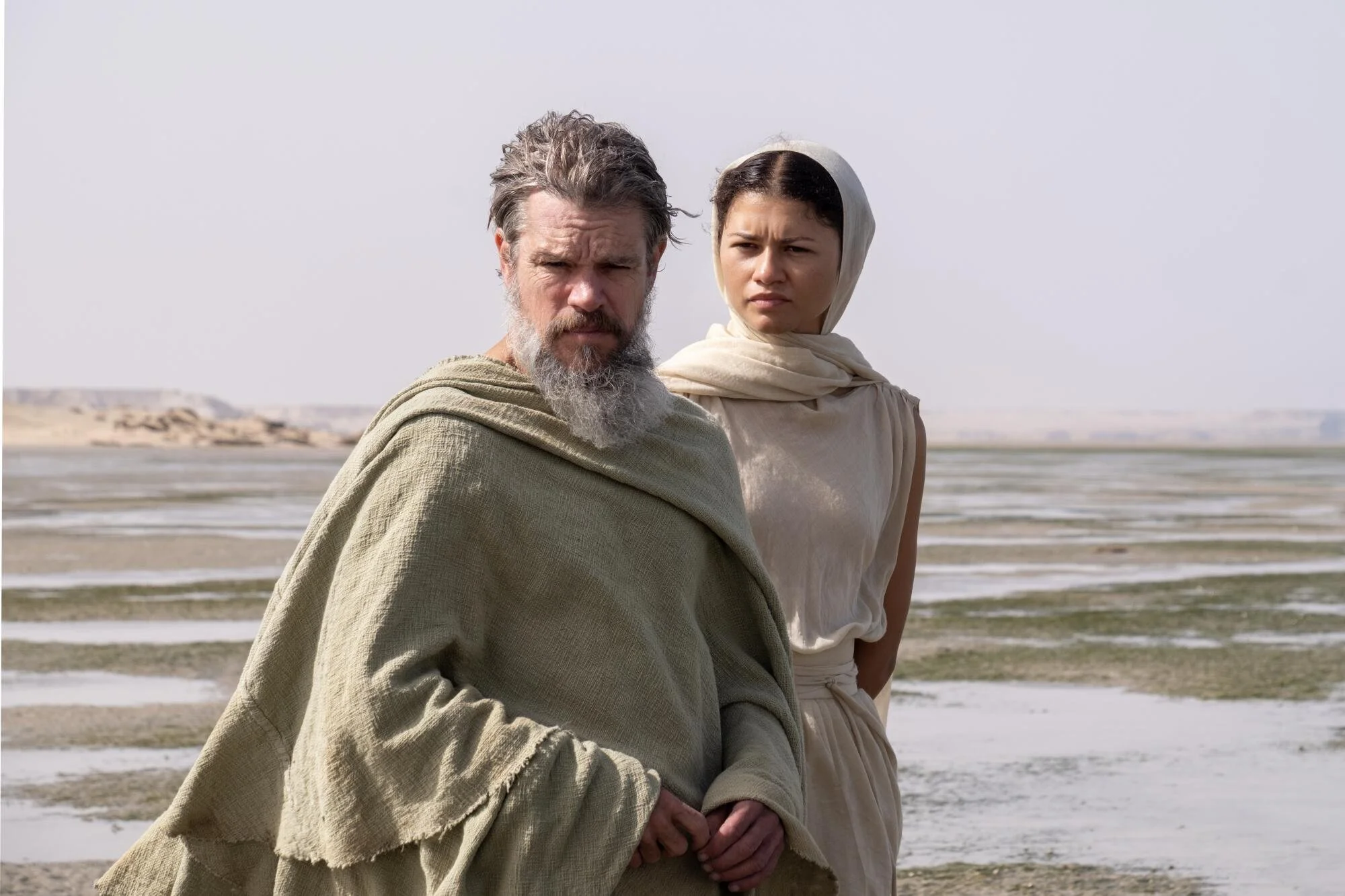
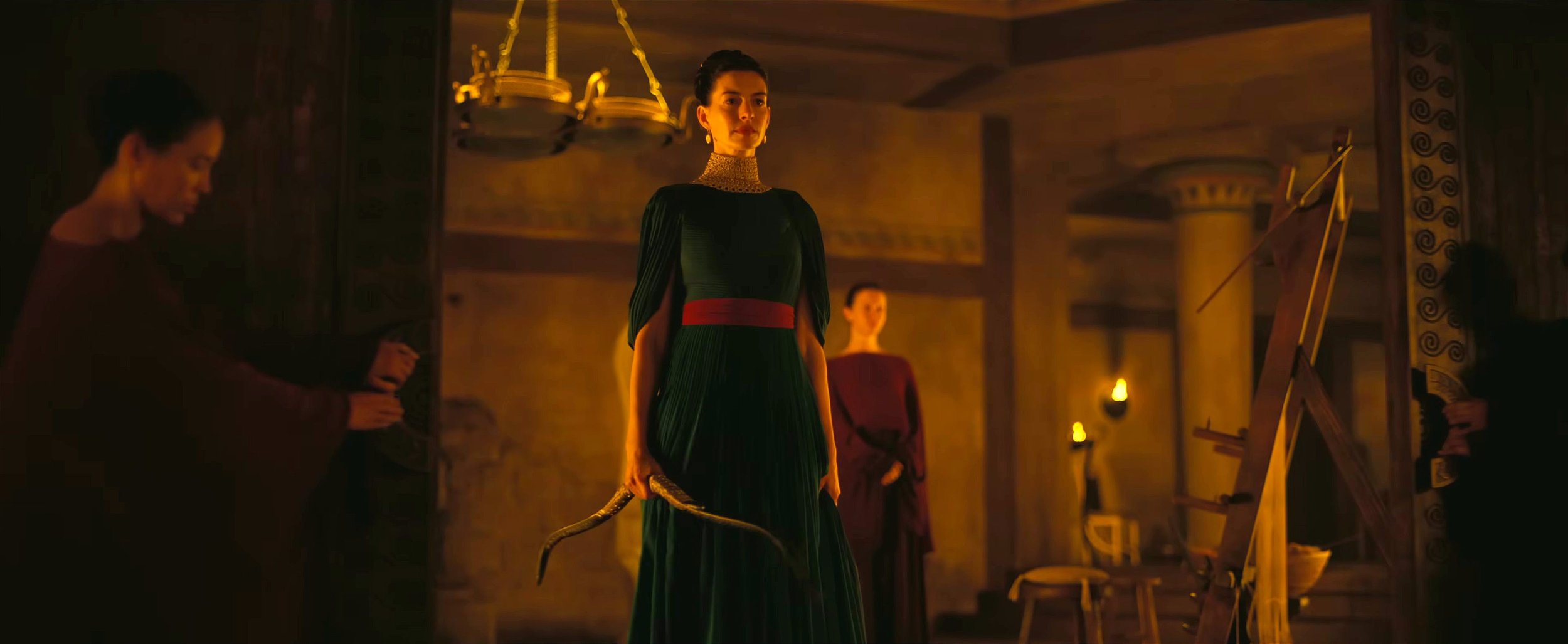
As the film kicks off, the destruction of Troy is the most recent piece of information anyone in Greece has about the king of Ithaca, Odysseus (Matt Damon). After spending 10 years serving in the Trojan War at the behest of King Agamemnon (Benny Safdie), Odysseus has been missing for another eight years since. Odysseus’ son, Telemachus (Tom Holland), is desperate to find any information about his missing father, especially as the situation in Ithaca worsens in his father’s absence. Odysseus’ wife and queen, Penelope (Anne Hathaway) has spent years entertaining a rotten gang of suitors who wish to marry her and assume the throne, the most loathsome and tenacious of them being Antinous (Robert Pattinson). As Telemachus goes on a journey to see if the king of Sparta, Menelaus (Jon Bernthal), knows what happened to his father, Odysseus finds himself with memory loss on a strange island with the mysterious Calypso (Charlize Theron), slowly remembering what happened to his crew and who he must return to save.
That description fails to mention an enormous ensemble cast that includes Lupita Nyong’o, Zendaya, Elliot Page, Samantha Morton, Himesh Patel, Mia Goth, and many more veterans of film and television acting. At the risk of sounding cruel, the least interesting cast member is Tom Holland, but not because he’s bad in his role. He is a fine Telemachus, he just has the misfortune of being surrounded on all sides by actors at the height of their powers. Robert Pattinson is perfectly awful as a power-hungry weasel, Anne Hathaway’s steely resolve and massive beating heart make her impossible to look away from, but the supporting player who steals the movie is John Leguizamo as the blind servant Eumaeus. Leguizamo has always been a great dramatic actor, and his turn in The Odyssey is the most staggering demonstration of this fact his career has allowed in years.
Then there’s Matt Damon as Odysseus. His performance is restrained for most of the runtime, but the longer the film goes on, the more Damon is allowed to reveal greater depths to his interpretation of Odysseus, especially as he interacts with other characters on his journey home. Himesh Patel is equally as fantastic as the soldier Eurylochus, who struggles to deal with Odysseus’ methods and tactics for trying to get the rest of his men to Ithaca. Another standout among Odysseus’ soldiers is the deeply tragic Sinon, played by Elliot Page. Page’s Sinon haunts the film, literally and figuratively in a deeply unsettling sequence set in Hades.
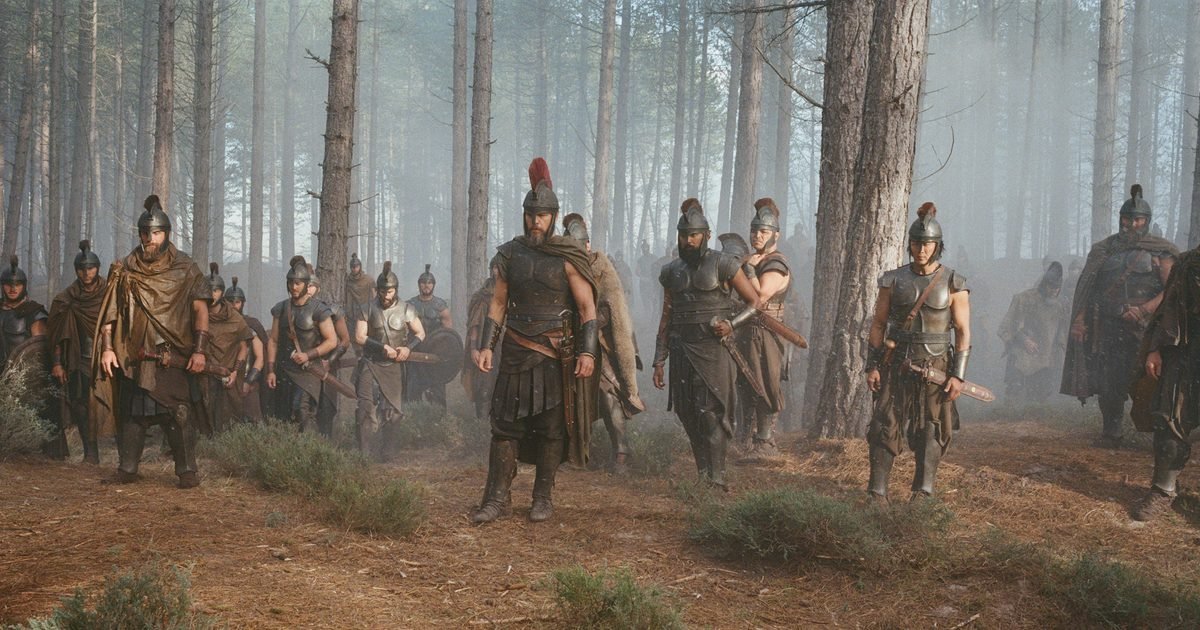
The Hades sequence is one of many fantastical elements required to adapt The Odyssey properly, and this aspect of the film is where Christopher Nolan’s style strains the most under the pressure of its source material. Nolan’s obsession with making his filmmaking as practical as possible and grounding his visuals in reality whenever he can is a blessing and a curse for this adaptation. Most of the fantastical sequences work well within this grounded style, particularly the horrifying encounter with Circe (Samantha Morton). Not only is Morton’s performance flawless as she moves between quiet menace and spectacular rage, but the depiction of her powers is the most grotesque imagery Christopher Nolan has ever conjured in his filmography. Far less effective are scenes with the beast Scylla, which are shot and staged nicely—until Scylla’s design appears in plain view. It’s by far the most baffling artistic decision in the entire movie, looking like a mangled hybrid between a pile of rocks and leftover digital dinosaur skin textures from the Jurassic World movies.
While there are obvious tradeoffs between Nolan and cinematographer Hoyte van Hoytema’s practicality and the fantastical, everything else is gorgeous beyond measure. Much publicity has been made of the fact that The Odyssey is the first feature film to be shot entirely with IMAX film cameras, and the massive expanses of every single frame combined with on-location shooting make this a film worth getting lost in. Perhaps this goes without saying, but anyone planning on seeing this film should seek out the biggest screen possible to do so—and it also won’t hurt to seek out a theater with a great sound system. Nolan’s aggressive sound design is as ruthless as ever and complemented by a spectacular score from Ludwig Göransson. Although the score mirrors The Odyssey itself in that the earlier parts are less interesting than what comes later, it becomes far more ambitious the longer the journey goes, deepening in complexity at the same pace as the story itself.
This is the oddest aspect of The Odyssey on the whole: the gap between its first two-thirds and its final third. Even with Christopher Nolan’s signature Russian-nesting-doll story structure jumping around time, the beginning and middle of the film feel slight at times, especially in making Odysseus a compelling character. He’s not without any interest, yet it’s hard not to feel like there’s more to him than what the movie conveys. The only thing that seems to drive him isn’t even trying to get home to his family, but getting his men back to Ithaca. He rarely speaks of returning to Ithaca for any personal reason, but constantly speaks of trying to save as many of his men as possible during the journey.
This is not a mistake on Nolan’s part, but deeply intentional. This becomes apparent as the final third kicks in, bringing disparate moments from the previous two-thirds together in a jaw-dropping way. There is no doubt that The Odyssey will play like a completely different film upon second viewing, because Odysseus finally opens up his soul to the audience near the end of the film, clarifying what has been eating away at him on his journey. The result of this culmination is the best third act of Christopher Nolan’s career, the apex of what blockbuster summer filmmaking can achieve when crafted by an artist with a deeply specific vision, both intellectually and emotionally. The reveal of Odysseus’ mindset expands the themes of violence and its consequences in surprisingly thoughtful ways, while also providing opportunities for thrilling combat that manages the feat of feeling massive despite its intimate scale.
The most surprising aspect of the thematic expansion in the third act is how it puts The Odyssey in direct conversation with Nolan’s previous film Oppenheimer. Though separated by 2,000 years, the stories of both films wrestle with personal legacies. And the similarities between the two aren’t surprising, considering The Odyssey functions almost as a collection of Nolan’s past preoccupations. Interstellar and Inception both follow best-in-game professionals trying to achieve the impossible while returning home to their families, and the isolation of being on top runs through well over half of Nolan’s filmography. The Odyssey was always perfect material for Nolan to tackle, but its relationship to Oppenheimer in particular is most fascinating considering the gap between a tale of Greek mythology and a biopic about the father of the atomic bomb. In Nolan’s view, though, Odysseus and J. Robert Oppenheimer are cut from similar cloth: one idealized through mythology as a lesson generations will fail to learn, and the other being one of those who failed to learn the lesson, to the peril of the world around him.
Even if Oppenheimer didn’t exist to compare it to, The Odyssey exemplifies phenomenal epic blockbuster filmmaking on every level. Gorgeous to look at, overwhelming to listen to, and one of the rare movies at this scale that is designed to reveal greater depth upon rewatch, The Odyssey will be remembered as one of the best American blockbusters of the 2020s and a high watermark in Christopher Nolan’s run.
If you enjoyed this article, please consider becoming a patron of Hyperreal Film Journal for as low as $3 a month!
Jacob is a writer based in Austin, TX who loves giving infamous movies a chance, for better or worse. You can find him on Letterboxd at @Jacob_Ethington and on Instagram at @midwest_bummer.