
Bubble, or, Mundanity and its Discontents
You wake up. In the baby blue embrace of dawn before your brain catches up to your eyes, you see the world anew. You forget who you are for a while. Staring out the window set low to the ground, you can almost imagine a garden. You can hear the birds singing softly, wet grass sighing and surrendering under morning dew's loving embrace. You forget you're home. You forget the thankless task of caring for your aging father. You forget you're trapped. When you leave, the town is still the same. There are the neat rows of tiny ranch homes interspersed with empty, grass-blood green lawns like gapped teeth; there are the trailer parks, the water tower, and the doll factory; there's the new McMansion development outside of town with its sapling trees clinging to life. And of course, the familiar sights going over the bridge. You know the one.
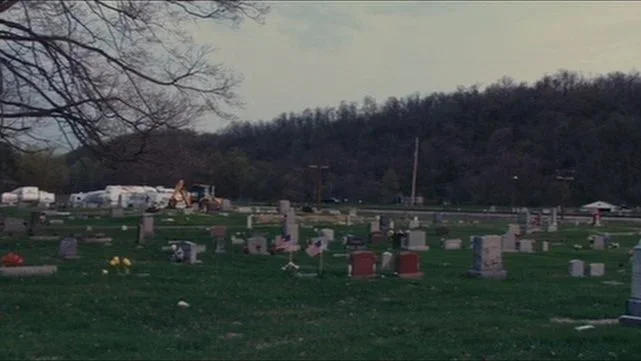
This is Bubble (2005) by Steven Soderbergh, an intimate and spare exploration of what happens when life gets its hooks in you and won't let go. Think murder mystery/impossible love triangle, but make it Mumblecore. Wedged between big-budget films like Ocean's Twelve and Ocean's Thirteen, Soderbergh aimed to return to low-budget filmmaking reminiscent of his 1989 directorial debut sex, lies and videotape. Filmed over 18 days in the border towns of Belpre, OH and Parkersburg, WV, situated on the banks of the Ohio River, we observe the quotidian realities of life in the blighted community. This is no cloying tale of Americana, all wrapped in nostalgia and summertime haze. Clad in cool undertones, this is an ultra-realistic, dreary portrayal of life in rural small-town America, where mundanity and its discontents take center stage.
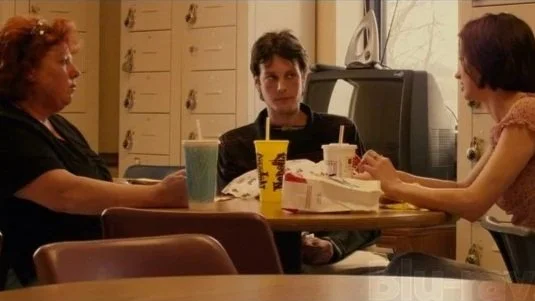
Our three main characters are played by local actors recruited from the area, most of whom still only have the one film credit to their names. Much of the 75-minute film follows the characters talking about nothing in particular in the disaffected vernacular of the working class. Old jobs, future beach trips, and bad decisions are shared matter-of-factly over fast-food lunches and drinks at the bar downtown. There's Martha (Debbie Doebereiner), the middle-aged dreamer; Kyle (Dustin James Ashley), the numb escapist; and our newcomer Rose (Misty Dawn Wilkins), the scrappy realist. Through each of their stories, we get the full picture of what life is like in a town that the present forgot.
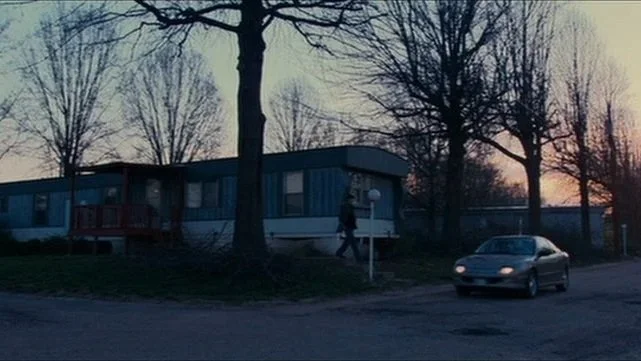
Martha is a dreamer. She's the oldest and therefore the most worn down. In the film, you see her dutifully caring for her aging father, for Kyle, for Rose, but never for herself. Not even when she gets her hair done is it for herself. Even the way she spends her free time serves a purpose — "he watches TV while I sew," referring to making clothes for the dolls she assembles at the factory. We often see her staring into space, into a cryptic light. She enters into this dream-like state during moments of transition: when she wakes up, when she's in church, when she's driving from one place to another, and when she's in jail awaiting trial. The audience is made to wonder what she sees in this light. We don't hear much of her desires. She's an inscrutable character. We don't get to know her because she doesn't get to know herself.
Kyle is a numb, anxiety-ridden high school dropout, suspended in time. Of course he's a stoner and High Times enthusiast, as is the way of self-medicating small-town youth. He gets the habit from his unemployed mother, whose drug of choice is numbing out in front of the TV. Kyle doesn't say much of anything. He nods, mumbles one word answers, and sometimes he even smiles. Consequently, he's also not much in control of anything. In an early scene, we see Martha direct him to stand and pose for a photo because he's her "bestest friend.” This is a perfect representation of their relationship — Martha directs and he obliges. He spends his mornings in the doll factory and his evenings at the sawmill, shoveling sawdust into an incinerator. On his one day off, he smokes and reads magazines. He tells Rose that he has "drawer change" saved. Children of working-class parents know all too well that the one day of recovery is never enough to get ahead. The drawer change is never enough to get ahead.
Rose is a realist. She soberly assesses that they live in a town where there's no way to make money, "everything's poor." She wants out. Her ex and child's father is an artist who's "really into his work," and "babysits sometimes." She's on her own. It becomes obvious that she's got a fighting spirit during the first conversation we observe her taking part in — she mentions how often she was exploited in her previous job as a "professional ass wiper." Something we never hear Martha or Kyle complain about. She left that job and ended up at the factory, which she doesn't think she'll like much better. She steals Kyle's drawer change after their date. Rose is also the only disagreeable character, demonstrated when she tells Martha to mind her own business after she witnesses the fight with her ex. She has no stars in her eyes regarding her situation and she's willing to do what it takes to thrive, including using the people around her.
The mechanics of dreaming in this world work like this: they don't. Everyone here is afraid to dream. At least for real. They inhabit a sort of ghost world, a bubble, where the only place that exists is the town. The doll factory, the sawmill, the trailer parks, the apartment complex nestled near the embrace of the woods behind them, and the bridge are the backdrop to the exasperated restlessness of their lives. The three of them are dying. One of them is fighting it, and the others have already accepted its indifferent embrace. The wan melody that plays throughout the piece is simple and sweet yet coy. It contains a question at the end. When will the bubble pop?
The light only comes when you're alone. Pale blue, luminescent white. What do you see? Fame and fortune? A slow dance with Kyle? A frolic in the sun? Have you ever been to the beach? Do you even believe in God? Or do you just go to church to stave off the loneliness? Do you like to sew? Does making dolls fulfill you? When you press the eyes in and the sound it makes when the air bleeds out — is it meditative? Is caring for your father worth it? Or do you really wish he'd just hurry up and die? Under the streetlights, you let yourself smile. There's no reflection in your eyes. Everything is right in the world now. The quiet furore you felt is gone. The threat is no more. You don't know what happened. You don't remember anything. You know fresh life is inside of you.
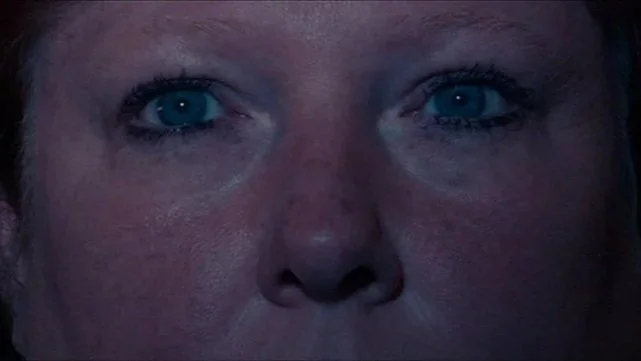
"I don't understand," Martha says, voice cracking. She isn't lying. She really doesn't understand. She doesn't understand anything. She works and works but nothing changes. She sews but nothing changes. Something changed. Petechial hemorrhage to the eyes. A constellation dressed in red. Dead eyes, like Martha and her dolls. Dead eyes across the jailhouse grate doors. The bubble has finally popped.
Do you understand now? Are you free?
If you enjoyed this article, please consider becoming a patron of Hyperreal Film Journal for as low as $3 a month!
Tawanda is an arts and culture essayist and experimental prose poet exploring the dreamlike spaces beyond our imagination. Her work commonly features themes of catharsis, ambivalence, hope, obsession, and despair. She currently resides in Austin, Texas with her little dog, Blanche. You can also find her elsewhere.