
Weird Wednesdays: The Apple—Biblical, Musical, Disco Hell!
This screening was part of the Alamo Drafthouse’s Weird Wednesday series. For upcoming shows, click here.
It’s easy to have a soft spot for disco. With funky outfits, lively nightlife and catchy records, there’s much to romanticize about disco as a genre of music and as a cultural movement. Trying to cash in on the musical boom of this era, The Apple, a biblical musical allegory commenting on the music industry, critiques disco as an evil, conformist part of late 1970s culture; the movie takes it one step further, contrasting disco culture to hippie culture which the writer (Menahem Golan) clearly views as a more appropriate alternative. As much as The Apple purports to hate disco, the film couldn’t have made it look anymore glamorous, glittery and fabulous. Really, how do you use a queer subculture (musicals) to critique another queer subculture (disco) without coming off severely out of touch? Viewing the film today, The Apple is a campy, blast from the past, borderline hippie propaganda mess that I couldn’t look away from and a not-so-genius product of its time.
The opening number, “BIM,” short for Boogalow International Music, performed by disco duo Dandi (Allan Love) and Pandi (Grace Kennedy) is phenomenal. A spectacle of an opening with all the razzle dazzle you’d expect from a musical. The costumes were gorgeous, the choreography was perfectly executed, the hair was large and it’s all in the name of a Eurovision type show called 1994 Worldvision Song Festival. At this point, surely they’re a shoe-in to win… right? Enter Alphie (George Gilmour) and Bibi (Catherine Mary Stewart), a prudish couple, walking onstage with only a guitar. Their white peasant shirts and bell-bottom jeans contrasted the showy Dandi and Pandi. In contrast, Alphie and Bibi have Mormon-inspired looks. At first, the audience, dressed like Dandi and Pandi, is weary of their Carpenters sounding music – booing and shouting at the couple, but as they continue playing, the audience is won over. That is, until BIM executive Mr. Boogalow (Vladek Sheybal) decides to step in and ruin the singing duo's audio.
After ensuring his label's victory, Mr. Boogalow tries to sign Alphie and Bibi to his label. Mr. Boogalow, similarly to Satan in The Book of Genesis, tempts the pair by promising fame and fortune for their signing with BIM. While in Boogalow’s office, Alphie has a vision of Mr. Boogalow and his henchmen as demonic forces, out to hurt him and Bibi through their signing of the contract. Immediately distraught by the proposition, Alphie tries to get them out of the studio but Bibi, more innocent and gullible, signs a deal with BIM. This again mimics Genesis where Adam, in his role as man, is protecting (or supposed to) Eve from the snake in the Tree of Knowledge and Eve, in her naivety, eats (drum roll) the apple. It is really at this point in the film that the biblical comparison is in your face, going so far as to have a garden themed room in Boogalow’s party space and a dance sequence with a giant apple being passed around by demons.
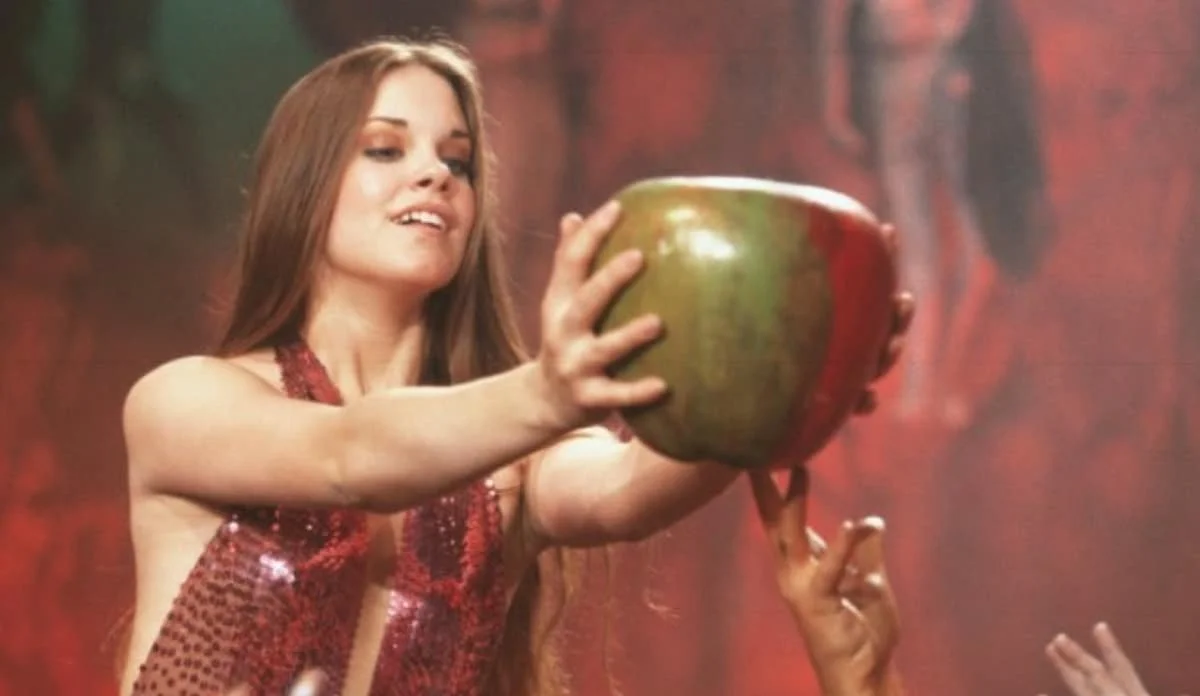
This “eating of the apple” inevitably leads to the couple's separation with Bibi being brought into the industry, glamourized by stylists and Mr. Boogalow’s henchmen. With her new style, Bibi quickly rises to fame using disco music and meticulous fashion choices as her keys to success. Meanwhile, Alphie is trying his best to reach Bibi, tracking her moves and hoping that she will realize signing with BIM was a mistake. As Bibi reaches icon status, BIM only becomes more powerful – forcing everyone to wear BIM marks, a small, glittery triangular sticker, to show allegiance to BIM or be fined by the police. BIM creates a compulsory National Fitness Hour which requires all citizens to participate in disco dances, akin to Jane Fonda style workouts. Alphie successfully reaches Bibi and is able to convince her that this isn’t the life she wants (which feels as anti-feminist as it sounds). They run away together into the forest where they join a hippie commune headed by a man who very clearly represents God. Alphie and Bibi live there for a few years, begin bearing children and leave their life of music behind them. The film ends with a “final battle” between good and evil, with Mr. Boogalow looking for Bibi at the commune and another God-like figure protecting her and the hippies in the commune from Boogalow’s influence and control.
From the plot summary, it is so hard to believe this film has 14 songs within its 92 minute run-time. Overall, the music is about 50/50 on whether it is catchy or interesting. The best songs, of course, are those performed by Bibi at the peak of her music stardom and those of Mr. Boogalow and his henchmen. For a film that’s clearly trying to sell the audience on the purity and love associated with hippies and frankly, heteronormative whiteness, the songs that exhibit those things are the most boring and lifeless. It was impossible to believe any person would prefer the simplicity of Alphie and Bibi’s performance to the disco performance of Dandi and Pandi. In terms of disco music too, this comes nowhere close to the soundtrack of Saturday Night Fever and even the catchy tunes don’t feel like they stick post-credits. As a huge fan of movie musicals and avid listener of their soundtracks, this wasn’t a soundtrack I felt like listening to in the car on the drive home afterwards.
There were a lot of other dazzling elements about this film though and it’s a shame the movie wasn’t a bit more put together. The costuming was beautifully 70s, taking lots of the iconic fashion of the decade and adding more sparkle and modern flare. The film, although often anti-queer in sentiment, showcased a great array of queer costuming from the drag queens to the leather daddies. Many of the actors depicting queer characters were also people of color, which viewing in 2025, highlighted to me the diversity and vastness of the queer community. This was a bit ironic given the overt intent of the writing being that queerness and racial diversity are bad for the country and for moral correctness. As the film progresses and BIM begins to take over the country, the costuming and even other design elements, only get better. They lean into the ideas of what modernism of the 70s looks like (think Flash Gordon (1980) or Logan’s Run) and have it infiltrate every aspect of The Apple.
The choreography was also a highlight for me and when I found out who the choreographers were, it made sense as to why it was unusually good for so-so music. The film was choreographed by Nigel Lithgoe and Ken Warwick, dancers in the famous British TV dance group called “The Young Generation.” This isn’t their real claim to fame though; the pair became television producers, with Lythgoe creating and producing So You Think You Can Dance and the pair producing shows like American Idol and America’s Got Talent. It’s not lost on me how funny that is – the duo choreographed a musical about the evils of the entertainment industry to then go on and create the most famous shows that directly rope young, impressionable artists and musicians into it. It’s poetic, really. Their choreography is top notch though and they have a knack for dancing that feels rare. It’s a shame they pivoted to producing but with the death of the movie musical post The Apple, it makes sense why they pursued other ventures.
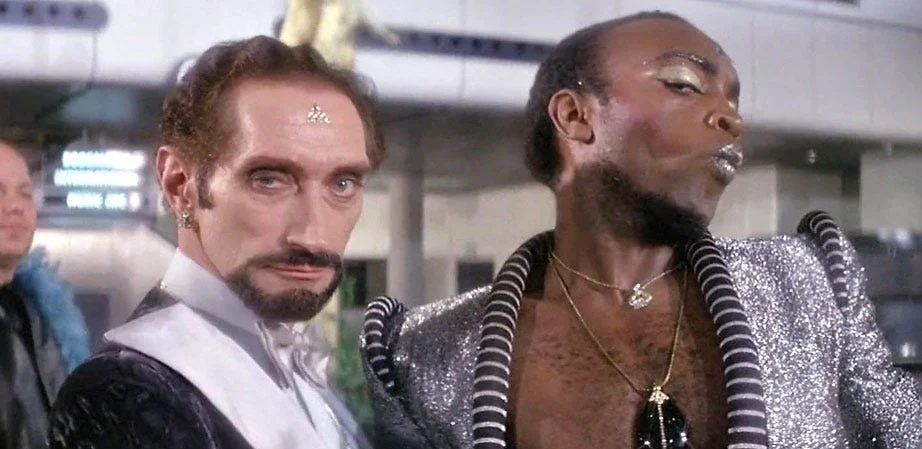
The record label as the metaphor for the Garden of Eden was certainly a choice and I do wonder what inspired it. While it’s no secret that the music industry can be exploitative and music contracts can be misleading and unfair, comparing a disco record company and its executives to Satan is not a jump that's made easily. The overall message of hippies being the epitome of moral soundness in comparison to disco is also intriguing. Hippies were very much the counterculture of their time, often subverting traditional institutions like marriage, child-bearing and full-time work for a more fluid lifestyle; it was certainly not seen as morally superior. With 2025 eyes, it reads more like heteronormative, white and traditional values are superior to queer, non-traditional, people of color – still not a great message and still does not read well.
Mr. Boogalow deserves a character study all his own. His motivations don’t seem inherently evil – he wants his record label to have successful musicians and Alphie and Bibi have musical potential. Based on the opening sequence and Bibi’s success, Mr. Boogalow is not bad at his job either. Outside of his differing style and musical tastes to Alphie and Bibi, there isn’t a clear reason or motivation why Mr. Boogalow is evil. Sure, it could be argued that there is personal gain for Mr. Boogalow but that shouldn’t inherently make him a bad guy. Outside of signing the contract and making music for him, Alphie and Bibi weren’t being threatened or coerced into anything overtly. Even the implied or suggested actions didn’t feel that menacing – Mr. Boogalow is consistently having fun parties, wearing bold costumes and dancing to disco music – is that all that makes him a bad guy?
The Apple is a sight for sore eyes. With the lack of color and greying of modern movie musicals (yes, I’m talking about Wicked), The Apple breathes color and life into the movie musical, even if there is still much to be desired in terms of plot and music. I can see why this film didn’t do well when it came out; comparatively, there are way better movie musicals, both generally and from this era. I would even go as far as to say this movie may have killed the movie musical, it’s that not good. But if you’re in the mood for a biblical, disco musical where hippies are morally superior, you’ve found the film.
If you enjoyed this article, please consider becoming a patron of Hyperreal Film Journal for as low as $3 a month!
Lauren is a writer based in Austin, TX who loves horror movies and supporting local artists. She frequents local movie theatres, comedy clubs and dive bars.