
SXSW '26: The Saviors
In director Kevin Hamedani’s The Saviors, which had its world premiere at SXSW 2026, the fear of the other (specifically the racial other) becomes a catalyst for an American couple’s revitalizing relationship. The plot follows Sean (Adam Scott) and Kim (Danielle Deadwyler), a husband and wife on the road to divorce. In order to make ends meet, they decide to rent out their guest house to Amir (Theo Rossi) and Jahan (Nazanin Boniadi), a brother and sister who immediately strike Sean as being just a bit off.
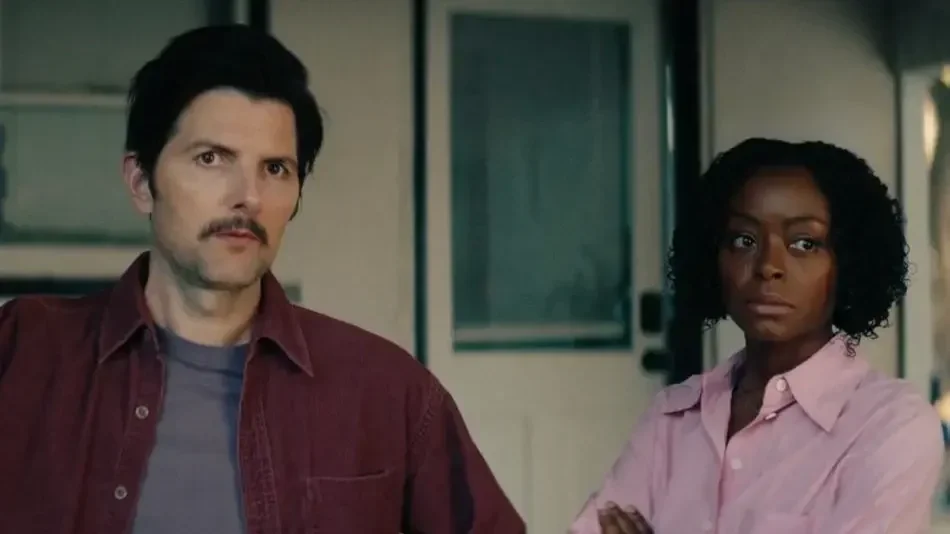
His growing obsession with the siblings, combined with the impending visit of the sitting US president to a mausoleum down the block, draws obvious parallels to the Islamophobia and fear of the middle east that ran rampant following 9/11 (and unfortunately has continued to be ever present since). Sean is in an interracial relationship (even if it is in the process of devolving), and thus comes across as a bit less reactionary the character as written might be otherwise, even with an explicitly racist set of parents (Ron Perlman and Colleen Camp appearing in a one scene cameo).
The film wants to present Sean’s suspicion in a few different ways—that even seemingly “good liberal-minded people” might hold biased racial views, that Amir and Jahan really are suspicious in some hard-to-define way, and with regards to the central copy’s relationship, first a point of conflict with Kim’s slightly more explicit sympathy, then becoming a point of shared excitement as they investigate their new tenants.
That last angle provides the strongest emotional hook, even if it is a bit broad and familiar. Kim’s reason for divorce is that Sean has stagnated since losing his job and that the spark of adventure in their lives has faded—lo and behold here is an opportunity for cloak and dagger investigation, for the frayed relationship to be relied upon again. It’s far from an original hook, but Scott and Deadwyler are such adept performers that they are able to infuse a deep lived-in reality to their characters’ relationship. The duo feel like two people that have known and loved each other for years and are right on the cusp of irreconcilable differences. Some of the best moments of the movie come in moments where Sean or Kim reach for physical intimacy out of muscle memory before consciously realizing that they don’t do that anymore.
Unfortunately, the movie falters in the main mystery of Amir and Jahan. The latter two are simply undeniably creepy in their affect and actions; it doesn’t take long for Sean to convince Kim because Amir and Jahan just do weird things. There are moments in the film where the latter two are indefensibly unsettling, far beyond the liberal prejudice Sean and Kim are working through. In one scene, Amir appears in their house without warning after eavesdropping on them, or the supposedly-deaf Jahan creepily mimics Sean humming a song.
These choices push the needle too far for a viewer to realistically doubt that Sean isn’t on to something by finding them suspicious. It’s not a question of Amir and Jahan’s culture seeming alien; they themselves seem off in an almost sci-fi way, which the film lampshades with jokes about robots and UFO art hanging in Sean’s office.
However, that explicit push for suspicion primes an audience to expect an upcoming swerve. It would be far too simple (and offensive, especially for an Iranian-American filmmaker like Hamedani) for the film to end with the reveal that the Middle Eastern-coded characters to be bomb-making terrorists trying to kill the president. And the film can’t quite keep them at a pure remove from the viewer’s sympathy, either. One moment in which Jahan’s hijab is ripped off by Sean’s sister (Kate Berlant) as part of a distraction is treated, both by the characters and the camera, as the horrific violation that it would be in the real world. That means that when Amir and Jahan’s true origins and purpose are finally revealed, the film is basically over. The entire second and half of the third act becomes a waiting game, less mystery and more anticipation for a wrinkle in the story that never gets fully explored before the credits roll.
While Scott and Deadwyler are magnetic performers, The Saviors becomes too focused on its own plot to let the viewer engage with it as a pure character piece, but the plot is so obviously foreshadowing a twist that the film feels slow in execution. And while there’s plenty of jokes and to live up to Hamedani’s post-film Q&A reference to Evil Dead as an inspiration, there’s none of the electrifying camera work or madcap energy that Sam Raimi brought to the table in that film. What’s left is a film that leaves an audience asking for “more;” more ambition, more daring, more time spent interrogating these characters outside of plot points. Here’s hoping Hamedani’s next film can deliver.
If you enjoyed this article, please consider becoming a patron of Hyperreal Film Journal for as low as $3 a month!
Ziah is the founder and former editor-in-chief of the Hyperreal Film Journal. He can usually be found at Austin Film Society or biking around town.