
Making Nothing Out of Something: The Austere Beauty of Stop Making Sense
Recently returning to theaters in Austin, Stop Making Sense is, 42 years on, still a masterpiece in austerity and obfuscated movement highlighting the ecstasy of performing in a live musical setting. Reagan era sentimentalities and a sleek, stripped down stage production juxtapose against an inordinate amount of hidden movement from the stage crew to produce an oddly still business. All the movement in the film comes from the camera work: the band members jump and dance around, and a few of them occasionally walk around, but for the bulk of the performance they are rooted in their individual locations on stage. The juxtaposition between the frantic performances and manufactured stillness builds progression into the performance, resulting in a paradoxical and euphoric audio-visual experience where the audience is so mesmerized, through camera work and shadow play, by the lack of movement that all they are aware of is movement—that of the band members’ bodies. The sparse movement and sound production slowly build on each other with each subsequent song as the members join the stage, and the songs themselves follow this pattern and slowly morph from restrained pieces of music to monumental cacophonies, until the audience is continually blasted with a wall of sound and bodies that overwhelms the senses.
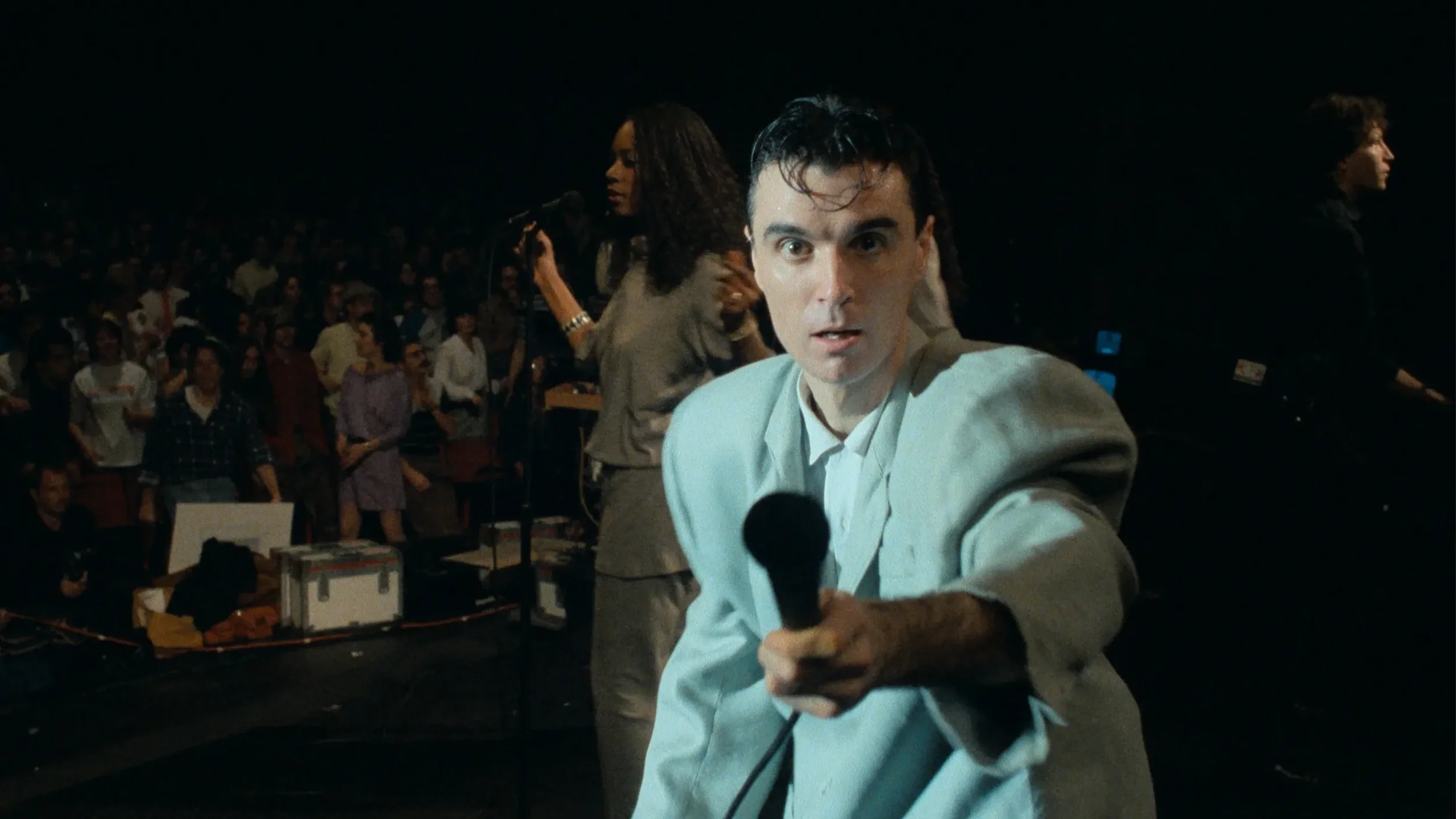
Opening with a solo performance of “Psycho Killer” from David Byrne and a bare stage that looks as if the set is still under construction, the film begins with simplicity. The first image isn’t even of Byrne — it’s of his legs in a bland, gray suit. There are no grand light shows or elaborate stage props. You only get shots of Byrne, but from about half a dozen or more camera angles so there is a constant sense of rotating about the stage. The alternating angles then give way to a series of still and tracking shots of Byrne wandering across the stage introducing actual movement to the scene before we get the first few images of the crew setting up the stage for the rest of the band. Ostensibly the only thing we are given here is the simple image of Byrne, but because the shots are either closeups of his wildly contorting face or him stomping back and forth, there is a chaotic energy that, when combined with the calm demeanor of the crew in the background, produces friction between movement and stillness.
As Tina Weymouth, Chris Frantz, and Jerry Harrison are added one at a time — and later Lynn Mabry, Ednah Holt, Alex Weir, Bernie Worrell, and Steve Scales — the audience is presented with manicured chaos. The visual energy here is contained to swaying and foot tapping, but one occasionally gets glimpses of the amount of work actually going into the performance. Through “Found A Job” into the start of “Slippery People,” we see the all black clad stage crew adding equipment to the stage. They calmly bring out microphones, guitar pedals, and extra percussion, while the four main members hop and bop to the rhythm before heading into “Slippery People.” There is a long corridor style shot of Mabry, Holt, Byrne, Weymouth, and Weir that slowly zooms in on Weir before cutting to a wide shot of the whole band. The movement here is simple: everyone is just gyrating up and down. Because the shot is on an intersecting axis to the movement, though, your eyes don’t see it all at once, instead journeying through the movement from person to person until you see all of them. The juxtaposition between the close and wide shots throughout the film is what ultimately amplifies its chaos. The closeups show overwhelming bodily movement and only in these wide views do you realize they’re just dancing or running in place, especially because the wide shots show their physical barriers: the tape they use to mark their spots.
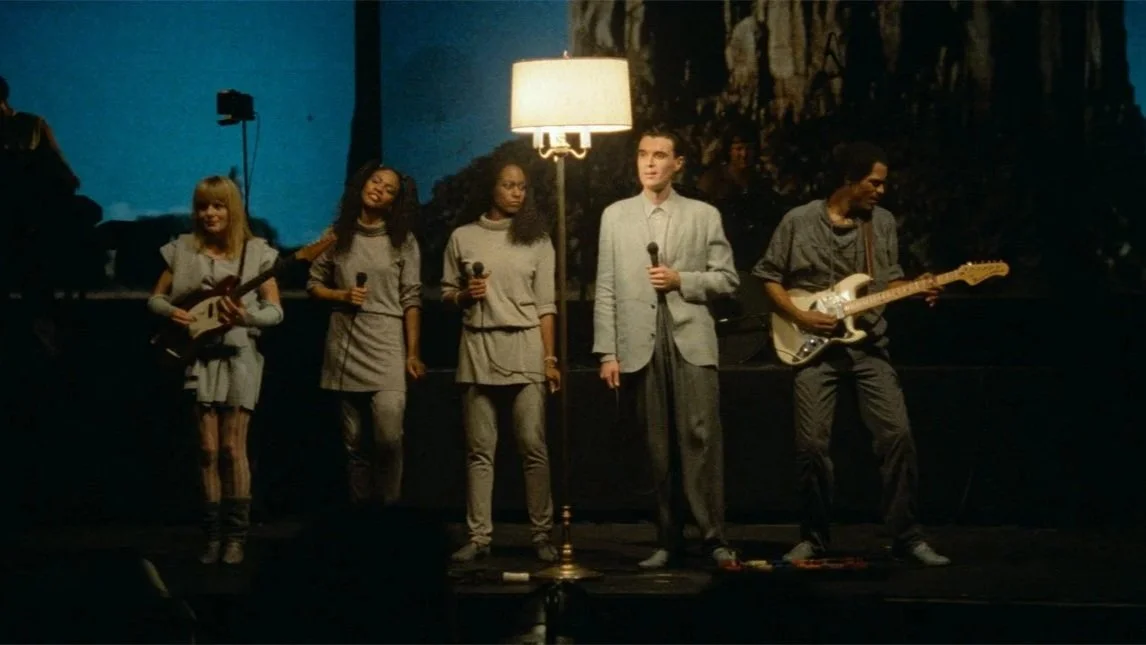
The band doesn’t use actual visuals until “Making Flippy Floppy” almost halfway through their performance. It starts the most rapidly shifting period of the film, speeding through four songs with wildly different visual aesthetics. As if to mark this shift into a more consciously produced performance, Byrne slicks his hair back into a sleek, 80s wall street broker style hairdo. Even here, though, most of the images are focused on the movement of the band, and on screen are simple phrases against a solid background that read things like “VIDEOGAME SANDWICH DIAMONDS” and “BEFORE YOU’RE AWAKE.” This jarring shift marks a reset for the performance and a starting point for more experimental lighting. Once “Swamp” starts, we lose visuals of the band entirely, instead seeing their blank silhouettes against an all red background before shifting yet again to a black background and stark, shadow throwing foreground lighting. My personal visual high point of the film, “What A Day That Was” bathes the band in equal parts darkness and light. Coupled with their all gray getup, the production here obfuscates so much of the band that they essentially become floating heads. Shadows cover the top half of their faces and render their eyes almost completely invisible, presenting us with startling images of contorting, almost manic faces and mouths with distorted lines. Next is “This Must Be the Place” and its peaceful still shots of farms, cities, landscapes, and bodies paired with a stilted, almost awkward visual performance from the band. They all gather around Byrne and his lamp, and gone are the wild herky-jerky dances, instead replaced with gentle swaying and a shot of Byrne dancing with the lamp. This four song stretch is constantly changing visual perspectives and playing with the form of what a concert film can look like and really highlights just how much complicated work is being done behind the scenes simply to make it look like they’re hardly doing anything at all other than playing and dancing.
After an inspired performance of “Once in a Lifetime,” there is an interlude of Tom Tom Club’s “Genius of Love.” While it’s mostly just filler while Byrne changes into his Big Suit, the austere production is still here, and there is an iconic shot of the ladies of the band dancing while a strobe light goes off, effectively halving the amount of movement we see. Then we reach the last three songs of the set. “Girlfriend Is Better” gives us one of the few tracking shots of a crew member and the amount of hidden work going into the film when we see a gentleman, focused and deadly serious, crossing the stage with a light. Replacing the visuals on the screen behind the band are shadows of the performers cast by the light. This is also the first song we get with Byrne’s Big Suit, providing yet another new method of conveying movement. This suit distorts and hides Byrne’s body lines so much that most of the movement appears to be coming from the suit itself. As the band transitions into “Take Me to the River,” they are bathed in cold blue light from the sides. In the wide shots we can see that the concert audience is seeing the band almost melt into the stage because of the way the light hits their gray clothes. Because of the camera work, though, the film audience also gets a side view of the band where you can see them evenly split by shadow and light. The dichotomy produces a harsh yet playful feel to the tune before the overheads come on and drown the band in light. This song is particularly notable in the film because, after the initial visual experimentation at the start, it is the first time since the beginning of the film that all pretense of manipulating the sense of movement drops away. There’s no shadow play, sheer lighting, or sleek, alternating camera work, just the band in clear view slowly building energy and anticipation before unleashing a wall of sound.
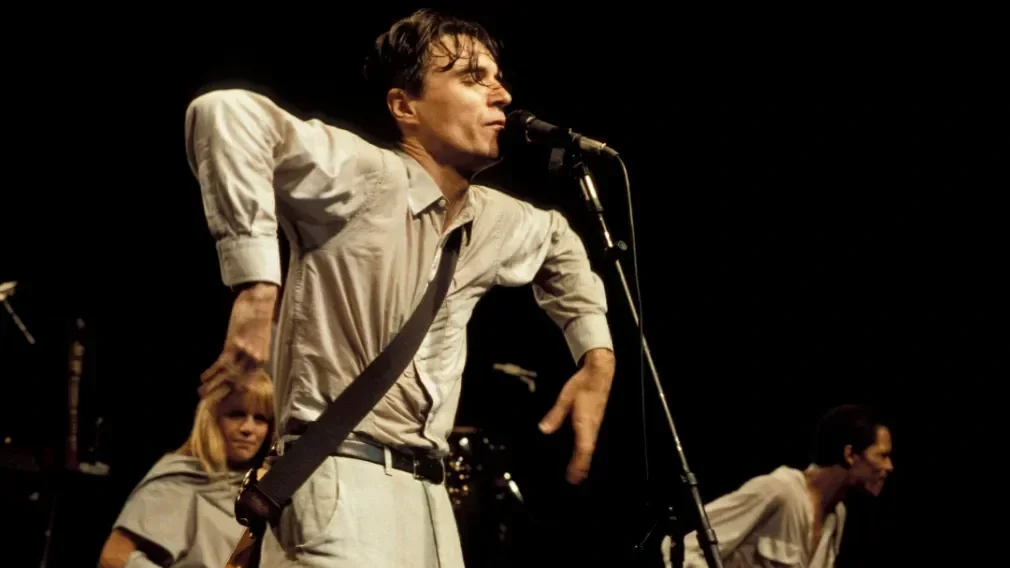
Finally, the band reaches “Crosseyed and Painless,” bringing the performance to a head. It is comparatively sparse sounding to the rest of the show but highlights another integral element of the way the film is so focused on this feeling of cooperative movement. Again, the camera first focuses on Byrne losing his mind before sweeping across the whole stage and then alternating images of the band members and a pivot between Weir and Byrne feeding off each other’s energy. This is perhaps the most energetic moment in the film as the camera next begins showcasing the whole band again, but this time from one camera in a continuous, spinning stream instead of hard cuts. Every member is on display and looking at the other members, giving the feeling of a constant transfer of energy and movement around the stage. Movement, obscured for the entire performance, is now monumentally flooded onto the viewer and we even get our first clear shots of the audience now fully on their feet and pulling energy off the stage. And as quickly as movement reappears, the film ends and it’s over, the shared bodily experiment gone.
An intentional overwhelming of the senses, Stop Making Sense is one of the few concert films to convey the true experience of live music. It begins with a thesis of obfuscation and deliberately gives the viewer a sparse visual experience so they can focus on the music and band. It is through this obfuscation that the film creates its sense of shared movement. Because the images it presents are constantly shifting, you barely have time to take them in before they’re gone, so it feels like almost nothing is happening and yet everything is happening all at once and you’re connected to everything and everyone around you. The hidden cascade of background movement from the crew simultaneously drives the film as it builds energy and momentum andalternately hides and exposes movement from the band. The lighting and shadow play provide simple yet stark images of the band that melt them into an amalgamation of twisting bodies, mouths, and instruments before unleashing a final torrent of unobstructed movement and sound, and the result is a film that truly earns its title as the greatest concert film ever created.
If you enjoyed this article, please consider becoming a patron of Hyperreal Film Journal for as low as $3 a month!
Aaryn Stafford is a proofreader for the state legislature and aspiring writer and publisher. He enjoys all genres but particularly enjoys horror, anxiety inducing thrillers (think Dog Day Afternoon), and sports documentaries. Aaryn lives in south Austin with his two cats, Mabel and Biscuit.