
Alpha Review
Sometimes great filmmakers reach beyond their grasp, and, sadly, that is the case with Alpha, the new film from French horror auteur Julia Ducournau. With Raw and then Titane, which won the Palm d’Or at the 2021 Cannes Film Festival (the second female filmmaker to do so) Ducournau announced herself as a mega talent. Both were transgressive, confrontational movies with a real undercurrent of emotion. I recall walking out of Titane as if being struck by a lightning bolt, body and mind being energized with the sight of a fantastic vision. In that sense, Ducournau is a pop filmmaker. She doesn’t surrender to the trend of realism. Her films are vivid and exciting, and you’re disturbed and elated. The act of watching Alpha is better described as deflating and tedious, a filmmaker doing some impressive moves, but ultimately stumblingly to the finish line.
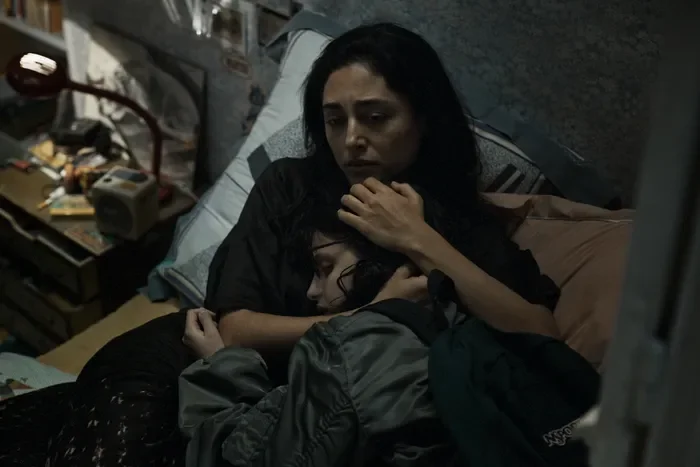
Alpha is a plague movie in an undetermined time period, most likely the 1980s/90s, and a blood borne disease named the Red Wind is spreading. When infected, one coughs up dust and slowly becomes marble, the end result resembling a human statue, the film's most arresting image. The titular 13 year old character, Alpha (Mélissa Boros), gets the letter A tattooed on her shoulder while unconscious at a party, making her fear that the disease has been transferred to her via a dirty needle. This frightens her doctor mother, played by Golshifteh Farahani, who specializes in the disease, and all of this is made more emotionally complex when Alpha’s heroin addict uncle Amin (Tahar Rahim) comes to stay and sober up.
It’s obvious that Ducournau’s ambitions don’t fall into making another horror movie. Alpha is by far her least grisly work to date, with heavy emphasis on sketching out the inner lives of her characters, accompanied by what can be described as a lax pace. In theory, none of this is a problem. Her style is malleable enough to fit into a plethora of genres, including drama, however, the type of drama Ducournau has chosen to make is far more grounded, and frankly, she is not good at that.
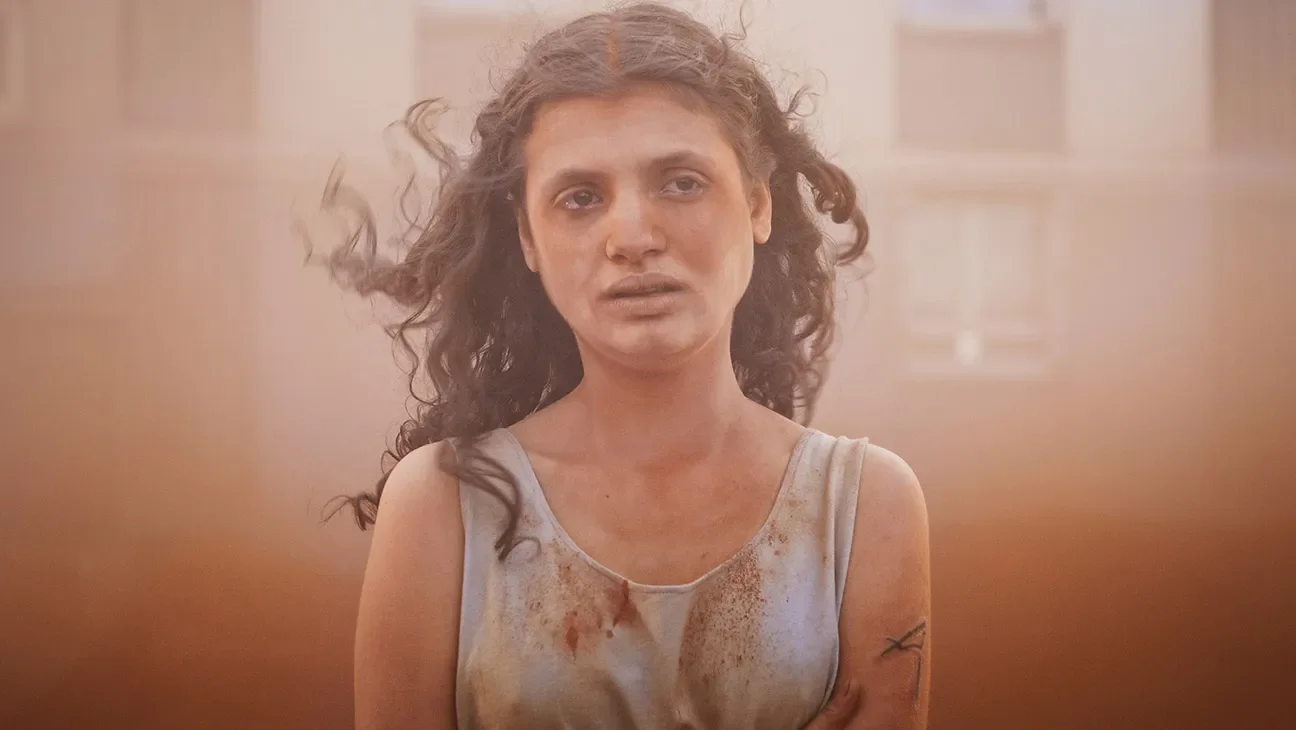
Alpha is a fine protagonist and, like the audience, she is attempting to understand the world around her. Boros physically fits the role of a child on the verge of adulthood with her nearly oversized circular glasses, and I like the scenes of Alpha dealing with bullying from her peers, as her illness effectively turns her into a pariah. It fits well into the theme of ostracization and the ways disease (a la AIDS) creates a new kind of social status. But, by the second hour, Alpha as a character is majorly sidelined and fully becomes just a POV. In fairness, none of this has to do with Boros as a performer; the whole cast is uniformly solid, especially Rahim. He reportedly lost 40 pounds for the role of Amin and carries an effective presence, starting out as an object of fear and becoming one of sympathy. The core of the issue resides in Ducournau’s structure.
The film deploys a flashback structure to show the initial outbreak of Red Wind. The present has an overtly cold, blushish tint; uniquely conveying a feeling of sickness, without relying on the usual technique of extreme greens. The color pallet matches that of the illness itself. On the other end, the flashbacks resemble more of Ducournau’s previous work, with strong use of yellow. This section of the film is easily the best with Ducournau showing the desperation of the outbreak through the eyes of Alpha’s mother. The scene of all the ill standing outside the hospital waiting to be let in is properly haunting. It makes you wish this was the movie. The structure creates a great disconnect between the two timelines, as the film makes you wait too long to arrive at the connection, and once that connection is revealed, it plays like an airless balloon.
Ducournau desperately wants it to be the emotional crescendo in an otherwise grounded work, but it simply doesn’t work. She introduces an element of magical realism that was not present before, causing you to look back at the previous two hours and wonder how much of the film was an objective depiction of reality; it wants you to ask, “what was a memory?” Except, it doesn’t play that way. Instead, it comes across as a “twist” and as a twist, it makes one ask “is that really it?” While not the exact same, Docournau pulls a similar move in her film Raw, where the ending recontextualises the narrative, but the key is that what we learn doesn’t negate anything. The ending of Alpha does, a case of magical realism backfiring.
If I’m being generous, Ducournau wants to make her The Spirit of the Beehive, the 1973 Spanish masterpiece by Víctor Erice, about a young girl living in a small village who also happens to believe in Frankenstein’s monster. Both films are narratives about observing life in specific circumstances and the ways it affects the character, with the case of Erice’s film being Franco Spain. Through cinematography and mood, Beehive accomplishes a wonderful sense of place, combining realism and light fantasy. It’s filled with wonderful images. Ducournau never successfully establishes a world or a tangible mood, outside of vague sadness and prejudice.
At best, Alpha is an uncurated collection of ideas and metaphors. It’s far from unwatchable and a couple of moments hint at a far better film, but only a day has passed from watching the film, and I already have trouble recalling most of it.
If you enjoyed this article, please consider becoming a patron of Hyperreal Film Journal for as low as $3 a month!
Hayden Claborn is a film writer based in Austin, TX. He began writing about cinema in high school and was the film critic for his college newspaper. He loves a variety of genres, but his main area of interest is horror films and can talk your ear off about the greatness of Judy Garland. Depending on what day you ask, he’d say his favorite movie is either The Exorcist or The Apartment, with his favorite filmmakers being James Cameron and David Lynch. He goes by He/They pronouns.