
One Desert After Another: Revolution and the American desert in One Battle After Another and Zabriskie Point
The ending of Michelangelo Antonioni’s Zabriskie Point is possibly the most direct expression of revolution ever committed to film. In it, we see the spontaneous explosion of a modernist house in the Arizona desert, repeated multiple times from various angles, each cut moving us closer and closer to the blast. Consumer items combust, hurtling towards us in slow motion: appliances, clothes, food and books breaking into fragments before our eyes. Name brands like Kelloggs and Wonder Bread hang suspended in mid-air. A rotisserie chicken tumbles through the frame. An unfolding of shapes and colors over a dizzying Pink Floyd score. It is a sequence that should be felt, experienced, rather than explained - pure cinema. Suddenly, the explosions stop; we cut back to our lead, Daria Halprin’s face. The hillside house is still standing. All of this has happened only in her mind, a brief retaliatory fantasy against the powerful men gathered inside. Resigned, she gets back in her car and drives off into the burning sunset.
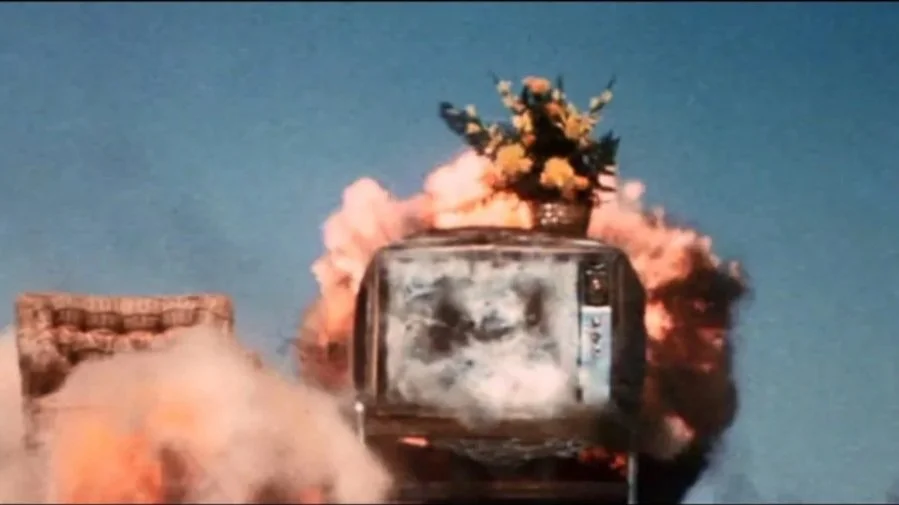
Fifty-five years later, the question remains: is it possible to authentically portray such a revolution on film? One Battle After Another begins with those explosions that Daria fantasized about at the end of Antonioni’s film. Whereas Zabriskie Point opened with a meeting of activist students arguing about racial solidarity, One Battle shows us a multiracial coalition of revolutionaries, named the French 75, welcoming a white explosives expert, Bob, into their fold as they enact a daring assault on a detention center. Does Bob ever truly become one of them? The arguments around both films are noticeably similar: do the films fully embrace the politics they portray? How radical can big-budget films released by major studios ever really be? It should be noted that Zabriskie Point was made by MGM for a then-unheard-of seven million dollars; One Battle After Another was financed by Warner Brothers to the tune of one-hundred and fifty million.
Both films stare directly at their burning political moments. They both deal with the aftermath of a violent act of revolution and unfold as a pursuit across the state of California. Similarly, both films have an almost too-easy villain: In Zabriskie, it’s a sinister land development conglomerate, Sunny Dunes Estates, promising to bring golf courses and swimming pools to the harsh American desert. In One Battle, it’s the brilliantly named “Christmas Adventurers,” a white supremacist cult seeking to eliminate “lunatics, haters and punk trash.” Both conspiracies are intended to elicit laughter.
To be clear, while they have many things in common, these films could not be more different. Zabriskie Point is esoteric and slow moving, even by Antonioni’s standards. Its leads, chosen for their look as representatives of the new youth culture, are stoic and humorless. One Battle, on the contrary, is a kinetic, bracingly funny movie enhanced by the raw humanity of its ensemble cast. What really unites the films is their use of similar visual strategies to underscore their political commentary.

Crucially, both films choose to end in very specific desert landscapes. Zabriskie Point, located in Death Valley, is the lowest region in the continental United States, and its pale sand and soft ridges are meant to evoke the forms of the lovers who participate in the film’s “orgy” scene, Antonioni’s lowest point. One Battle’s exhilarating car chase takes place in Borrego Springs on a stretch of Highway 78 known as the “River of Hills,” in which pursuer and pursuant are obscured from one another’s view.
But perhaps there are deeper reasons for two films about revolution to end in the American desert. Like Bad Day at Black Rock or Thelma And Louise before them, the answer may be in how our characters get there: Daria, en route to her boss’s (Rod Taylor) hillside house, is driving a conspicuously dated 1952 Buick. Along the way, she stops at a desolate roadside saloon to ask directions. Inside, its crusty patrons lament the end of the American West. “Tennessee Waltz” plays on the jukebox. A place stuck in time. Later, back on the road, she signals to our somewhat hero played by Mark Frechette, flying overhead in a stolen plane, by pulling over and writing in the sand with her cupped palms.

In One Battle, Bob races to intercept his daughter, Willa, at the designated rendezvous point in a battered 1991 Nissan Sentra. Along the way, he stops at an intersection and asks directions from migrant workers running a fruit stand, attempting Spanish. Arriving just after the climactic shootout, he tries to locate her with an obsolete tracking device, pitifully holding it in the air, again struggling to make contact. At every bend in the road, he’s a few steps behind - in a film that is constantly measuring time, even in its ticking, clock-like score. It is also, memorably, the security question that Bob can’t answer over the payphone: “What time is it?” The desert, in both films, functions symbolically as a place where this time no longer exists. The clunky cars that the characters drive, relics of human time, draw attention to the futility of modern endeavor.
Even the mission where Willa takes refuge, like the saloon in Zabriskie Point, seems stubbornly stuck in the past, oriented towards the purity of another human century. Communication -technology itself - is strained, and in the case of Zabriskie Point, returned to pre-historic methods. The desert is presented to us as a place beyond politics or laws, where the conflicts of the first acts of the films are reduced to their barest elements. In his novel Point Omega, Don DeLillo articulates the mystic quality often ascribed to this terrain: “The desert was clairvoyant, the landscape unravels and reveals, it knows past and future.”
Visually, the American desert is the inverse of the crowded, industrial settings that occupy the first act of both films. In Zabriskie Point, the edifices of the man-made world dominate most of its compositions, bombarding us with billboards and retail signage.

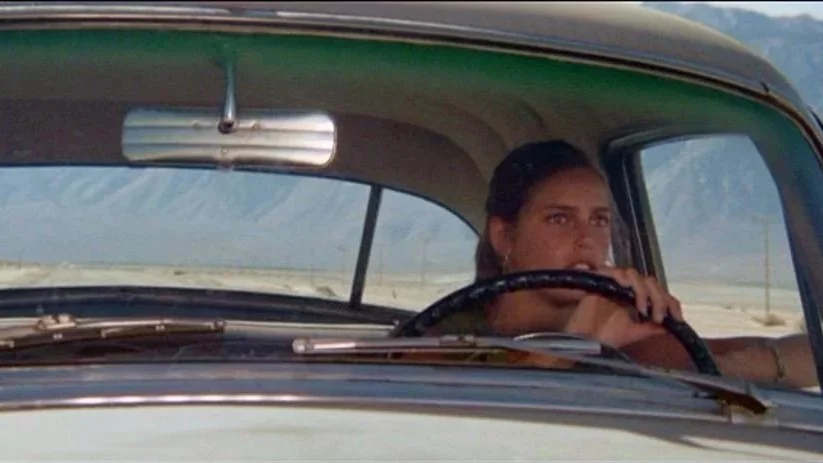
Advertising is omnipresent. Murals, suggesting nature, dwarf the human figures in the frame. Alternately, One Battle’s first act takes place in a corporatized, concrete cityscape that’s completely scrubbed of color. The only signage visible is that of banks. In both films, the natural world is often seen in reflection, framed and divided by the windows of a sleek, sexless interior.
In his examination of the American desert, Jean Baudrillard writes, “If humanity’s language, technology, and buildings are an extension of its constructive faculties, the desert alone is an extension of its capacity for absence, the ideal schema of humanity’s disappearance.” In both films, the deeper conflict is expressed through these warring landscapes, the constructed and the untouched, the material and the physical. One Battle establishes this warzone in its opening shot, showing Teyana Taylor crossing an overpass overlooking a detention center. The frame is split evenly between the asphalt and the desert sand below. Tellingly, her compensation for “naming names” will land her on a similar frontline: a suburban tract house on the desert-edge of an unfinished development. A cinderblock wall hinders her view of the mountain range in the distance. Zabriskie Point culminates in the complete obliteration of these barriers while One Battle instead resolves in the triumphant reunion of a father and a daughter, dust-covered human forms against the backdrop of a vast absence.
As both endings suggest, the battle is never won, though One Battle’s emphatic closing shot is more optimistic than Zabriskie’s. At the end of Zabriskie Point, Daria drives off into the sunset to the sound of Roy Orbison’s wistful ballad, “So Young,” a song about the timelessness of place. In One Battle, Willa buckles herself in resolutely to Tom Petty’s anthemic “American Girl.” Time slows down remarkably at both climaxes, only to resume pace shortly after. Past the setting sun, the future strides towards us, bloodied, undispatched. History does not end; it is the ceaseless present.
NOTE: One Battle After Another and Zabriskie Point are currently streaming on HBO Max.
If you enjoyed this article, please consider becoming a patron of Hyperreal Film Journal for as low as $3 a month!
Graham is an Austin-based videographer and film-goer. On his Substack, Mad Carlotta, he suggests double features, pairing classics and contemporary releases with lesser-known but thematically-similar films.