
AFF ‘26: Bassam Tariq on Your Mother Your Mother Your Mother
“I’m just here to get milk for my baby.” So says Mahershala Ali’s Latif, the protagonist of Your Mother Your Mother Your Mother, who, after the sudden passing of his wife, sets off on a winding quest across Houston to provide for his family. He’s a Muslim and a hitman, two identities that shape his journey and run-ins with a cast of characters ranging from his imam (Giancarlo Esposito); Hatty (Abubakr Ali), the spoiled son of his gangster boss, who runs a halal porn site; and Christian cult leader Hwan Yoon (John Cho).
Writer-director Bassam Tariq, who met Ali on the set of the planned Blade reboot before both departed the project, threads the needle between an intricate family drama and gritty thriller. Ahead of this year’s Austin Film Festival, we sat down with Tariq to explore his artistic process, cinematic influences, and advice for emerging filmmakers.
You have such a complex mix of genres and themes at work in Your Mother Your Mother Your Mother that still create a very coherent storyline. What in that mix came first as you were writing?
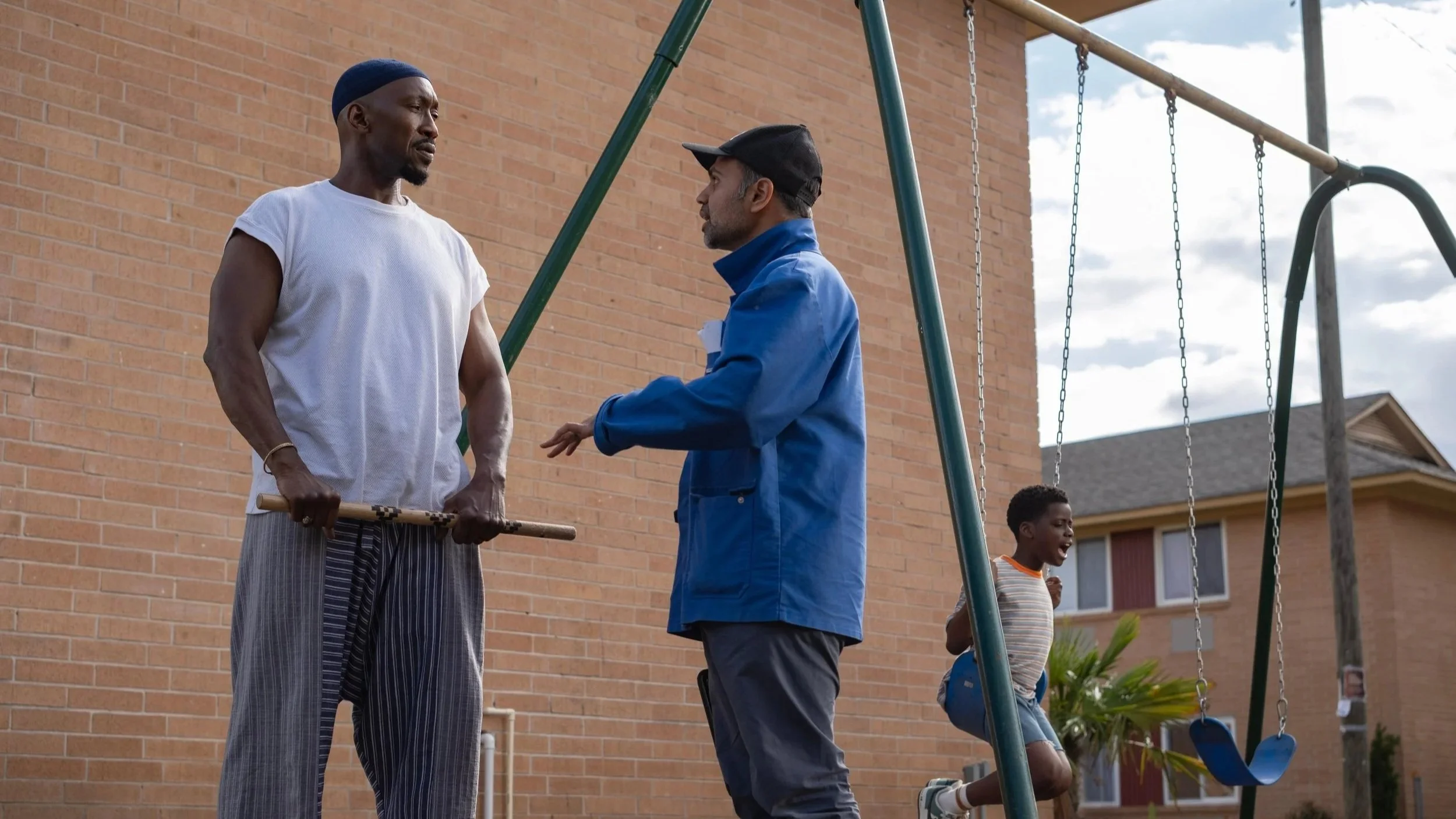
(L to R) Actor Mahershala Ali, director Bassam Tariq and actor Jahleel Kamara on the set of YOUR MOTHER YOUR MOTHER YOUR MOTHER, from Amazon MGM Studios.
I think I always knew that breast milk was going to play an important role, and the mother was going to be out of the picture, and it was the father trying to fill these shoes that he can't fill. But it took me a minute to realize that it's actually a story about him and his daughter. When I nailed that part of it, then I tried to look at each scene to understand, “Where is their relationship in this moment in the movie?” The first person that he speaks to is his daughter, and then the first person we see after him is his daughter. So we wanted to make sure of that connection, because if we can nail that relationship, then whether we go to space or make it a sci-fi, we'll go along with it. Because if we care about that relationship, then everything is fair game.
Did the storyline evolve when you got on set with the cast and started to see it come to life?
Yeah, I think a lot changes once you see the actors embody the roles. I think knowing how Mahershala was going to play it, just knowing a bit about him, I was not so surprised with that. I was surprised with the gravity that Adia brought playing Fatiha, and how she was really the soul of the film. She breathed life into this thing, because in a way [Latif’s] kind of manic, and he's looking for breast milk in all the wrong places, so we need somebody that we can anchor to in the film. Like, “OK, this guy's wild, I like him and I'm with him, but who here is a little bit normal?” So [Fatiha] becomes our eyes and ears in a way, and the way she's responding to things is also how maybe we would respond as viewers.
She is incredible on screen. It seems impossible to go toe-to-toe with Mahershala Ali, but she does in every scene. What was it like working with the cast overall?Whenever I'm meeting a possible person to work with, I've realized that they all have to bring a curiosity. They can't be like, “This is how I'm gonna play it, this is what I do, and I'm really good at that.” I didn't want any of that.
Even Giancarlo Esposito, who's probably the most seasoned in our cast, was like, "Yeah, I'm really curious about how we do this, or how we do that." We're having conversations, and we're gonna seek truth together. I think every single one of my actors was coming with that curiosity.
With John Cho, I wasn't like, “You're going to have grills” and this and that. There was a very different imagination I had. But then we sat together and we started to build out how Pastor Hwan would move. So then that's what it is: How do we find that way of both being curious and not just putting our foot down to be like, “This is the way it's got to be.” I think we figure out what the parameters of character are, and where we want to go with it, and then all those interesting embellishments, that's got to be them being able to feel empowered, to really make them fly.
I know the casting process began with Mahershala Ali, but how did it expand beyond that first role?
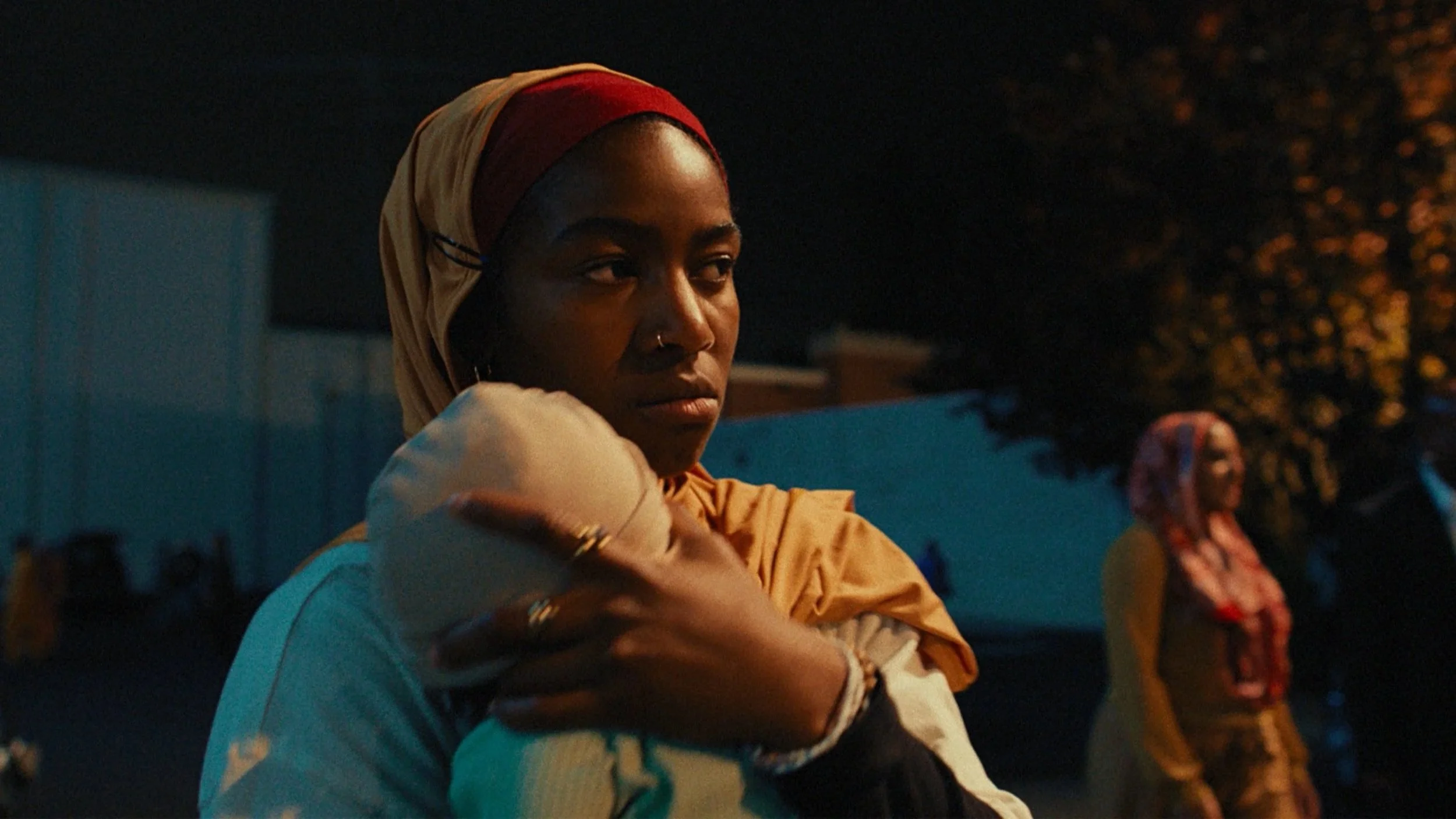
The first and most important person to cast in this movie when we were greenlit was the daughter, because we knew that it was going to be a discovery. I wanted someone that we would be surprised by, that we didn't think of, and Adia really came through very quickly. It was a miracle. There's no other way to put it. I remember when I first met her, I met her on Zoom, and I was like, “Oh, she's amazing.” But then I'm like, she's probably 6’7”, there’s something about the way she's carrying herself. She's like, “No, I'm 5’2”.” And I didn't believe her, so I flew out to D.C. to go meet her in person. And I saw her, and I was just like, oh, she is it. She's going to be the person that's going to take us to the next level in this film.
But also a massive shout out to Susan Shopmaker, who is our casting director, who walked me through this process. Steven Soderbergh, one of my favorite filmmakers, said that the fatal flaw in a film—as a director, you're casting all the roles, you're casting your costume designer, who's going to do makeup, you're casting all that. You can go wrong in those few places, but if you go wrong in casting your actor, he said that’s a fatal flaw, you can't save that thenBut I think we were really blessed in creating a safe space for everyone to explore and experiment and make mistakes. Particularly me, I was making tons of mistakes every day on set, and they were all really forgiving and compassionate towards me.
What do you think is the biggest lesson you learned while on set with this film?
Learning to surrender and listen to how things are moving and how one must lead, because you can't lead the same way with every project. And for this project, I would say compassion and grace were so necessary at every turn. I've been learning about the power of compassion and kindness, even in moments when I don't want to show it, where it's like, “Go meditate, go center yourself, because you can't freak out on set.” It’s okay if other people do, that's fine. But the one thing I control is myself, so I have to make sure that at those moments I'm still centered. That was probably one of the most challenging and exciting parts of the process.
Do you have someone who modeled that kind of leadership for you in your career?
I would say that my biggest teacher in this whole thing was my first co-director, Omar Malik. We made this documentary called These Birds Walk, which is still, I think, one of the things I'm the most proudest of. It's about runaway kids in Pakistan, and I remember when we got back from Pakistan from our first trip, we didn't finish the movie, and we ran out of all the money, and we had to come back to New York, and we were almost kidnapped—it was just like a real difficult trip. We were at JFK airport, and we're parting ways, and he holds my arm, and he goes, "We're good, right?" I'm like, “Yeah, yeah, we're good.” He goes, “No, no, look at me. Tell me we're good, because I'll burn all our hard drives if you and I are not good. Because this is what matters the most to me.” And that to me has become—I pray that it stays the foundation of what I want filmmaking to be about. It's about relationships. These things are going to get made, andwe don't control how it'll be accepted by the world. I think everyone wills into the world a film that's going to be well-regarded and well-reviewed, but that doesn't happen to all films, and the filmmaker doesn't control that. But I do control how I am to you, and how I am to my team, and all that, and how I'm attentive to people.
I know you grew up partly in Houston, and even though you didn’t shoot there, you really captured the spirit and the energy of the city. Was there anything you set out intentionally to convey about Houston?
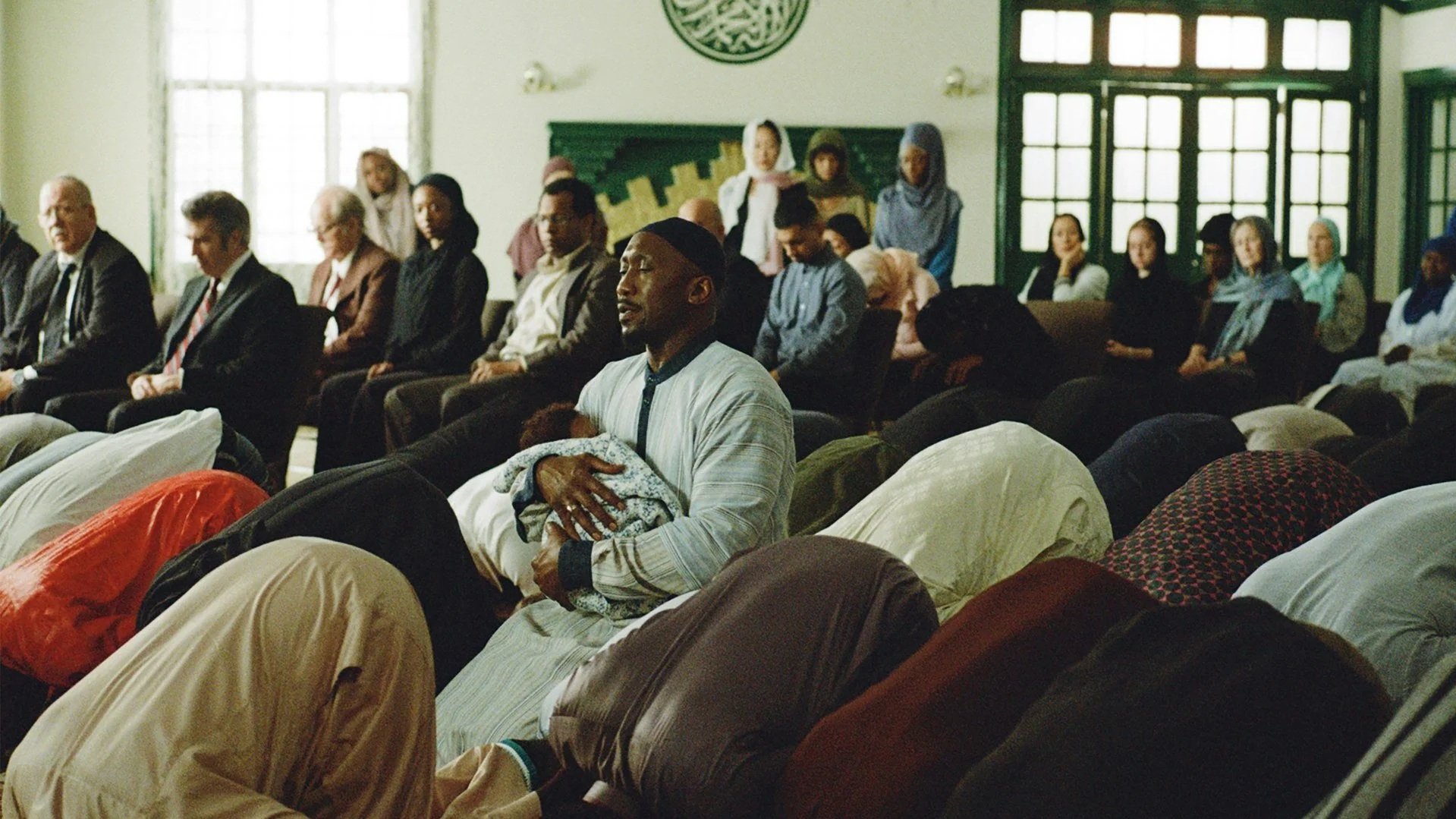
I think it was the collision of different communities and religions that are constantly happening there. And because of the lack of social services, the churches and the mosques fill those spaces so people identify a lot or are affiliated a lot with their local mosque or local churches. That can create a very self-righteous community, but it can also create these really amazing moments of dialogues that happen. So I wanted to figure out a way to do that, maybe in perhaps a more heightened way.
The other thing about Houston is there's no zoning laws. I remember going to a prayer circle in a strip mall, and in that same strip mall we'd have a topless bar at the end called Babes. It's like, what's going on? But that's how it was and it still is that way. I think there's something very wild west about Houston that is exciting to me, and really diverse.
One of the things that struck me is you have these big ideas of faith and fatherhood and religion and family, but they never feel didactic. And I was curious how you balanced that, because so often I see filmmakers now spoon-feeding the audience what they want them to take away from the film.
I really dislike that, and I think that's a problem that I have with a lot of documentaries sometimes, where it becomes an issue-based documentary, which is fine, they're important. But for me, it's like, “I know the issue. I'll just go read the New Yorker piece on it.” And I think that'shappening a lot more. I've also seen a very cynical side to filmmaking, and I think I'm personally at a place where I don't think I need that cynical stuff. I do believe that what we put out into the world is then what we manifest. So it's like, because we've made such cynical stuff, I wonder if that's why we're in such cynical times. And I want to believe in a better way.
I have a very complicated relationship with faith. I want to explore my own feelings of how faith can be weaponized to gaslight people, to abuse women, to start wars. But at the same time, I've seen faith as a way to create community, to create meaning, and there's nothing like faith that allows for grace, which is forgiving somebody when they don't deserve it, because you believe in something unseen to be able to forgive somebody or see the light in them that they don't see in themselves. That requires some woo-woo kind of thing, you know.
But how do you go about it without being didactic? I would say it requires a lot of screen testing, in a very practical sense. I did over 30 screenings with friends and with audiences that didn't know who I was. That was really important to just get a sense of like, is this getting too weird and woo-woo, or does it actually work? And finding that balance was the hardest part.
Were there any films or filmmakers that you kind of drew influence from when you were making this?
[Masaki] Kobayashi made this film called Harakiri, it's an incredible samurai movie that deals with the the idea of of harakiri, the suicide that you do as a samurai, and it challenges a lot of ideas of what a samurai is, and it's very existential, and it's also like a revenge movie. I really loved that film and the way it was shot, and I think the choreography for the final battle is incredible. It's phenomenal. Another film that we looked at a lot was Jim Jarmusch's Ghost Dog: The Way of the Samurai. To me, we're kind of like a spiritual successor of that film. There’s particularly one scene in the beginning where Latif is doing his little sword-wielding practice in the playground. That to me was our version of Forest Whitaker on the roof with his pigeons, wielding a sword.
Many of our audience are emerging and new filmmakers. What advice you would give them from where you are now?
Be open to all the things that are around you. I think everyone is your teacher, and I think when you start seeing the world like that, and you're not just trying to get to a result of “I need to make a film by a certain age because I'm like 22 right now, and by the time I'm 25, I need to have this whole body of work” and blah blah blah. Have that as a benchmark, because I think it's important to have benchmarks. But also be really curious. Stay curious and see how everyone is around you to teach you something.
Can you talk a little bit about what you have next or what you're excited to do next?
Right now I'm trying to figure out what balance looks like. I have young children. I have a wife. I'm trying to figure out how to balance all the parts of me that are me, and giving to others as well as myself, and how do I feed myself as a worker? Because I'm a worker and I like to work, and this is also a form of work. So how do I make sure this is also enriching for me? And it just doesn't feel like oh, I gotta be out there for the film. So I think that's the part, the balance that I'm trying to understand right now. And I think in the balance, I think that will create something for me. So I think what I'll say is, discipline is something that I'm trying to find more now in my life.
This interview has been lightly condensed and edited for clarity.
If you enjoyed this article, please consider becoming a patron of Hyperreal Film Journal for as low as $3 a month!
Alix is the editor-in-chief for Hyperreal Film Journal. You can find her on Letterboxd and IG at @alixfm.