
Snake of June: On Rain, and Getting Wet
Snake of June is an erotic thriller that stars Rinko, played by Asuka Kurosawa, as a despondent woman stuck in a sexless marriage and hoping to rekindle a passion that she lost.
Her well-meaning but oft-distracted husband, Shigehiko, is played by Yuji Kohtari. Both of their lives get turned upside down when a stalker/spy begins blackmailing Rinko with candid, revealing photos that were secretly taken of her: Michiro Iguchi, played by the director himself, Shinya Tsukamoto (also director of Tetsuo: The Iron Man).
But I would argue that there is a 4th main character in this movie, a character that is potentially the most important, and that is rain.
Rain acts almost like a mythological force in this movie, a true force of nature. There’s never a break– it covers every scene in the movie in a wet and slippery sheen. It’s probably the most aggressive rain I’ve ever seen in a movie as well. Thick thumping torrents that plink and plunk off of every surface creating a suffocating soundscape. It drowns out dialogue, it drowns out the rest of the sound design, it often IS the sound design. The drumming, beating relentlessness. The rain never stops.
So much of the movie is characters doing everything they can to avoid rain, and doing it poorly. Umbrellas are a staple of the movie’s environment, and every character is bundled up in enough layers to survive an avalanche. At one point, one of the characters closes their window blinds and the rain-sounds outside stop completely, a thematic representation of the character “shutting out” the rain and not wanting to hear it anymore. Avoiding it, not wanting to face the downpour. Still, the rain never stops.
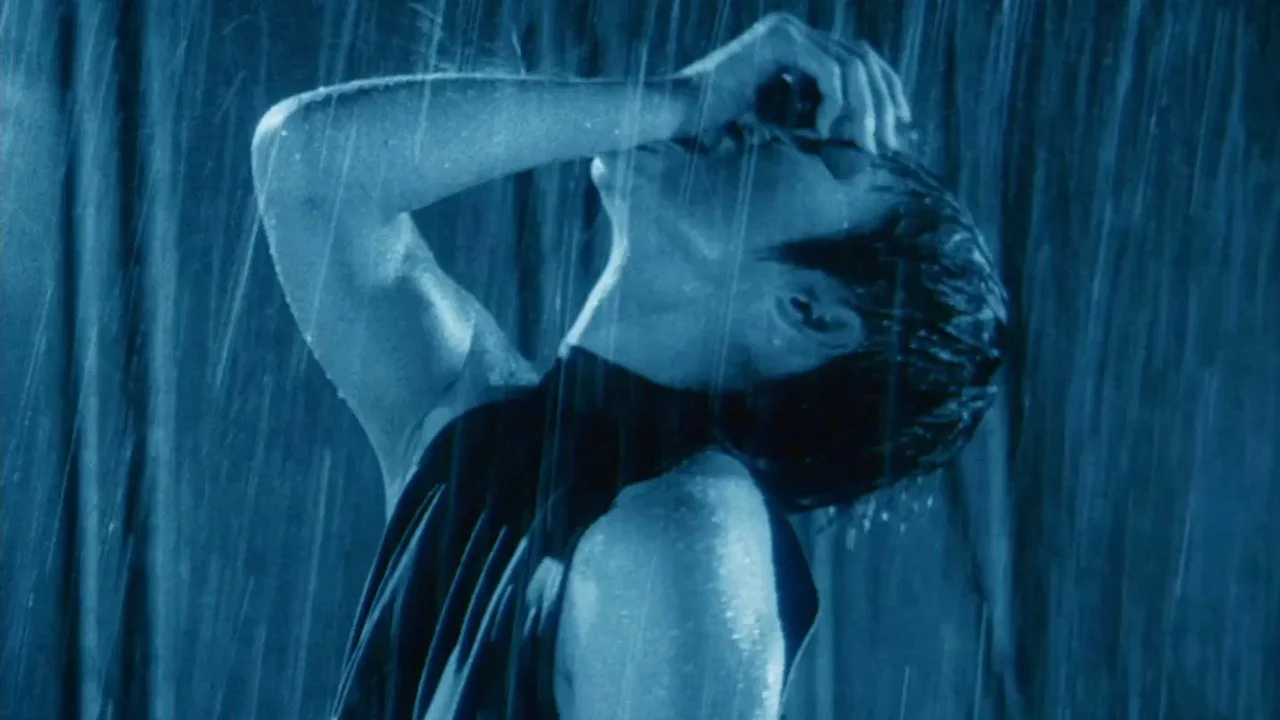
During the first half of the movie, Michiro forces Rinko to partake in these sexually degrading public humiliation rituals. These scenes are often uncomfortable and hard to watch, as Rinko stumbles and struggles through them. Near the end of the movie however, she repeats these same rituals with all the sexiness and confidence that consent enables. She struts and side-eyes her way down the street that once acted as a symbol of humiliation. And in the best scene of the movie, walks into an alleyway (husband and Michiro in tow), throws her umbrella to the side, strips naked and she… gets wet. Oh, and she allows the rain to finally cover her as well. Rinko reaches out and forcefully takes back the independence that she was craving, physically and sexually. Through all of this, the rain never stops.
All of us are dealing with some sort of storm in our life. A thundering and maddening chorus that feels larger than life, larger than what we’re able to deal with. A force of nature. We can bundle up and take our umbrellas with us and do everything we can to avoid our problems, but that’s just kicking the can down the road. The rain won’t stop. We don’t have to accept the thing that causes us to lay awake at night but we can’t avoid it either. Like Rinko, we must live with confidence despite the rain that drenches us. Through her, director Tsukamoto teaches us a simple message: It’s OK to get wet.
If you enjoyed this article, please consider becoming a patron of Hyperreal Film Journal for as low as $3 a month!
My name is Matthew. I'm a recent transplant to Austin TX, but a lifelong movie lover. Horror enthusiast! I love talking about and (over)analyzing movies. AggroSup on Letterboxd. I'm always at a Drafthouse or AFS so say hello if you see me!