
Sundance '26: Ha-Chan, Shake Your Booty!
Grief is a powerful, oftentimes suffocating thing. When we lose someone, it can become a block of darkness that threatens to blot out the light of the life we knew before. Trying to get back to that light can be a messy process. For Haru (Rinko Kikuchi), this is especially true. In Sundance indie Ha-chan, Shake Your Booty! we watch as one woman tries to find her way back to herself through the deep and uncertain waters of grief.
Haru and Luis (Alejandro Edda) complement each other perfectly in their marriage and on the dancefloors they compete in. The pair live an idyllic life in their Tokyo home, adorned with great movie posters and beautifully crafted decor. In between sharing meals and watching their dog, they compete in ballroom dance competitions. Luis steadies Haru’s anxieties about performing perfectly, offering a warm foundation for her to fall back on. Their chemistry is evident, especially on the dancefloor, where every move feels both considered and natural -- a combination of choreography and pure feeling. Then, midway through one dance near the beginning of the film, Luis collapses and so does Haru’s world. With Luis gone, Haru must navigate what it means to be alone, and how to come back to dance without her partner.
Ha-chan has the great distinction of being an exploration of grief that doesn’t take itself too seriously. Haru’s loss is immense, of course, but there is plenty of surrealism and heartfelt silliness to keep things from being too maudlin. This is thanks to the great script from director Josef Kubota Wladyka and writer Nicholas Huynh, but also thanks to the assortment of excellent performances on display throughout the film. Rinko Kikuchi is incredible as Haru, embodying her wounded heart with straightforward vulnerability, but also her unhinged self-destruction in the face of grief, too. Kikuchi treats exchanges with a cute, chibi-style bird that enters her home and serves as a physical manifestation of her grief, seriously, using these conversations as a space for Haru to sit with her loss. When she starts seeing a dance instructor who’s in an open relationship and does questionable things in the name of jealousy, you can feel Haru’s rage and desperation for connection simmer off the screen. The supporting cast here is equally great. There is Hiromi (You) and Yuki (Yoh Yoshida), the supportive friends that add extra color and quirk to the film, either brightening up or annoying the grieving Haru, depending on the situation.
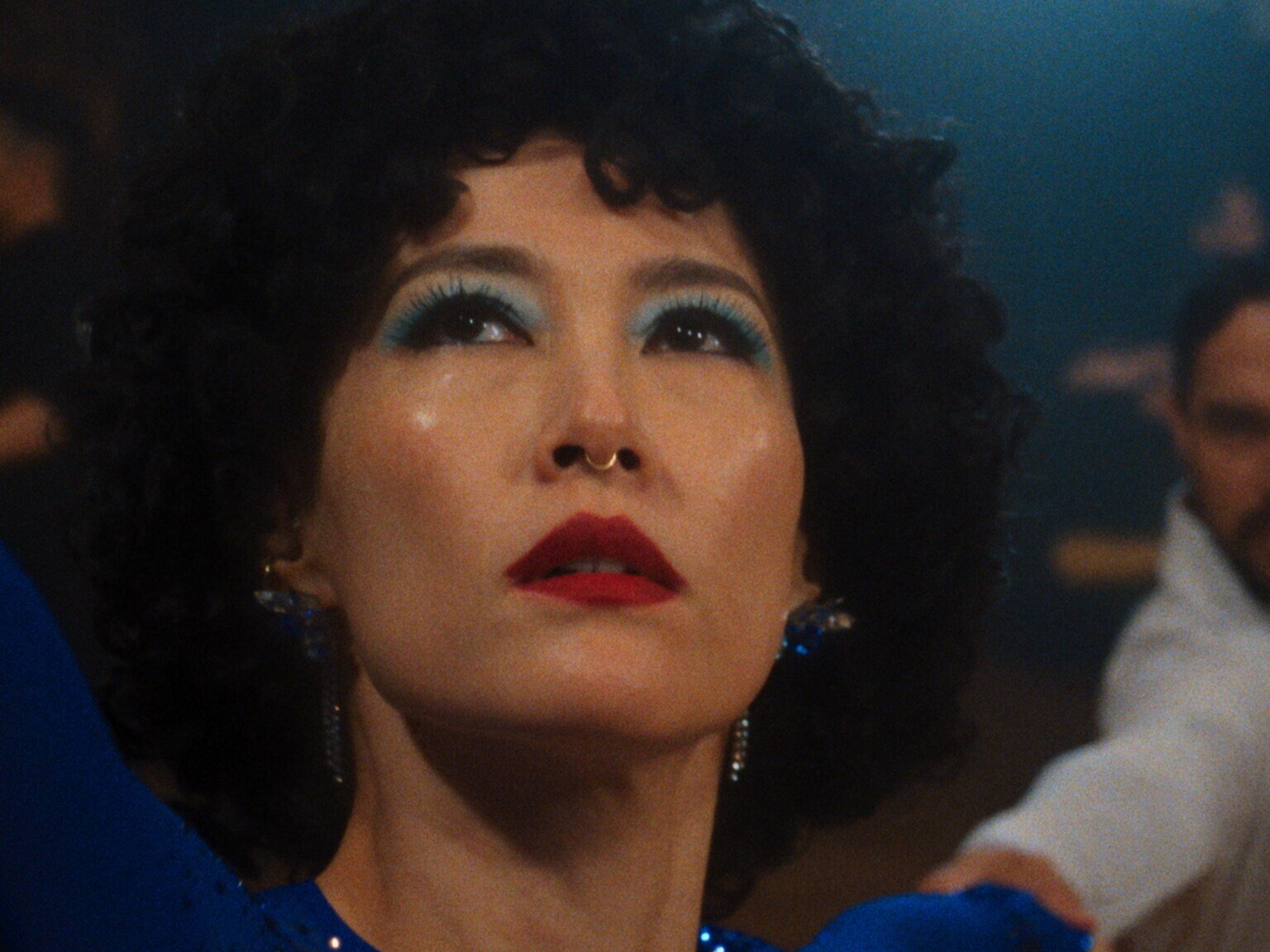
Another stand-out element of Ha-chan are the surreal dance sequences peppered throughout the film. An extension of Haru’s imagination, dance can break out with the outpouring of any kind of emotion, punctuating the film with a unique rhythm that keeps us firmly in Haru’s headspace. When her dance instructor/date for the evening, Fedir (Alberto Guerra), gets into a tussle with rude men on their way home, the film makes the battle royale a dance-off that’s more West Side Story than anything else. Haru imagines the men confronted by a gyrating crowd of people, herself and Fedir included, creating a whimsical moment that simultaneously lets us into Haru’s perspective even after she snaps back to reality.
Ha-chan faces a dilemma that every movie straddling the line between heartfelt emotion and quirky comedy must face: balancing it all out. However, the scale never tips too far in one direction, keeping everything from spiraling out into either sentimental drudgery or twee overload. Thankfully, the movie understands that the messiness of loss is no straightforward thing, and the more it leans into it, the better the film is. Take for instance, a sequence where an envious, forlorn Haru breaks into the apartment of her new dance instructor/lover. As Haru climbs her way up to the man’s apartment (that he shares with his wife), the movie briefly turns into a thriller -- will she realize how extreme her actions are before she gets caught? It’s both hilarious and hard to watch someone play out an impulse that can come up from the messiest parts of ourselves. Kikuchi plays it well, though, offering a vulnerability that makes Haru compelling to watch, even when she’s indulging in the worst parts of grief. Few films can capture the messiness inherent in grief, but Ha-chan Shake Your Booty! does a stellar job. With a remarkable cast and irreverent but heartfelt tone, the end result is a movie about how we can all triumph over the losses in our lives, no matter how fraught things get.
If you enjoyed this article, please consider becoming a patron of Hyperreal Film Journal for as low as $3 a month!
Alejandra Martinez is a Tejana archivist, writer, and film lover in Austin, TX. She loves coffee, David Lynch, and tweeting about everything under the sun.
Twitter: @mtzxale.