
Weird Wednesdays: Challenge of the Lady Ninja
This screening was part of the Alamo Drafthouse’s Weird Wednesday series. For upcoming shows, click here.
There is a moment early in Challenge of the Lady Ninja (1983) when you realize the movie has no intention of playing fair with you, with history, or with the basic laws of physics. Our heroine, Wu Siu-Wai (Elsa Yeung), is completing her final ninja exam in Japan when she deploys her signature technique. She twirls in place like Lynda Carter mid-transformation, her red ninja garb dissolves into something considerably less tactical, a skimpy pink bikini, and every armed man in a fifty-foot radius simultaneously forgets he has a job. They stare. They drool. They walk into traps. This is her primary combat ability. It’s not a sword or smoke bombs. Weaponized thirst.
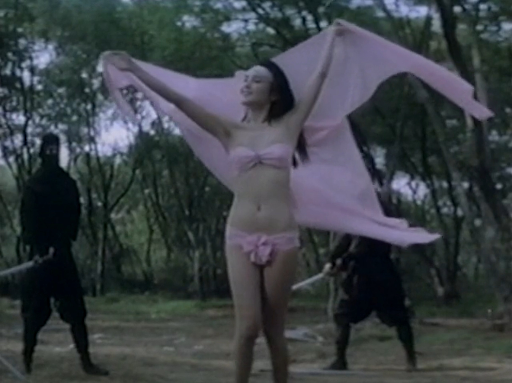
It’s like a strange mix between Wonder Woman and an adult Sailor Moon.
The movie could have been called Wonder Ninja. It could have been called Lady Ninja Fan Service. My personal pitch is Red Ninja Sprite: Obey Your Thirst, because the film treats male desire the way Sprite commercials treated dehydration: as a universal constant that overrides all reason, training, and survival instinct. Director Lee Tso-Nam, who I found out is a Taiwanese workhorse that gave us Exit the Dragon, Enter the Tiger and a pile of reliable low-budget kung fu, clearly decided that if the ninja boom demanded a lady ninja, he was going to give the people every single thing they could conceivably want, all at once, whether it made sense or not.
Here is the plot, thick enough to cut with a chainsaw yet still thin enough to make Kung Pow look reasonable. During the Japanese occupation of Shanghai, Siu-Wai becomes the first woman to graduate from a Japanese ninja academy, which raises immediate questions the movie never once considers. Why is a Chinese woman training with the occupiers? Unclear other than she’s done it for 17 years. She returns home to learn her father has been murdered, and the man responsible is her own fiancé, Lee Tung (Shaw Brothers legend Chen Kuan-Tai), now a collaborator doing wetwork for a Japanese general. When Lee Tung first appears onscreen, in a crisp white suit, the soundtrack plays the actual Imperial March from The Empire Strikes Back, copyright be damned. This is the level of subtlety we are working with.
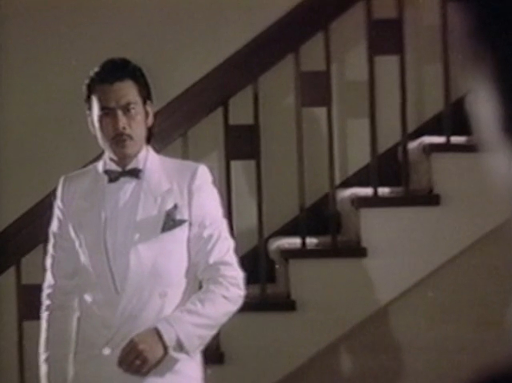
This is practically the outfit you see the villain in for the entire movie.
And about that villain. The English dub gives Lee Tung and his goons the vocal stylings of a 1930s Warner Brothers gangster picture. These men are supposed to be collaborators in occupied Shanghai, and they talk like Jimmy Cagney is about to tell you that you dirty rat, you killed his brother, Bugsy. Mid-Atlantic Mad Man was on my shortlist of alternate titles for this reason alone. It is impossible to take the geopolitical stakes seriously when the chief antagonist of the Sino-Japanese conflict sounds like he should be running numbers out of a Newark barbershop.
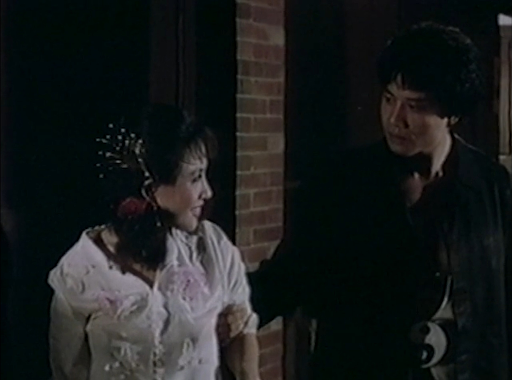
"Are you mad?" "Yeah, and I'm mad in bed too!" An actual exchange in this film.
The geopolitics deserve a closer look anyway, because this movie's politics are genuinely deranged. On paper it is a fiercely anti-Japanese revenge picture. Japan is the occupier, the Japanese general is flanked by an underling styled with distinctly vague Nazi energy, and our heroine's crusade is framed as patriotic resistance. But watch who actually does the betraying. The fiancé is Chinese. The traitors who emerge in the third act are Chinese. Practically every knife in Siu-Wai's back has a countryman's hand on it. For a film waving the anti-Japanese banner this hard, its functional thesis is that you cannot trust a single person in Shanghai (which is outright stated in the film), and the fact that Siu-Wai got her powers from the Japanese ninja academy in the first place just scrambles the message further. The movie wants to be a resistance anthem. It plays like a paranoia fable with pom-poms.
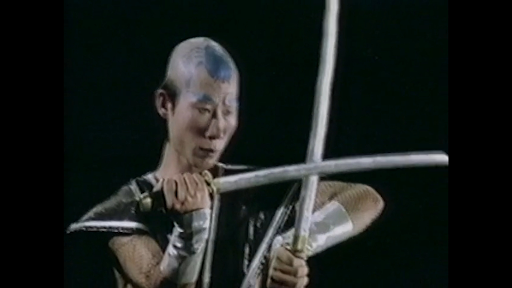
Trained at the Ringling Brothers School of Samurai Fighting
Siu-Wai's plan for revenge is to train three new lady ninjas: a circus acrobat, a kung fu fighter, and a sex worker. Her own training took seventeen years. Theirs takes a montage. From there, the film becomes a parade of henchman boss fights that would make a video game designer blush. There is a swordsman who throws spider webs made of rope. There is a whip guy. There is Robert Tai, future director of the legendary Ninja: The Final Duel, as a samurai with a giant blue bug tattooed on his shaved head. And there is a female Tae Kwon Do expert whose duel with Siu-Wai inexplicably relocates to a water-logged wrestling ring, where two barely dressed women grapple in slow, soapy circles while one of them keeps finding handholds in places that have nothing to do with judo. The bath house energy of this sequence is off the charts. It arrives from nowhere, serves no narrative purpose, and is unmistakably the reason the movie exists.
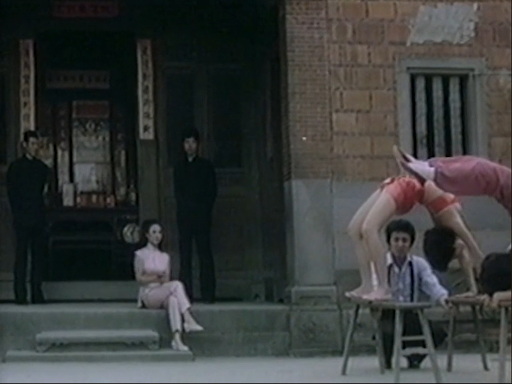
Official Chinese Resistance training in action during the movie
The final boss, and I promise I am not making this up, fights by burrowing underground and erupting beneath his opponents like a graboid from Tremors, seven years before Tremors. Siu-Wai counters by splitting into three copies of herself, a technique that anime fans will recognize because Naruto would build an entire franchise on this exact move two decades later. People fly on visible wires with the kind of floaty, gravity-optional grace that Crouching Tiger, Hidden Dragon would later render poetic and that this movie renders hilarious. Mystical objects zip through the air of their own accord. The editing cuts mid-motion, mid-sentence, sometimes seemingly mid-frame, so fights have the rhythm of a slideshow assembled during an earthquake. And underneath it all, the score veers from stolen John Williams to passages that sound like a fourth grader honking through a school recorder solo, confidently and defiantly out of tune, while the music teacher stares into the middle distance.
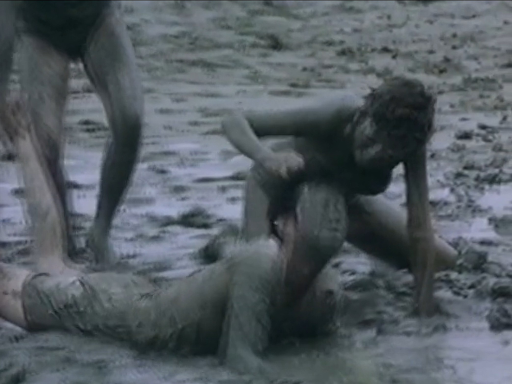
They worked hard, therefore they got to play hard.
Then there is the matter of time itself. The film is set during World War II. The film also contains 1970s Cadillacs, feathered disco hair, leather miniskirts, and interior decor straight out of a 1982 Sears catalog. Guns exist in the early scenes and then simply evaporate, because apparently everyone in wartime Shanghai collectively agreed that disputes would henceforth be settled via ancient martial arts and seduction magic. There is not one frame of period detail in the entire picture, and honestly, the commitment to not caring is almost admirable.
Because here is the thing: Challenge of the Lady Ninja is never boring. Not for one second. It is sleazy, incoherent, historically illiterate, and edited with a machete, but Lee Tso-Nam understood the assignment at some primal level. Every scene delivers something: a fight, a betrayal, a twirl, a bug-headed samurai, a human graboid. Elsa Yeung anchors it all with real charisma and enough legitimate screen fighting to make you wish the movie trusted her fists as much as it trusted her costume changes. The lady ninjas keep declaring that anything men can do, women can do better, and the movie keeps proving it by having women defeat men who are too busy ogling them to block. That is not feminism, exactly. But it is not not-feminism. It is whatever ideology exists at the exact intersection of empowerment and baby oil.
If you enjoyed this article, please consider becoming a patron of Hyperreal Film Journal for as low as $3 a month!
Jesse is a retired Navy veteran and Texas State Alumnus with a Degree in Digital Media Innovation and minor in Theater. In a past life he was a red shirt on the Enterprise doing nuclear power and propulsion plant reactor operations and maintenance. He currently resides in Austin helping to repair physical media players and doing communications work with We Luv Video along with veterans advocacy work as Senior Vice Commander with a local DAV chapter. He has co-hosted The Texas Hemp Show and hosted Lonestar Collective which has won 2 statewide fan favorite awards for best online production in the hemp industry. If he’s not out catching a flick he’s possibly hanging out with his family or playing on guitar with his son.