
“Wuthering Heights": Love, Leeches and Excess on the Moors
Which David Cronenberg film features a room made to look like the protagonist’s skin, its fleshy walls streaked with veins and moles and at one point covered in leeches?
Wait, nevermind—it’s from the new Valentine’s Day movie starring Margot Robbie.
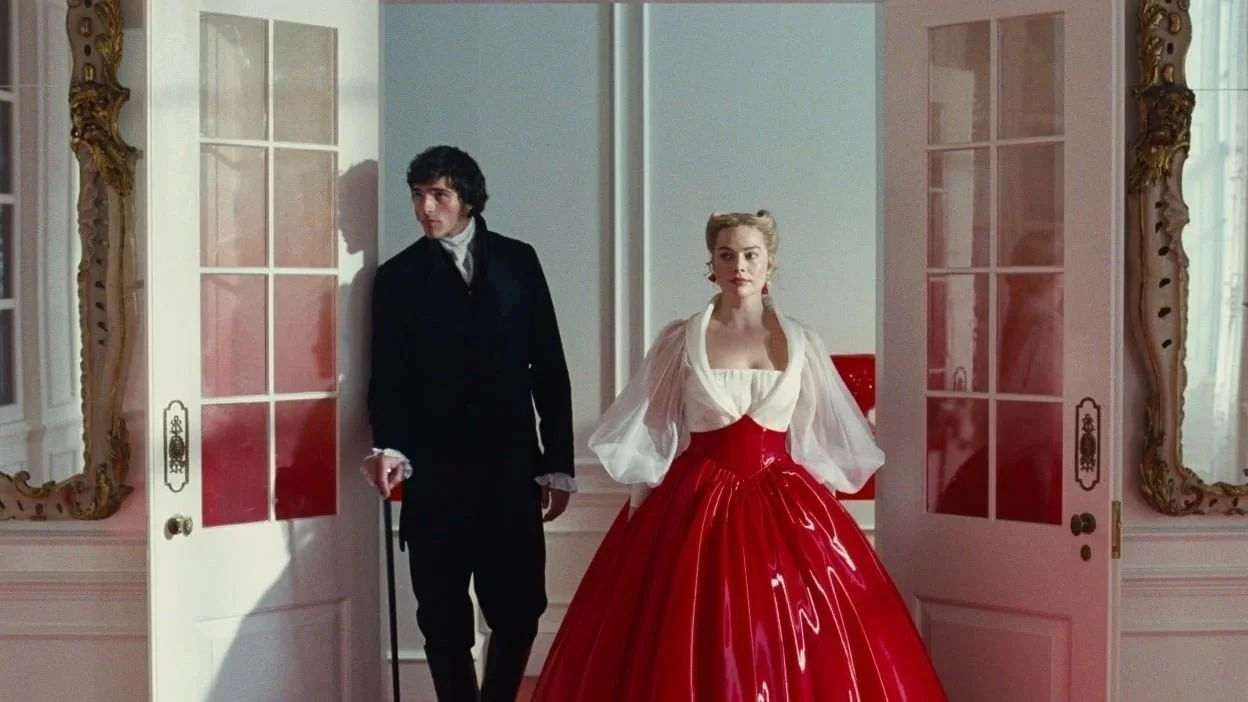
The phrase “bodice ripper,” in reference to passionate historical romances, already carries a hint of the “body horror” coined to describe the Canadian auteur Cronenberg’s visions of biological chaos and evolution. Both phrases apply to Emerald Fennell’s strange and fascinating take on the high school reading list staple, Emily Brontë’s 1847 novel Wuthering Heights.
“Wuthering Heights” (stylized with quotation marks) has already achieved notoriety for its many diversions from the source material. For one, Fennell streamlines the novel’s sprawling cast of characters down to the bone, focusing on the forbidden romance between the rough foundling Heathcliff and Catherine “Cathy” Earnshaw, the daughter of the titular estate’s landlord.
In another major break, the film opens with a bizarre public hanging straight out of a Ken Russell movie. As the unknown corpse-to-be writhes in the noose, he sports an undeniable boner, to the delight of a group of children attending the spectacle including young Cathy. The kids are scolded by an old nun, who then appears to have an orgasm herself.
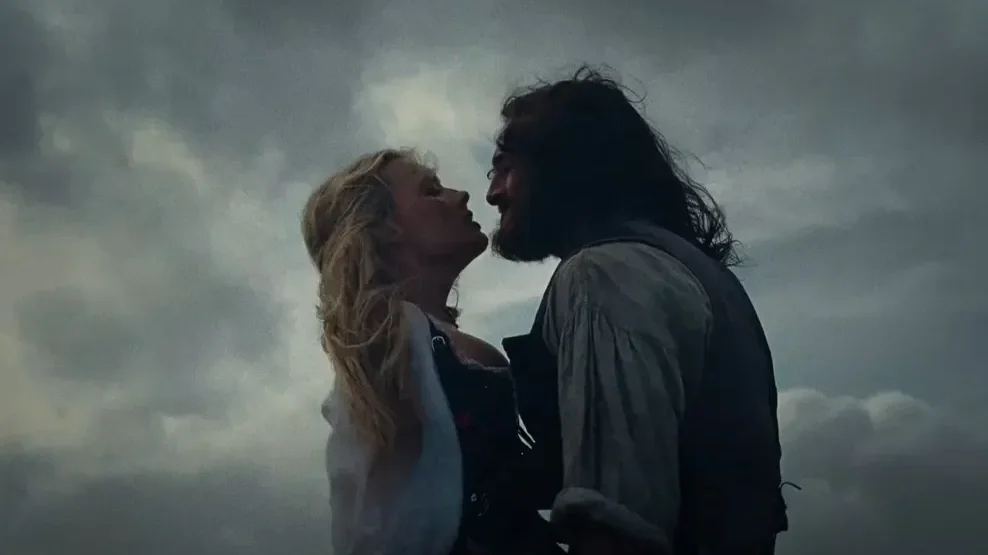
It is here that Cathy, played as a youngster by Charlotte Mellington, and her dissipated father (an excellent Martin Clunes), meet and welcome an orphan into their family. “Can I dress him up?” Cathy asks excitedly, and her father replies, “He shall be your pet.” With this imbalance firmly established, young Heathcliff (Adolescence’s Owen Cooper) becomes the target of Mr. Earnshaw’s frequent drunken rages, his back marked by whip scars.
As adults, played by Robbie and Jacob Elordi, Cathy and Heathcliff’s sibling-esque bickering evolves into something more complicated. As the estate’s heir, Cathy is expected to marry into a similarly established family. It’s also become a necessity, as Earnshaw senior has gambled away much of their fortune. Heathcliff, a lowly servant, has no chance despite his intense love for her. For her part, Cathy sublimates her true feelings for Heathcliff, reverting to the playground antics of their childhood days.
Robbie co-produced Fennell’s previous two films, but it’s her first time in front of the director’s lens. Regardless of the film’s ultimate reception, the team deserves props for turning down a huge amount of money from Netflix, insisting on a wide theatrical release. (The film is being distributed by Warner Bros.)
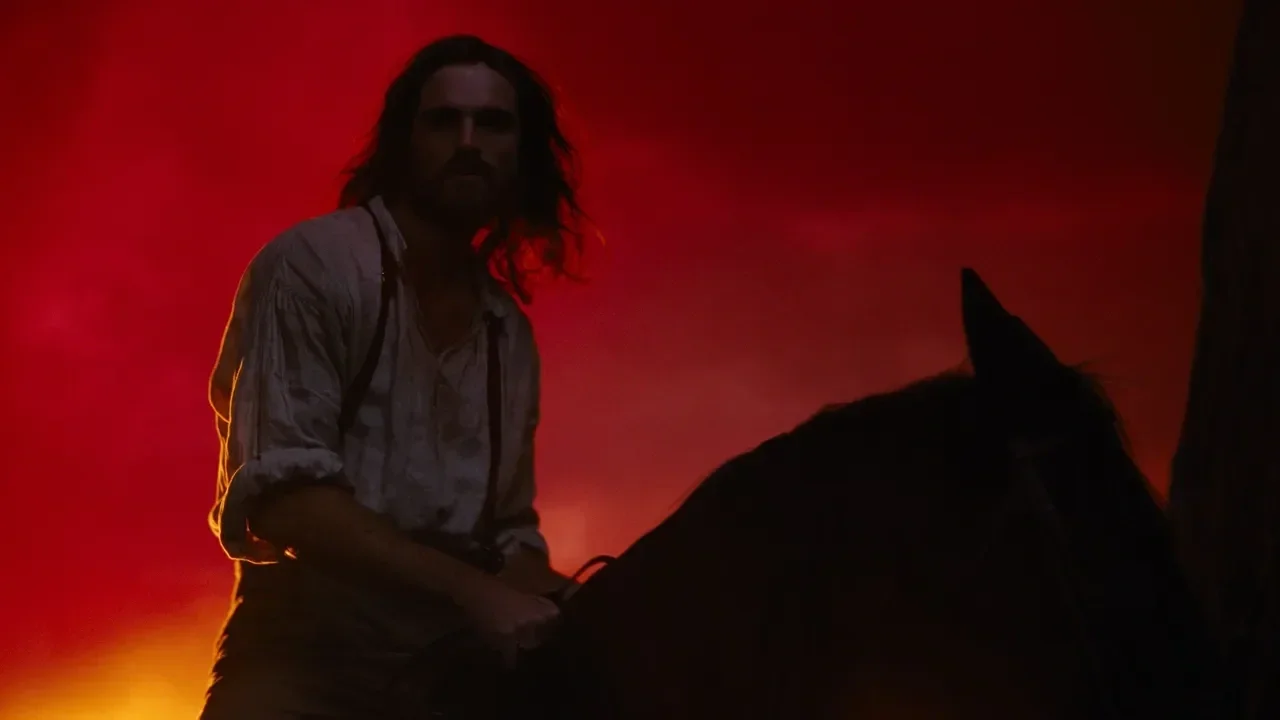
As a filmmaker, Fennell has come a long way from her debut, the visually flat and glibly #MeToo-coded Promising Young Woman. The extravagant high Gothic vision displayed in “Wuthering Heights” has more in common with Guillermo del Toro’s Frankenstein than your average period romance. Like del Toro’s film, every penny of its $80 million budget is splashed onscreen via massive sets, lavish costumes and visually overwhelming production design.
The film also gives the towering Elordi another mournful character embodying the me-against-the-world energy of Frankenstein’s Creature. Many have balked at Elordi’s casting as the ethnically ambiguous Heathcliff, which is a conversation worth having. Fennell has said Elordi resembles an illustration of the character from her copy of the novel. Robbie has also defended the casting, saying simply, “He is Heathcliff.” (Her casting has also been criticized—too old, too blonde.)
Given the aforementioned body horror elements, and the heavily hyped Charli XCX soundtrack, realism and authenticity don’t seem to have been top of mind on this project at all. Fans of overt anachronism will be disappointed to learn the pop superstar’s music is used sparingly in the film, although the lyric “I shouldn’t feel like a prisoner” does pop up in a key scene.
“Wuthering Heights” (those quotation marks do get tiresome) includes plenty of bodice-ripping romance on the foggy moors, but its overall affect resembles Sofia Coppola’s Marie Antoinette curdled into a horny, death-haunted nightmare. Despite Fennell’s proclamations of reverence for the book, she plays fast and loose with it, amping things up to a hot, sweaty, bloody mess. Purist fans of the novel may balk at the film’s pop-art spectacle, but in its haters-be-damned weirdness, it is defiantly its own thing. As such, it’s a good time at the movies, although more literal-minded viewers may leave the theater wondering–is that really how septicemia works?
If you enjoyed this article, please consider becoming a patron of Hyperreal Film Journal for as low as $3 a month!
Matthew K. Seidel is a writer and musician living in Austin since 2004. The above selfie was taken in an otherwise empty screening of Heat at 10:30 in the morning. You can find him on Letterboxd @tropesmoker.