
Merry Christmas from Weird Wednesday: Santa Claus
This screening was part of the Alamo Drafthouse’s Weird Wednesday series. For upcoming shows, click here.
Have you ever wondered if Santa Claus could beat Lucifer in an ultimate battle of good and evil? If yes, do I have the movie for you! Directed by Rene Cardona with an English language dub by K. Gordon Murray, Santa Claus (1959) follows Santa (Jose Elias Moreno) on his mission to stop Lucifer’s demon, Pitch (José Luis Aguirre), from tempting children into doing evil things like stealing, bullying and breaking and entering. K. Gordon Murray, called the “King of the Kiddie Matinee”, redubbed and released foreign films for American audiences such as Santa Claus and would go on to release over 60 films in 15 years. His dubbing of this film is something that stands out—his narration is good and has character because it has to; he narrates every single character's dialogue, something I’d never seen before even in dubbed films. His narration feels playful, almost like he’s making it up as he goes along (for all I know, he could be) and feels interested in following along with the audience, adding in his own commentary to the dubs.
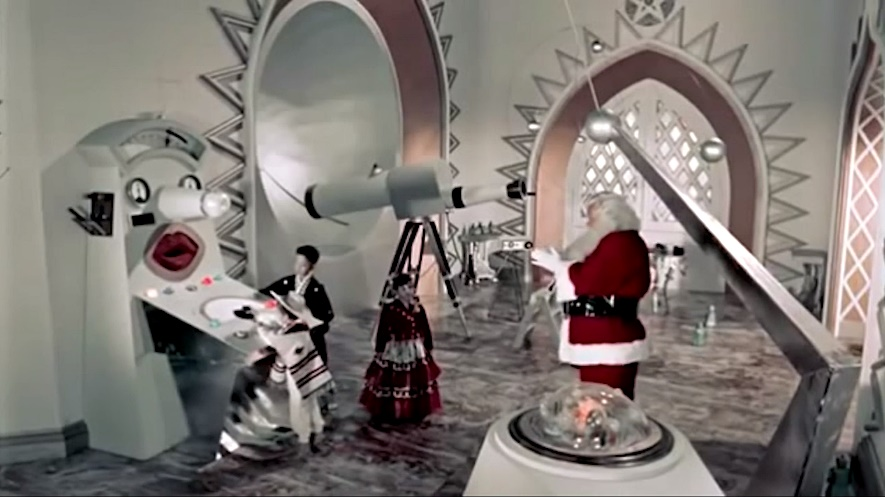
There are some things about this film that bring Santa’s lore into question. Every deviation makes Santa all the more fun and interesting. Santa’s workshop, for one, is in outer space. It’s very futuristic for what we would normally think about Santa’s workshop—he has a telescope where he can check in with children to see if they’re being good. The telescope is connected to an all-seeing eye type device which Santa’s helpers facilitate the use of. The design of Santa’s workshop is very simplistic, mostly whites and greys and not the traditional brown gingerbread or brick you’d think of when visualizing Santa’s workshop. The halls are large and grand and mostly empty—I guess it’s a difficult trek to get items to space.
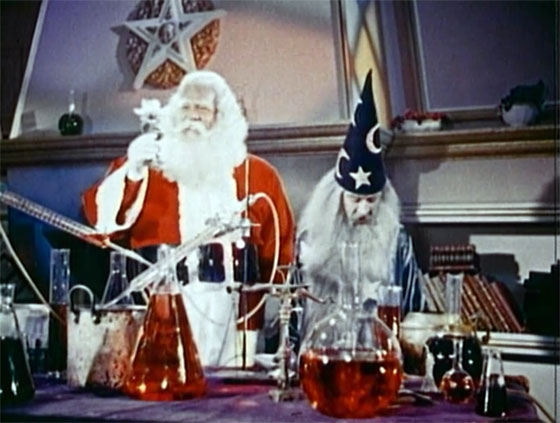
Santa also has a magic workshop, run by Merlin (Armando Arriola). Presumably, most if not all of Santa’s magic comes from Merlin’s work behind the scenes such as “The Flower to Disappear” and the “Cocktail of Remembrance.” Both of which Santa uses in his journey to Earth to deliver presents to children and defeat the Devil. In most depictions of Santa, Santa has magic inherently within him – the power of Christmas, the power of belief or children’s wishes. This film flat out denies that, essentially making Santa powerless without the use of science or his magical objects created by Merlin. Santa Claus does preserve the idea that Santa is inherently good and not a human-like being though. Santa has enough science and magic on his side to spar with Pitch and aid children toward goodness and away from sin—more Godlike qualities than human qualities.
Another choice lore departure is Santa’s elves—they aren’t actually elves, they are children from all the world. Logistically, this sounds like a nightmare. There is about a 10 minute sequence where we meet all the helpers from around the world in a little song while Santa plays the piano for them. It’s “It’s a Small World” vibes, including feeling a bit racially and stereotypically charged but considering it’s 1959, it’s not all that surprising. I did appreciate the fact that all of the children got to sing in their country’s language (though it’s impossible to tell if any were actually from said countries) and the fact that the American kids were dressed like cowboys. Cowboys feel like the best depiction of America on any international stage so it’s fitting that’s what was chosen, especially in 1959. The children are also never depicted doing any actual building of toys either—they are just in a dreamlike room, with the occasional helper going to Santa’s observatory or looking into his telescope.
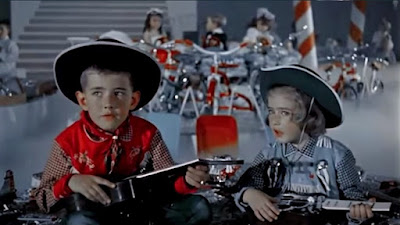
The film’s color-grading is impeccable. The audience can really see it in scenes with red in them, which is most scenes because of Santa and Pitch. The colors pop and it feels very similar and nostalgic to experiencing Christmas as a child. Filmed in Eastmancolor, a single-strip film technique started in the 1950s and a cheap alternative to Technicolor, Santa Claus maintains the vibrancy of many Technicolor pictures. The contrast is heavy and watching this made me miss this type of color-grading, which I’m sure is digitally possible but less preferred stylistically. Modern Christmas films and musicals like Wicked would benefit from adopting the color palette used here, creating a mystical and fairy-tale-like setting rather than a dull, muted world.
Santa Claus is a take on Santa Claus as a character never seen before and likely will never to be seen again. There were some big swings and creative liberties taken to make Santa a representation of moral goodness and helper of God. Santa was elevated to the level of an archangel here and I don’t think we as an audience will ever give Santa this much credit. (After all, Merlin is doing the magic.) The film made me question whether we could ever have any sincere and unique takes on Santa and be taken seriously with them. The current answer is no.
If you enjoyed this article, please consider becoming a patron of Hyperreal Film Journal for as low as $3 a month!
Lauren is a writer based in Austin, TX who loves horror movies and supporting local artists. She frequents local movie theatres, comedy clubs and dive bars.