
Tony: A Breezy, Beachy Biopic
Tony opens on a young Anthony Bourdain (Dominic Sessa) in the middle of making a pretentious pitch for a Vassar College writing scholarship. He’s high on his own supply, telling the three stuffy committee members opposite him that it’ll be what he mistakenly calls a “buildings Roman.” At a bar right after, and later back home with his parents in New Jersey, he brags that it’s a done deal for him to live as a writer in New York that summer. That sense of unearned success carries him right up until the phone call from a committee member telling him he didn’t get picked.
It’s a bit of a gamble to do this cold open, and one that mirrors the movie’s uncertainty in itself. Director Matt Johnson (BlackBerry, Nirvanna the Band the Show the Movie), working off a script co-written with Todd Bartels, Lou Howe and Matthew Miller, presumes his audience will have an immediate connection with “Tony,” as he’s known in the film, but that’s not a given. We know Anthony Bourdain as the grizzled, gray-haired world traveler, a man with a sense of gravitas nowhere to be found in this 19-year-old version of himself.

Johnson spins a few dozen pages of Kitchen Confidential into a mostly fictionalized take on Bourdain’s origin story. In the film, Tony steals some cash from his parents and leaves home for Cape Cod to chase after his crush Nancy (Emilia Jones as a character loosely based on Bourdain’s high school girlfriend and later wife.) Through several strokes of bad luck, he ends up working as a dishwasher at a local restaurant The Dreadnought, and it’s here that the central tension of the film—Tony’s desire to be a famous writer versus his reality—comes through.
Once established in the kitchen, the movie hits a groove, as Johnson translates restaurant life to screen with a distinct sense of authenticity. Here Tony meets the restaurateur known only as “Chef” (Antonio Banderas) and his sous chefs, including bad boy Sal (Leo Woodall) and joker Dimitri (Stavros Halkias.) The whole crew moves with the grace of ballerinas in the tiny kitchen as they broil lobsters, shuck oysters, snort cocaine and yell slurs at each other. There’s a candidness to the dialogue that resonates with the level of stupidity and political incorrectness you’d find in any restaurant kitchen, married with a camaraderie between the cast that makes it feel like one big dysfunctional family. Woodall plays against type as Sal, a sometimes violent drug addict who Tony at first looks up to and later pulls away from as the sheen of coolness rubs off. In turn, Chef, whose porch hammock Tony crashes on all summer, mentors Tony in both cooking and how to become an adult with self-respect.
Sessa himself embodies the idiotic bravura described by Bourdain in Kitchen Confidential as that of a “spoiled, miserable, narcissistic, self-destructive and thoughtless young lout.” The Tony we see at the start chafes against his oppressively loving family and sees himself as a misunderstood, tortured artist, when in reality he’s a middle-class Jersey kid at a prestigious liberal arts college. He is indeed miserable and thoughtless, and to both Sessa and the script’s credit, you still end up rooting for him as he goes through the growing pains of young adulthood. And while the character of Tony might not immediately resemble Bourdain, Sessa makes him legible with the way he walks, talks and jokes. We watch Tony grow into himself alongside the rest of the kitchen crew (less authentically with Nancy, who is unfortunately relegated to little more than a plot device to further Tony’s character arc). With that growth, the parallels between Tony and Bourdain become more clear: his delight in new experiences, his endless curiosity and open nature, his ability to riff and improvise and shit talk with finesse.
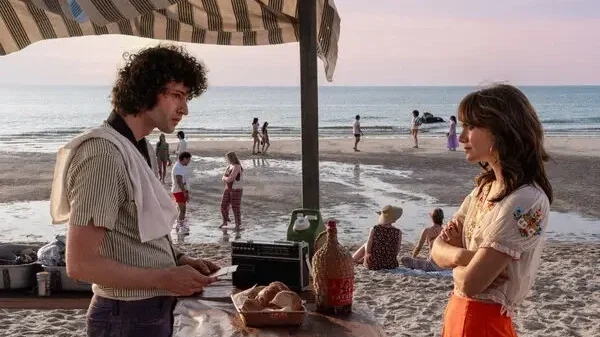
That strong lead performance is complemented by beautiful cinematography and a ‘70s look from Michael Bauman (a longtime Paul Thomas Anderson collaborator), whose scenery shots make you yearn for a vintage Cape Cod summer. Bauman lingers on the vivid beachside sunsets and makes scenes like a nighttime fishing excursion feel vivid and real. The production design also adds small touches to the characters, like Tony’s room back home, decked out in punk rock posters, and the Chef’s beach house, filled with books and art that belie his terse, skin-deep demeanor.
While Tony veers a little generic, it’s nice to have a biopic that avoids the usual birth-to-death overview of someone’s life,particularly one who’s already known for his onscreen presence. Though the story falls into some overdone tropes—like the eye-rolling inclusion of the Chef telling Tony he should use his full name, leading to the movie’s final line being Tony introducing himself as Anthony Bourdain—it’s a compelling thought experiment on who this public figure might have been at that moment in time.
Alix is the editor-in-chief for Hyperreal Film Journal. You can find her on Letterboxd and IG at @alixfm.