
The Running Man Sprints to a Win Despite Some Major Stumbles
Glen Powell is a handsome, even beautiful man. One of his great strengths as an actor is that he knows how to use his face, whether cranking up the roguish charm in Twisters or slipping between selves in search of who he wants to be in Hit Man. With the Edgar Wright-directed The Running Man, Powell uses his face in a new way, putting it through the wringer as his angry, angry hero Ben Richards does his damndest to survive the entire continental United States hunting him. Ben is not a Wickian bullet wizard or an Arnie-style demolisher—he’s a survivor, scrambling for any advantage and staying an inch ahead of his would-be murderers’ bullets and blades. When Ben temporarily escapes doom, it’s a relief. When he manages to definitively turn the tables on a foe, it’s thrilling. And it’s Powell’s expression work, coupled with a committed physical performance (which he shares with stunt double Danny Downey), that gives The Running Man a compelling, magnetic core. Powell is the reason to see The Running Man.
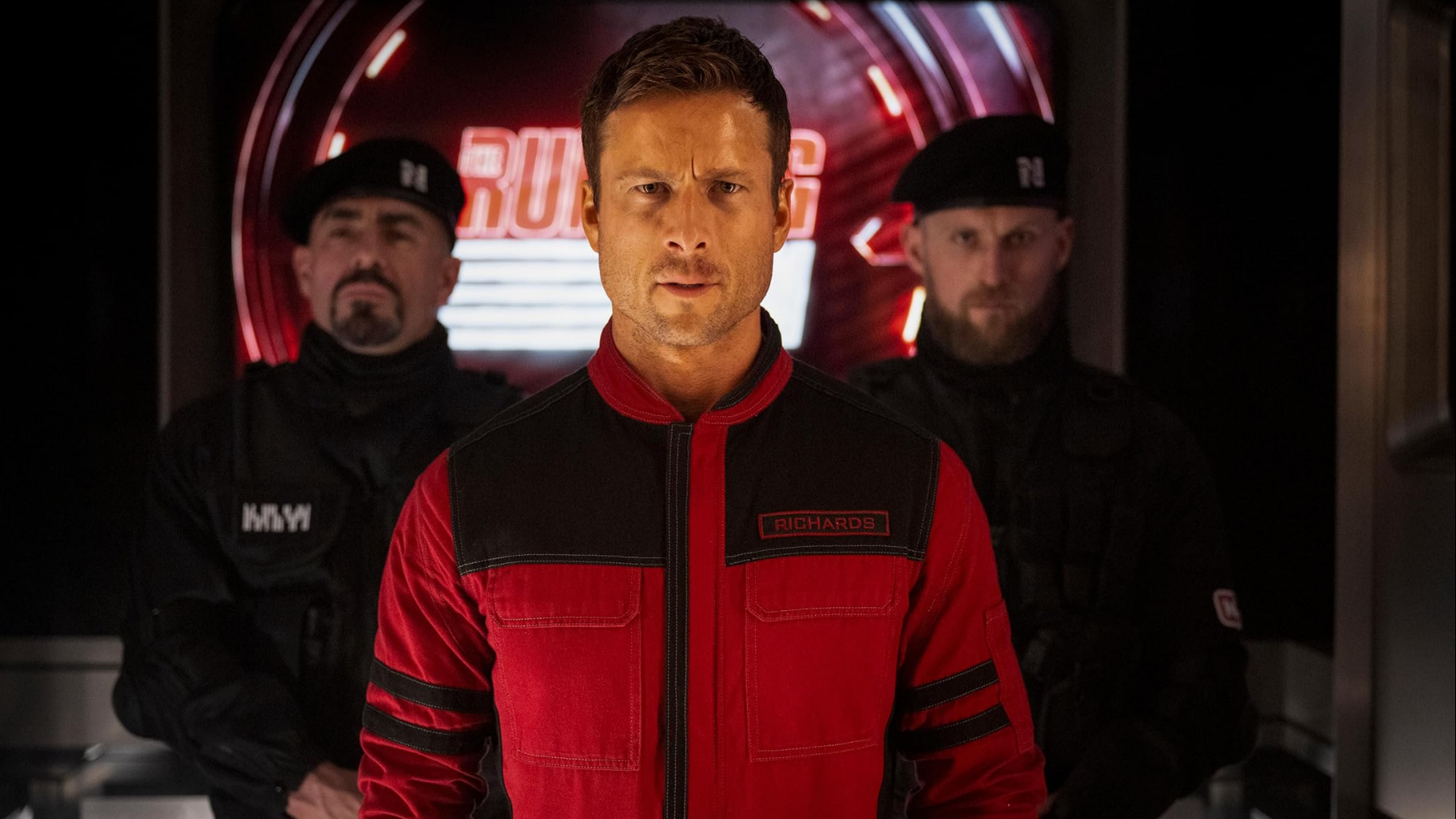
The Running Man also offers plenty of others pleasures to go with Powell’s fine turn. Edgar Wright, re-teaming with Scott Pilgrim co-writer Michael Baccall, adapts the Stephen King novel of the same name (one of several he wrote under the pen name Richard Bachman), a dystopian thriller set in a world where the wealthy powerful keep the less fortunate in line by stoking their bloodlust and making sure they turn it on each other. Every home has a Free-Vee, a gift from the terrifyingly powerful corporate monolith known as The Network. Its top draw is The Running Man, a 30-day contest that pits three Runners against any civilian who wants to inform on them, any and all law enforcement, and a team of elite Hunters, led by the unstoppable masked mystery Evan McCone (Lee Pace).
Ben is blacklisted from employment, for the unforgivable crime of having once talked to a union representative about a radiation leak at his former employer. His wife Sheila (Jayme Lawson, Sinners) pulls as many shifts as she can waitressing at a sleazy nightclub, but it’s not enough, especially with their infant daughter Cathy gravely ill. Driven by a mixture of love for his family and an unspoken desire to reclaim some agency for himself, Ben turns to the Network. They always need contestants, and he catches the eye of Running Man EP Dan Killian (Josh Brolin, delightfully oily), who won’t take no for an answer. Fortunately for Ben, Killian wants him on the show badly enough to advance him enough money to save Cathy. All he needs to do is run as fast and as hard as he can, for long enough that even if McCone does kill him, the prize money he’s won just by playing will set Sheila and Cathy up for life. It’s a terrifying proposition, but a simple one. On paper. In practice, Ben’s run brings him face to face with the worst and the best of humanity, and forces him to confront the fact that he’s becoming a symbol of resistance to a system that insists on its inevitability.
Wright has long had a strong eye for action as a director. Hot Fuzz is a loving spoof of buddy cop comedies with a climax worthy of Chow Yun-fat and company’s raid on the villain’s fortified mansion in A Better Tomorrow II. Baby Driver’s parking garage car chase is darn fine action filmmaking. With The Running Man, he and stunt coordinator Nikki Berwick build their setpieces around the long odds that Ben faces. He’s fit, smart, and good at improvisation, but he’s up against a cadre of heavily-armed goons led by Pace’s McCone, a man no one fights if they want to live. There is never an action scene in The Running Man where Ben starts with or consistently keeps the upper hand. Every edge our hero gains is a razor’s edge, and every victory he claims is claimed by the skin of his teeth. It’s consistently thrilling action-craft, boosted by Powell’s willingness to work vulnerability and fear into the way he moves, and Pace’s cool-headed death-dealing.
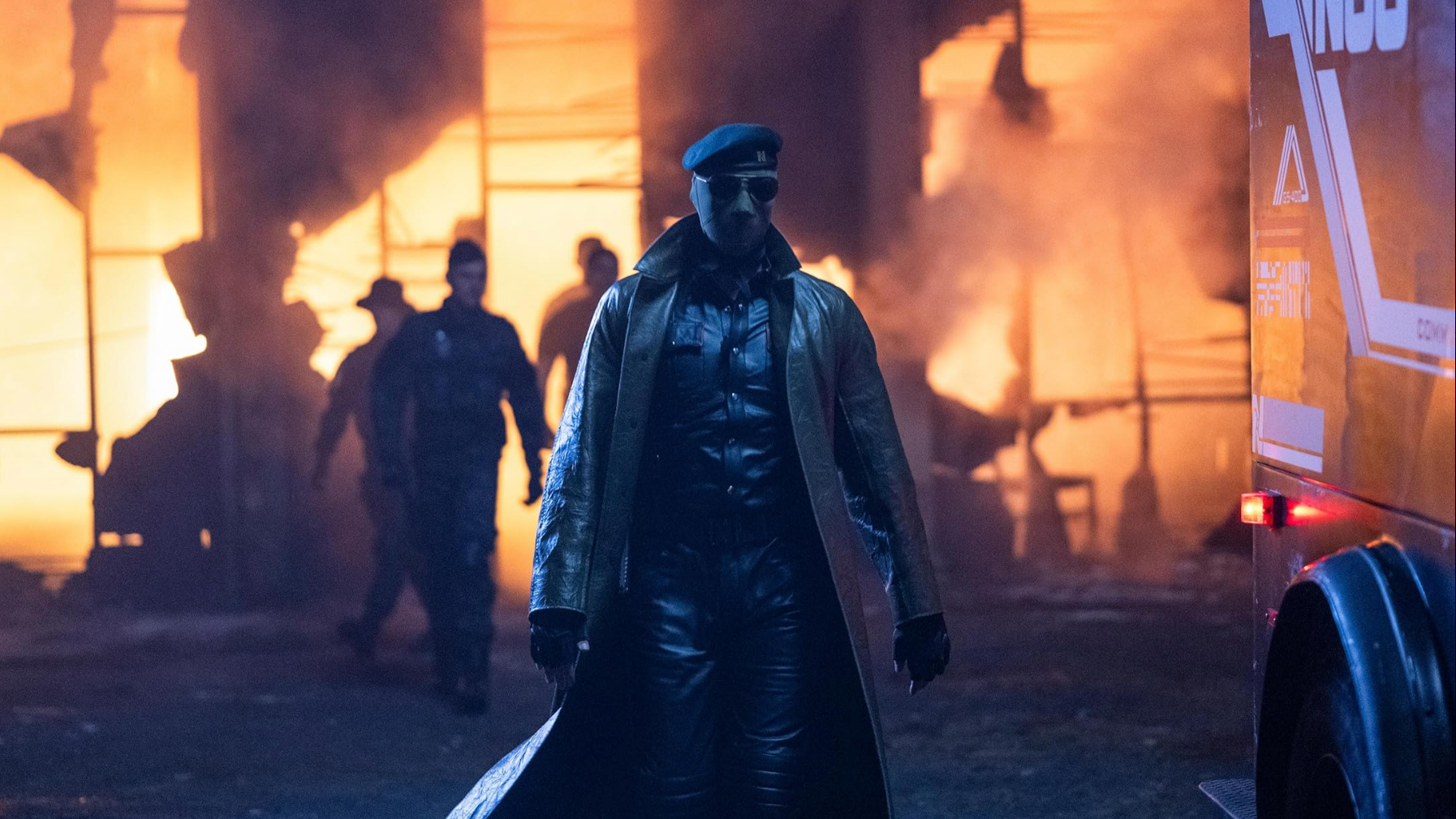
And Pace is very cool. Behind a full face mask for most of the picture, he conveys McCone’s confidence, sadism and skill by contrasting his calm, casual way of moving with a relentless precision in battle, whether with guns or blades. It makes sense that he’d be a star in a world where deadly games are the circus and prize money the bread. Evan McCone is the end result of the world that King wrote and that Bacall and Wright film, a world whose powers are adamant that they are eternal. They control the law, they control culture, and they’ve done their damndest to control the way their subjects think. Everyone needs to want more, always. But not too much more, not so much that they might rise above their station and upset the status quo. Trick is, that kind of control is not sustainable. Not without cracks in the concrete. The kind of cracks that an enterprising revolutionary might know how to stuff dynamite into.
The dynamite is where The Running Man trips a bit. The last act expands the scale and stakes of Ben’s trial significantly, and has to cover a lot of ground in a comparatively short amount of time. It gets cramped, particularly with the introduction of a late-to-the-game key player (Emilia Jones, doing what she can with limited time) and a sudden breakdown in what is and is not real. The climax has a lot that works, especially a terrific final duel between Powell and Pace, but it’s rocky enough to hurt the film as a whole.
Still, The Running Man thrills. Still, the action has speed and weight. Still, Powell and Pace do terrific work as Runner and Hunter, hero and nemesis. The Running Man’s stumbles are real. So are its triumphs.
If you enjoyed this article, please consider becoming a patron of Hyperreal Film Journal for as low as $3 a month!
Justin Harrison is an essayist and critic based in Austin, Texas. He moved there for school and aims to stay for as long as he can afford it. Depending on the day you ask him, his favorite film is either Army of Shadows, Bring Me the Head of Alfredo Garcia, The Brothers Bloom, Green Room, or something else entirely. He’s a sucker for crime stories. His work, which includes film criticism, comics criticism, and some recent work on video games, can be found HERE.