
The People vs The Toy: A Movie About The Thing Nobody Will Say Out Loud
There is a version of this article that was a powerpoint presented live at the Hyperreal Cinema Clubhouse. I walked everyone there through The Toy (1982) as a flawed-but-charming product of its era, a Richard Pryor vehicle hamstrung by a weak script and a miscalculated adaptation. A comedy that deserves credit for at least trying. That version lets everyone off the hook for time constraints. So let's start on the same exact uncomfortable sofa of movie viewing: The Toy is a movie about a rich white man who buys a Black man for his son to play with. Not metaphorically. On paper. With a transaction.
The problem is that the movie knows what it's describing, but it just refuses to do anything about it. It also helps to know that Richard Donner directed this. Not because his name lends it dignity, it doesn't, but because Superman (1978) was still doing a lot of heavy lifting for his reputation in 1982, enough that a movie with this premise could get greenlit, fully financed, and widely distributed on the strength of his last name and Pryor's box office pull.
A little context, because it matters. The source material is Le Jouet (1976), a French farce starring Pierre Richard, in which the premise plays as broad social satire. A man humiliated by capitalism, reduced to a commodity, the joke being on the wealthy man who thinks people are things he can buy and trade. When you transplant that premise to Baton Rouge, Louisiana, cast Richard Pryor as the man being purchased, and set the whole thing in 1982, you have not made the same movie. You have made a different movie that is pretending not to know it is a different movie. That gap, between what The Toy is actually depicting and what it is willing to say about what it is depicting, is where the entire film lives.
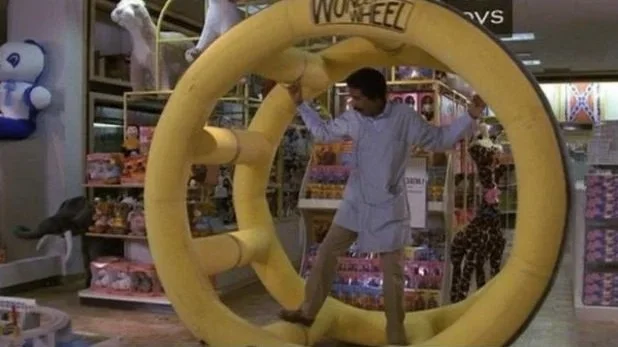
The Wonder Wheel scene. Everything you need to know about this film is also visible in the background, top right.
Jack Brown (Pryor) is a broke journalist in Baton Rouge, trying to hold his life together in the way Pryor characters always are: with charm, with performance, with a kind of exhausted dignity the script keeps undercutting. U.S. Bates (Jackie Gleason) owns the newspaper, the department store, and functionally the town. His son Master Eric gets whatever he wants, which is standard-issue rich-kid setup until Eric sees Jack playing in the toy department and decides he wants him. Bates completes the acquisition with paperwork. Jack agrees because he needs the money. To be clear about something: the son's name is Eric Bates. The household staff addresses him by title. That title is Master. The film actually pauses for the laugh on this one. Remarkably, it is one of the few moments where The Toy is fully aware of the joke it's making.
What follows is a movie that keeps handing its racial subtext a drink and hoping it will relax.
There is a Confederate flag in Bates' office. It hangs behind his desk, in multiple scenes, and the movie never once acknowledges it. Not a glance. Not a beat. Just hanging there, proudly, in the office of the man who bought the Black man, in a film set in Louisiana. This is either the most embarrassing oversight of Richard Donner's career or the most subtly damning visual choice he ever made. I genuinely cannot decide which, and I've thought about it more than I expected to.
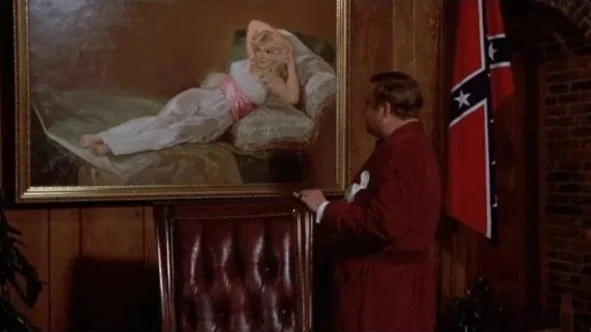
“You're looking particularly fine tonight, Fancy,” says the man in a bath robe.
The film accumulates strange details the way an attic accumulates furniture, things that clearly meant something to someone at some point, arranged in a room with no apparent logic. Let me walk you through some of them.
Bates, established early as a man of towering wealth and zero self-awareness, has a management philosophy that consists of two moves: if he likes you, he makes you drop your trousers on the spot as a kind of hazing ritual he finds to be serious reality because things are worse outside the job; if he doesn't, he fires you on the spot for infractions like having sweaty hands or having a mustache. The movie presents this as character color. It is, in fact, a fairly precise portrait of how American power has always treated the people underneath it, and the film never once connects this to the man who also just purchased a human being for his child.
The German nanny, Hilda, is introduced watching what appears to be Nazi propaganda footage in her bedroom. The film drops this immediately and moves on, because of course it does. The next two times Hilda appears she is in her evening wear, visibly infatuated with Jack, the movie implying with complete breezy casualness that she finds brown skin exotic. The film introduces a character watching Nazi footage and then uses her as a punchline about interracial attraction. This is a staple of this film.
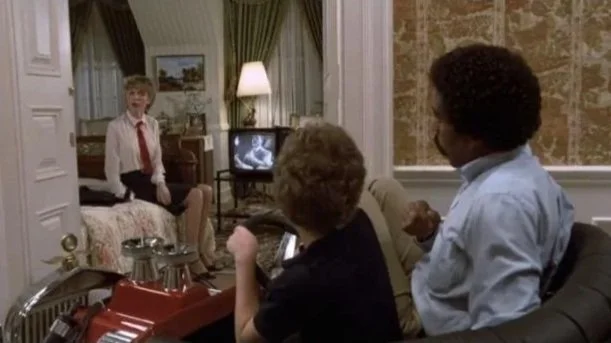
"I have finished my documentary. It vas very inspiring. Can I bring you somzing, Mr. Brown?
A painting in Bates' formal sitting room with his wife Fancy painted as a landscape vanity portrait, converts from a tasteful artwork to a nude portrait at the flip of a hidden switch. Mr. Brown accidentally activates with young Eric in the room. The painting literally operates like a novelty pen where the clothes slide off the body. It only makes you begin to wonder, who made this for him and who exactly was he showing this off to other than himself? This scene exists. Nobody questions it.
Pryor is required, at one point, to serve a Bates luncheon dressed in a female food service uniform, maid's dress, the whole thing. The scene is played for laughs. The laughs come from Pryor's reaction, because Pryor could generate laughs from a man reading a bus schedule, but the setup asks you to find the black man in the maid costume inherently funny. The movie does not appear to notice the ask it is making.
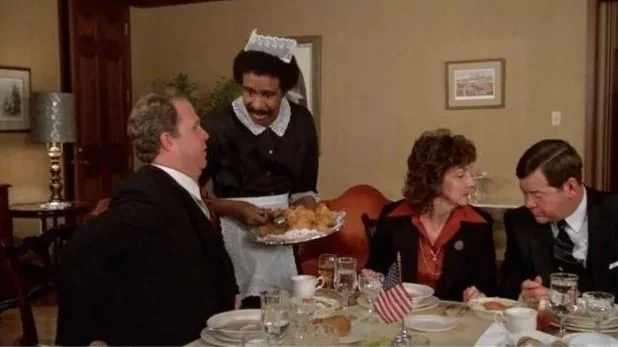
"I went to journalism school for this."
There is a domino collection. Bates has an elaborate, museum-quality domino collection for the time, and a scene exists in which this is treated with the gravity of a significant plot point. The dominoes topple. At least 3 times in the movie. This matters to the movie and nothing else.
Pryor discovers piranha in the river and exits it so fast, through water that should be waist-deep, that he is functionally running on the surface. Not wading. Not splashing. Running. On water. The film captures this accurately and without comment, because it is the most honest thing in the movie: a man moving at the exact speed the situation requires. It is a perfect representation in film of the colloquial expression of getting one’s ass in gear.
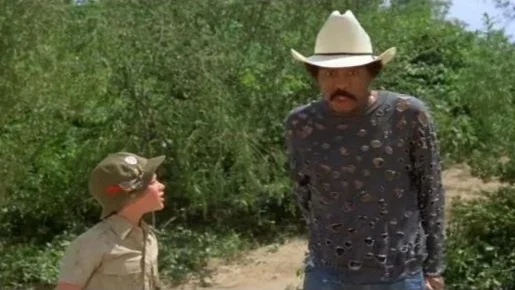
“They would've eaten my dignity too, if I had any left in this film."
Nobody on this production appears to have asked whether any of these elements belonged in the same film, or the same universe, or honestly the same medium. The answer in every case is: probably not! But here they all are, committed to film, distributed by Columbia Pictures, and seen by enough people to gross $47.1 million and land at number fourteen at the box office in 1982.
Then there is the Wonder Wheel scene, which is why I'm writing this.
Pryor is alone with a deflating inflatable toy. What follows is about five minutes of improvised grief that the movie has done nothing to earn and everything to provide the stage for. Pryor is playing a character who is playing with a toy, and somewhere inside that nested performance he delivers a meditation on American dignity that the script never once approaches. It makes no logical sense within the plot. It makes complete sense within the context of being Richard Pryor on a film set in 1982, working with material that is failing him, and deciding that since the movie won't say what the movie is about, he will. The camera keeps up. Not much else does.
Pryor wrote in his autobiography that he and Gleason were kindred souls, that Gleason's between-take stories were funnier than anything in the script, which, if you've seen the script, tracks. You can feel it in their scenes together. Gleason plays Bates with a cheerful, unreconstructed enormity, a man who has never seriously considered the possibility that the world might not belong to him, which is its own kind of horror rendered as comedy. Pryor plays against it with a precision that is its own separate performance. The warmth between them is genuine. Given what the film is about, this is also uncomfortable. The movie wants you to enjoy watching them together. You do. That's the trap.
The critics are not wrong about The Toy. Vincent Canby wrote that his mind was ricocheting between the screen and the exit sign. Rotten Tomatoes lands on "muddled and unsuitable for anyone." The Dissolve argued it encapsulates the tragedy of Pryor's film career so completely it might as well be subtitled The Richard Pryor Story. These are accurate readings. And in some scenes it’s obvious if you pay attention to Pryor’s body where one can see the burns scars of his notorious free-basing accident. The script is a mess. The racial politics are a house fire that everyone in the film agrees to walk past. Pryor deserved better material and almost certainly knew it, which may be exactly why the Wonder Wheel scene exists. A man investing everything into twelve minutes because twelve minutes is what he has.
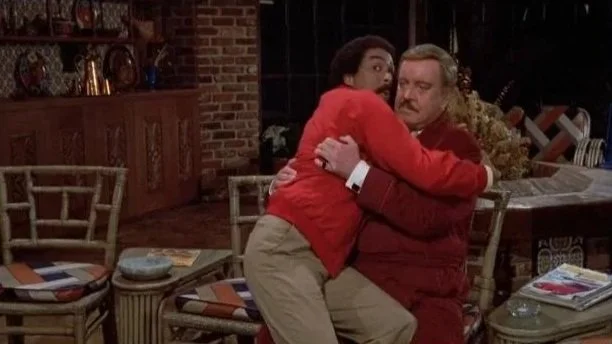
Fancy's face when she walks in suggests this is not the first time U.S. Bates has had a type.
Here's what The Toy does accidentally, which turns out to be more interesting than what it does on purpose. It lets Pryor be Pryor, not the cleaned-up, family-friendly studio product Pryor, but the Pryor who understood that being a black man in America meant performing a version of yourself that kept the room comfortable while the actual work happened somewhere behind your eyes. Those twelve minutes, scattered across a runtime that mostly doesn't deserve them, contain more truth about class, race, and the cost of being the funniest person in a room that doesn't quite know what to do with you than most films with the audacity to try.
The rest of the film exists so those moments have somewhere to land.
Is that enough to recommend it? I'll be honest: I don't know. The Confederate flag is still hanging in the office. The nanny is still watching the footage. The movie is still pretending not to know what movie it is. But Pryor is still there, fully present inside a film that doesn't deserve his full presence, doing the thing that made him Richard Pryor.
Make of that what you will.
If you enjoyed this article, please consider becoming a patron of Hyperreal Film Journal for as low as $3 a month!
Jesse is a retired Navy veteran and Texas State Alumnus with a Degree in Digital Media Innovation and minor in Theater. In a past life he was a red shirt on the Enterprise doing nuclear power and propulsion plant reactor operations and maintenance. He currently resides in Austin helping to repair physical media players and doing communications work with We Luv Video along with veterans advocacy work as Senior Vice Commander with a local DAV chapter. He has co-hosted The Texas Hemp Show and hosted Lonestar Collective which has won 2 statewide fan favorite awards for best online production in the hemp industry. If he’s not out catching a flick he’s possibly hanging out with his family or playing on guitar with his son.