
A Mystery Deflowered: The Name of the Rose
Any film adaptation of a source like a book is a truncation of the original’s artistry. Director Jean-Jacques Annaud’s “palimpsest” of Umberto Eco’s best-selling novel The Name of the Rose (book published 1980; movie released in 1986) is an inspired adaptation that captures its medieval setting through an ominous atmosphere and brilliant casting.
A palimpsest is a manuscript on which the original writing has been effaced to make way for later lettering but traces still remain. For the film to describe itself as a palimpsest in the opening credits is appropriate, as such a scholarly word matches Eco’s erudite prose. Also, it cleverly references how disguised clues are discovered in the narrative’s plot. After all, this movie is a “thinking-person’s” mystery, requiring Holmesian deduction to ascertain the truth.
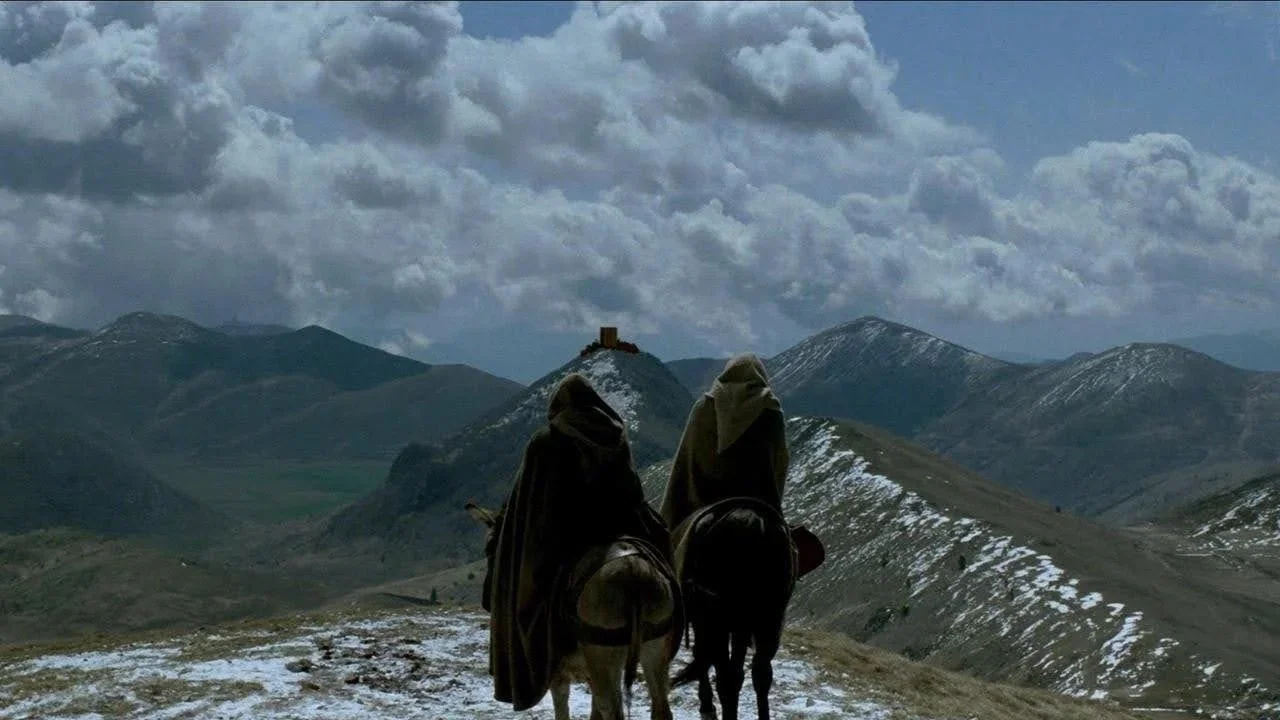
Upon the sound of period-appropriate bells, the film opens on two cloaked figures riding on horseback in a snow-spotted mountainous landscape. Though the two figures seek shelter in the abbey they ride towards, the atmosphere is ominous. This is not a monastery of safety, but one that guards itself with heavy wooden battlements for its front door. This religious outpost is far from welcoming.
The audience feels the young monk’s, Adso of Melk (Christian Slater), fear of this harsh abbey, its apocalyptic artwork and stone carvings depicting demons. Matching this hideousness are the faces of some of the monks themselves, especially Salvatore (Ron Perlman), a hunchback whose infamous past associations further reveal the danger of the location and the medieval era.
Emphasizing the ugliness of this setting is an inspired artistic choice for Annaud, as it creates a stark contrast against the youthful beauty of Adso and of The Girl (Valentina Vargas) who enchants him. This is an age when attractiveness is lustily sought after, even as it fights for its very existence. Also attempting to survive this mystery's numerous deaths is the beauty of thought, as the abbey’s famed library, with its secret books, is closely guarded under lock and key.
Leading this investigation is William of Baskerville (Sean Connery). The character’s origin is Eco’s literary nod to Sir Arthur Conan Doyle’s famed detective Sherlock Holmes and one of his more famous mysteries (The Hound of the Baskervilles). Like Holmes, Brother William detects and solves by means of intellectual logic and reasoning.

As The Name of the Rose was a best-selling novel upon its publication, there was significant competition for the casting of this leading part. Though a legendary actor, Connery’s box office draw had significantly dimmed by the mid-1980s, thus Connery not only signaled his interest for the part to Annaud, but also auditioned for it. This film signaled a creative rejuvenation for Connery’s career, winning a BAFTA for his performance, however the casting of Connery did come at a price for the production, as Columbia Pictures withdrew as a distributor, hurting its U.S. box office returns and casting this film into cult status.
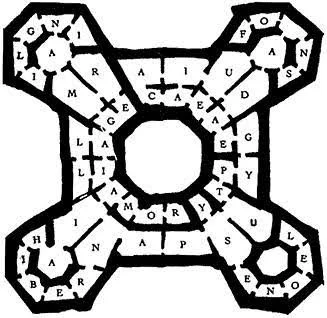
Eco was an Italian professor with specialties in medieval studies and semiotics, and his academic prose makes each of his novels a labyrinth to discern. How appropriate that his debut novel features an actual labyrinth – the abbey’s famous library. In the novel, Eco provides his own illustration of his devised library/labyrinth. In the film adaptation, it is artfully depicted as a maze of stairwells leading to a seemingly unarranged set of book-filled rooms. Naturally, in the heart of this labyrinth lies the answer to this narrative’s mystery, as knowledge is always found in any well-stacked library.

Set against the mystery is the meeting of different Christian sects who debate the Roman Catholic Church’s role in the 14th century – namely, whether or not the Church should be poor in a poverty-stricken world. While the film does not delve into this debate too deeply, it is clear throughout that this is a society stricken with conflict. Who is safe in this murder mystery where laughter and comedy is as hotly-debated as land and property ownership?
Despite the film’s artistic successes, Eco was unimpressed with the overall effort. In an interview with The Guardian in 2011, Eco referred to his novel as a “club sandwich”, and he critiqued the film for discarding the meat of his book’s theological/political elements. As such, no further adaptations have been made of Eco’s other novels, though The Name of the Rose was adapted again as a miniseries in 2019, after Eco’s passing.
Both the novel and film anticipated other 1980s/90s medieval output including Ellis Peters’ (real name: Edith Pargeter) Brother Cadfael series (set in the 12th century) which was adapted into a televised series starring Derek Jacobi, airing on ITV (Britain) and on PBS’ Mystery!. Additionally, there was Brian Jacques’ acclaimed children's fantasy novels chronicling anthropomorphic animals inhabiting the fictional Redwall Abbey.
The Name of the Rose’s status as an arthouse mystery remains firmly intact. Annaud’s masterful direction of the medieval atmosphere and its commanding performances are central to its legacy. Perhaps the greatest mystery of all is the secret to its title – what is the actual name of the rose? Eco writes in a postscript, “I leave the reader to arrive at [their] own conclusions.”
If you enjoyed this article, please consider becoming a patron of Hyperreal Film Journal for as low as $3 a month!
Paul Feinstein is an arts professional who has produced content in different mediums including film screenings, live music, radio, and theater. He is a native Austinite.