
The Longest Yard: It Is a Movie That Came Out in the 2000s
I've seen hundreds, if not thousands, of movies, and can say with relative confidence that the 2000s were the worst decade for mainstream American cinema. The rise of digital democratized the filmmaking process to some extent, but also led to a glut of color-grading that looked blown out and realistic in all the wrong ways. By removing the upfront cost of physical film, retakes and re-edits become leagues simpler, deprioritizing the importance of a good script and a director having a clear vision for the movie prior to shooting (see Anchorman for the best and worst example of this). And, most importantly, it was arguably the nadir of empathy toward non-white ethnicities, queer identities, and women. Homophobic, racist, and sexist jokes are in nearly every mainstream film of the era.
So, before we get into discussing in depth the critical value, or lack thereof, of Adam Sandler's mostly forgotten remake of The Longest Yard, I'm going to have to ask you, the reader, to allow me some grace in what I'm focusing on. Trust that I am aware of how lazy and mean-spirited it is that the women have no interiority, that a running joke features Tracy Morgan and a few background characters as jail prostitutes and cheerleaders, that the most prominent Black character dies in order to motivate a change of heart in the white lead. These are lazy choices and plenty reason to dismiss this movie out of hand. I know, accept, and agree with you on this—so let's move on to the other aspects of this film.
The Longest Yard, like the original, follows Paul Crew (Adam Sandler), a washed-up former football player disgraced after a points-shaving scandal. When a drunk driving incident lands him in prison, he's recruited by the football-obsessed warden to put together a team of convicts to flop miserably in a game against the warden's team of pro football player-cum-prison guards.
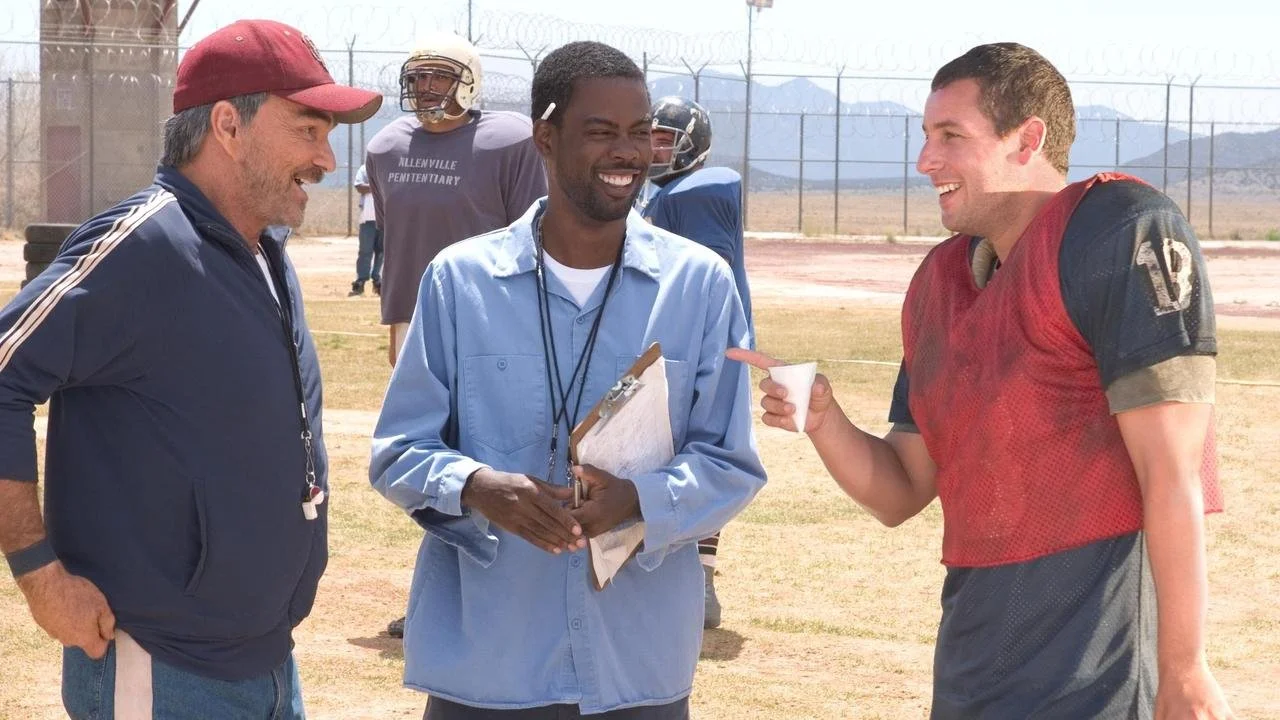
Adam Sandler, for all his considerable talents, is fundamentally unbelievable as a football player, let alone a once-in-a-generation MVP—and that's a problem when the entire film rests on his rugged football acumen defining every single scene. Sandler simply flounders at every single scene involving football, giving inspirational speeches with all the energy of a class clown delivering a presentation in school. He talks back to the guards with ironic detachment and Gen X hipsterism instead of the uber-masculinity that the role would require (and that the original film's lead, Burt Reynolds, achieved so effortlessly).
The only time Sandler seems to come alive is in a scene where Crewe has to play a game of pickup basketball to convince some of the Black convicts to participate in the football game. Sander's a noted basketball fan and it shows in the scene. He feels looser and more engaged, playing the game like a former pro (or at least enthusiast), which seems at odds with the rest of the movie. One wonders what about remaking The Longest Yard appealed to Sandler when he doesn't seem to connect with either the character or the sport.
The supporting cast doesn't fare much better. Chris Rock seems vaguely uncomfortable to be in front of the camera, while Burt Reynolds' role as a mentor figure to Sandler feels awkwardly inserted as a way to remind fans of the original. The warden and guard captain, played by longtime character actors James Cromwell and William Fichtner, respectively, nail the needs of the film by portraying repugnant, unloveable bastards, but they're not asked much more than that. The rest of the cast is filled out mostly by professional wrestlers, rappers, and ex-football players who are capital-F Fine, except for Nelly, who steals the show as Megget, a running back who joins Crewe's team after the pickup performance. Unlike the rest of the cast, Nelly seems to be trying a somewhat realistic, grounded character, and he's an easy standout. Also worth noting that casting a significant portion of the cast with rappers means that the soundtrack has some all-star talent.
Shockingly, for a movie that came out squarely in the middle of the 2000s, The Longest Yard has some really impressive cinematography. There's an ambition to the way that the camera moves: instead of the common shot-reverse-shot rhythm of studio comedies of the era, it circles the cast, pushes through buildings and windows, and illuminates lone figures shadowed against a brilliant sunset like a classic western. Even the football scenes look absolutely dynamite with dynamic angles and clear continuity. The ebb and flow of the final game (which takes up nearly 45 minutes of the film's running time), is incredibly exciting and mops the floor with other football movies of the era. Worth noting here that cinematographer Dean Semler has had some of the biggest highs and lows of any longtime filmmaker I've ever seen, working on everything from The Coca-Cola Kid and Mad Max 2 to Nutty Professor II: The Klumps and XXX. Either way, he brings the heat on this one.
I hadn't seen The Longest Yard since it came out when I was a kid, and I can't say it was worth revisiting except in the way that any movie is worth revisiting. Most of the jokes were either lazy or offensive, Sandler seems bored, and the point of the remake itself seems studio-mandated. As a relic of the 2000s, it was both exactly what I expected and surprised me nonetheless.
Ziah is the founder and former editor-in-chief of the Hyperreal Film Journal. He can usually be found at Austin Film Society or biking around town.