
The Invite: Dinner Party, Interrupted
Olivia Wilde is back to comedy with The Invite after a brief and unceremonious dip into the world of thrillers. Her latest, penned by Will McCormack and Rashida Jones in their first collaboration since rom-dramedy Celeste and Jesse Forever, is a remake of Spanish stageplay-to-film The People Upstairs. The trio behind the film might have aimed for it to be a meaningful excavation of a relationship on the rocks, but this marriage drama isn’t covering any new terrain.
The Invite has received many generous comparisons to Who’s Afraid of Virginia Woolf?; like that film, there’s a tight focus on two couples whose tensions surface while spending the evening together. Angela (Olivia Wilde) is over the moon at the prospect of hosting her effortlessly cool upstairs neighbors, Pína (Penélope Cruz) and Hawk (Edward Norton), for a dinner party. But Angela’s dream of hosting the perfect evening—complete with an expensive new rug, specialty charcuterie ingredients and massive bouquets—is immediately killed when her husband Joe (Seth Rogen) returns home, already in a bad mood after a miserable commute from the job he hates. The two launch into an argument covering the breadth of their relationship issues, stopping only when Pína and Hawk ring their buzzer.
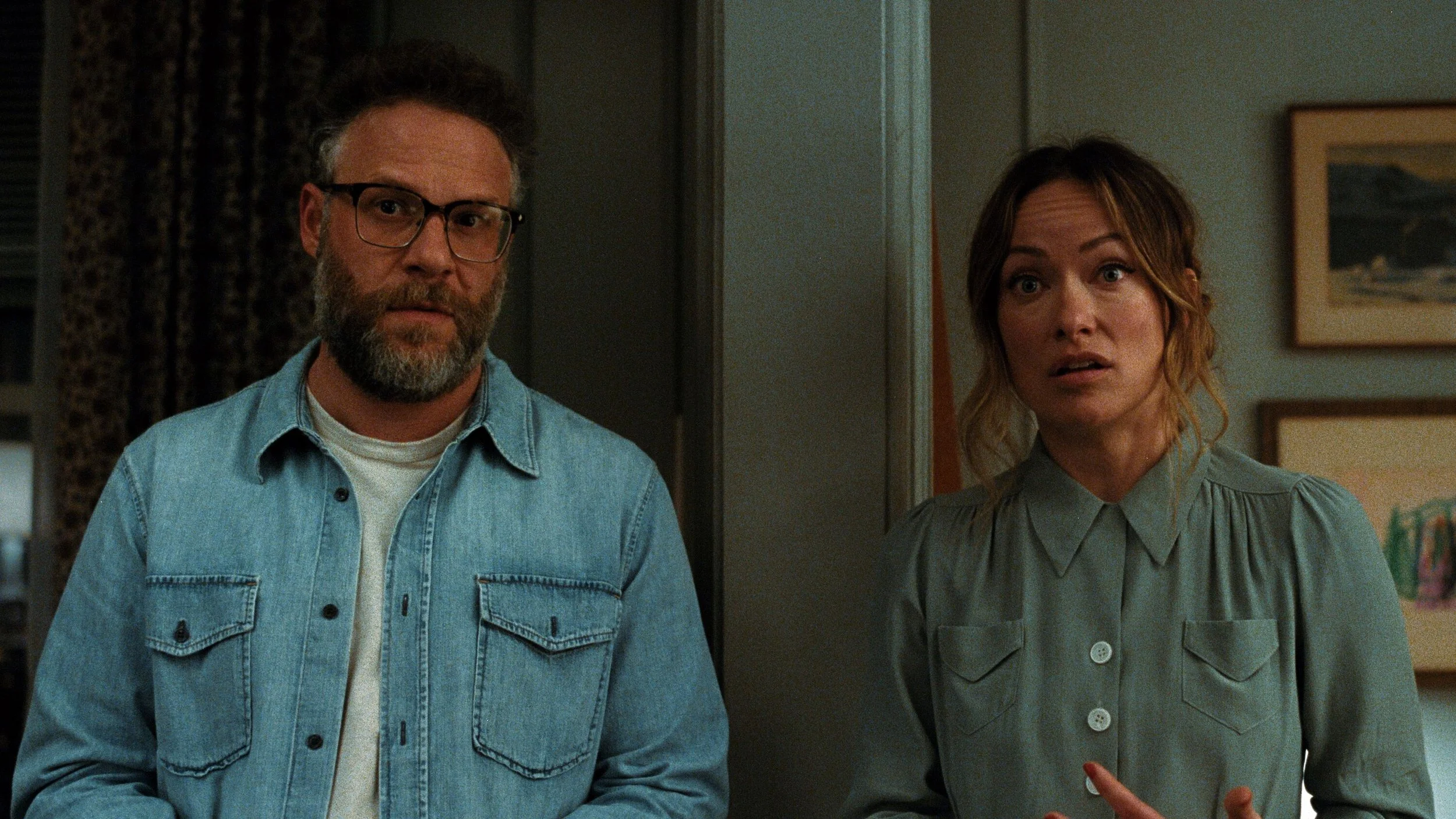
For a movie this concise, each act needs to stand on its own; unfortunately, the first part of the film feels as uneven and awkward as Angela and Joe’s failing relationship. There’s no finesse in the direction, as Wilde and cinematographer Adam Newport-Berra shows their hand with wide-lens shots of the couples carefully arranged, either diametrically opposed to each other or seen opposite each other through mirrors and windows. It’s as though you’re being tapped on the shoulder: “Look here at this unbridgeable gap between our characters!” Meanwhile, Dev Hynes, typically a maestro at composition, provides here an overbearing score that plays at top volume over each scene. It’s all strident chords and shrieking violins meant to emphasize the discord between the central couple, but coming across as an unwillingness to let the dialogue and performances stand on their own.
In point of fact, the score does almost distract from the pitfalls of those two factors. The movie’s brand of humor is predictable; each joke is delivered with an awareness that it will land well with the audience, and there’s an overreliance on the supposedly inherent humor of characters talking over each other at great volume. Wilde’s own delivery doesn’t help, with each line emphasized to the furthest extent and every reaction maximized like she’s about to stare directly into the camera a la The Office’s Jim Halpert. Rogen, meanwhile, is eminently readable as a shitty husband, but not given much to do other than smoke blunts and complain—no real stretch of the imagination for him.
It’s a relief when the focus shifts to Angela and Joe’s interactions with Hawk and Pína, as Norton and Cruz get more out of Rogen and Wilde than the latter do with each other. Both characters are foils to the main couple’s worse natures, with Hawk providing a kindly listening ear to soften Angela’s strident anxiety and Pína as the easygoing cool girl who Joe can’t find fault with. Their performances are more restrained, allowing space for the comedy and the drama that the movie aims to balance; it’s a shame then that they’re relegated mostly to observers of the chaos of Joe and Angela.
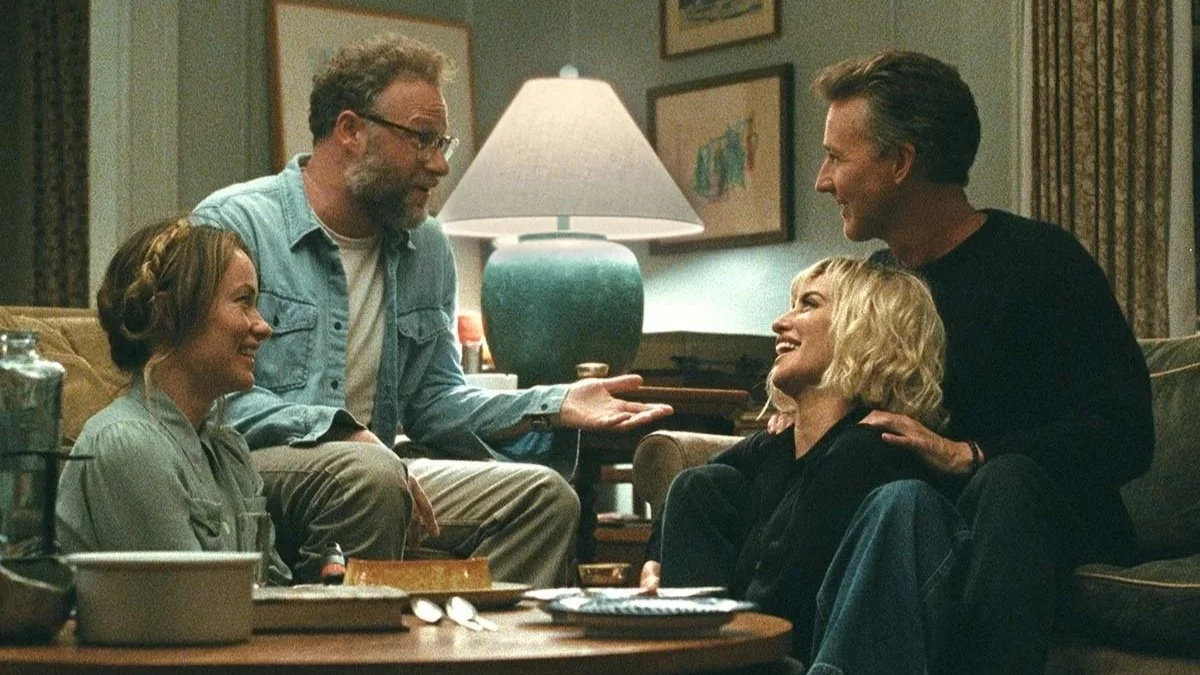
Midway through the movie comes a revelation about Pína and Hawk’s relationship that promises to lead into interesting new territory. But instead of deconstructing the key pillars of the storyline—monogamy, the institution of marriage, emotional labor and sexual liberty—McCormack and Jones choose to use the plot development as the butt of a joke before moving back into a predictable narrative. This narrative, in turn, stumbles by giving equal weight to Joe and Angela’s experiences of their marriage and the character flaws that affect that marriage. Angela may be a type A perfectionist, but Joe’s characterization as a distanced, emotionally unavailable husband more focused on belittling his partner than compromising with her makes it hard to care much about the devolution of their relationship.
Wilde’s second foray into comedy ultimately fails to replicate the freshness that made Booksmart succeed, even as she tries her hand at a new technique. But while the single-location film, with the right script and the right set of actors, can effectively heighten tensions and reveal character nuances, Wilde’s chamber piece only highlights an unbalanced set of performances and overly tame story.
If you enjoyed this article, please consider becoming a patron of Hyperreal Film Journal for as low as $3 a month!
Alix is the editor-in-chief for Hyperreal Film Journal. You can find her on Letterboxd and IG at @alixfm.