
The Bride! is Compelling, But Can't Quite Commit
From frame one, The Bride! promises to be the kind of surreal creative swing that major U.S. studios never make. Mary Shelley (Jessie Buckley), filmed in black and white extreme close-ups, speaks from beyond the grave about a story that’s been growing in her head like a tumor, which leads to a colorful sequence of a woman, Ida (also played by Jessie Buckley), in 1930s Chicago being possessed by Shelley at a table full of gangsters and their dates shortly before being shoved down a flight of stairs to break her neck. By the end of its two-hour-plus runtime, The Bride! offers countless other storytelling flourishes from writer and director Maggie Gyllenhaal that fly in the face of anyone expecting a straightforward retelling of any version of Frankenstein.
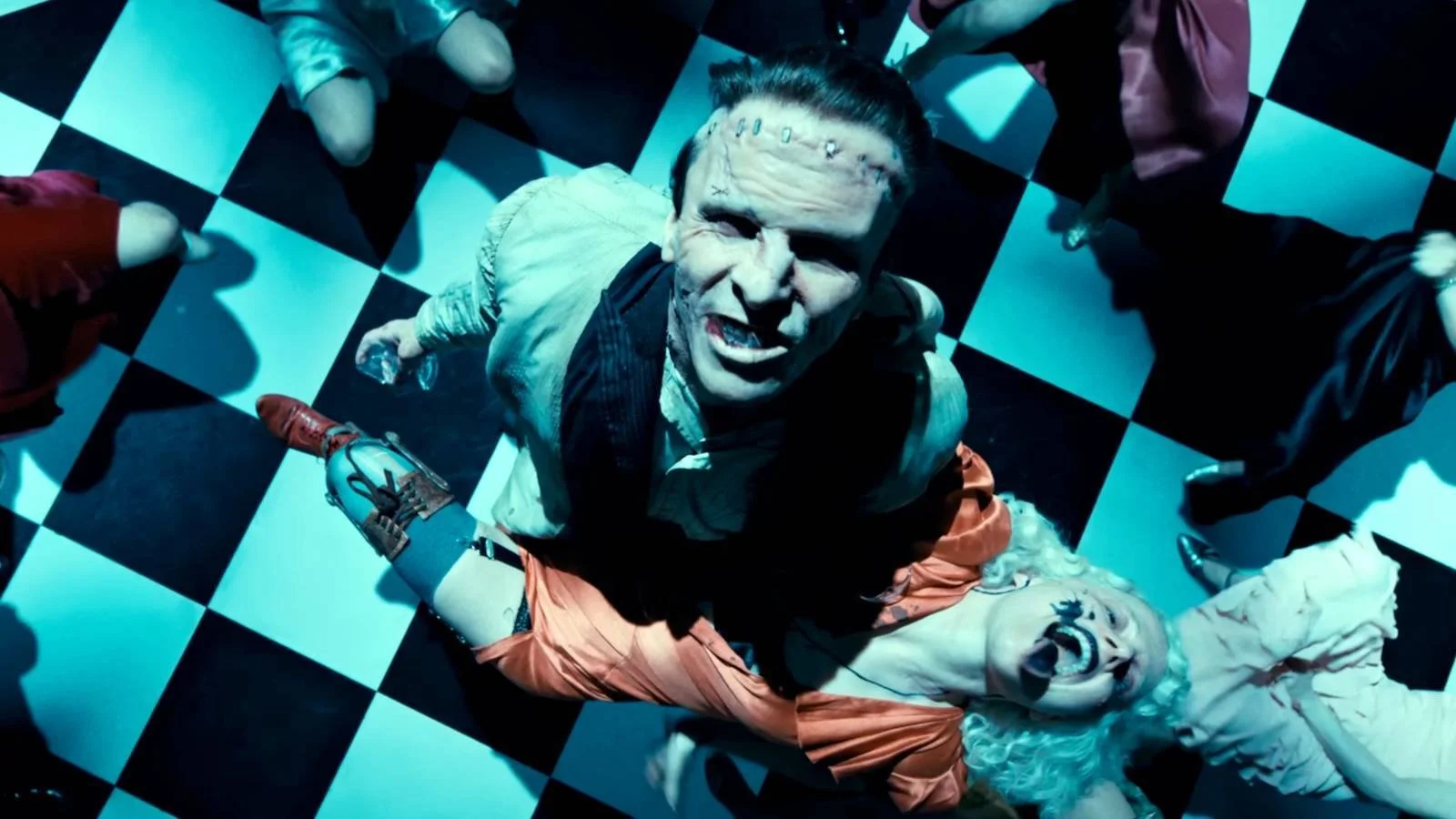
But The Bride! isn’t nearly as imaginative as it thinks it is. For all of the bravado that comes from the film’s musical cutaways, characters imagining themselves as silver screen stars, descents into perverse underground night clubs, and outbursts of violence, it is also puzzlingly easy to put into a box. Just as an unusual moment ends, The Bride! will become a pastiche of films as wide ranging as Bonnie and Clyde to Joker to Sid and Nancy. There’s a selection of ready-made jokes about The Bride! being Frankensteined together out of other movies, but those jokes miss the real tragedy of The Bride! on the whole. If only it was made out of only fantastical film parts instead of films with intensely literal storytelling.
Once the film moves past its unorthodox intro, a simpler story emerges. Frankenstein’s Monster (Christian Bale) has assumed the name of his maker. He approaches Dr. Euphronius (Annette Bening) in Chicago, a doctor who has carried on the work of Dr. Frankenstein in the decades since his demise. Frankenstein’s Monster feels he is dying of loneliness and recruits Euphronius to dig up a dead woman and reanimate her as a partner. They choose Ida, who cannot remember her previous life and speaks as if she’s possessed by Mary Shelley. Frankenstein’s Monster and Ida begin to bond, but when they kill a pair of men who attempt to sexually assault Ida, they go on the run while Detective Jake Wiles (Peter Sarsgaard) and Myrna Mallow (Penélope Cruz) pursue them. As Frankenstein’s Monster and Ida commit public killings in the name of women unjustly killed by men, they inspire a social revolution while also drawing unwanted attention from the Mafia.
Any merits of The Bride!, of which there are many, slam into a brick wall in the face of its biggest problem: undermining surreal storytelling with hyper-literal storytelling. No subplot in the film suffers more from this problem than the pair of detectives played by Sarsgaard and Cruz, who do almost nothing but dole out exposition and underline themes that Jessie Buckley and Christian Bale have spent the entire movie screaming at the audience in uppercase font, bold and italicized. The Bride! is at its best when it luxuriates in dreamlike sequences where traditional storytelling logic takes the backseat to letting emotional states take over. A standout sequence at the midpoint is an extended Young Frankenstein reference, a total musical blast of chaos. Inevitably, this is interrupted by the detective storyline trying to make sense of a scenario that doesn’t make sense by design.
There’s an unshakeable feeling that Maggie Gyllenhaal set out to make an even weirder film than this, but that someone at Warner Brothers realized this beast was going to cost $80 million, panicked, and forced more obvious storytelling beats into the edges of the film to keep average moviegoers from being “confused.” Perhaps that’s not the case, but whatever happened, The Bride! needed to commit much harder to one path or the other. The surrealist version of “Bride of Frankenstein, but it’s Bonnie and Clyde” is preferable by being a bolder pitch, but a more literal riff on the concept of “Bride of Frankenstein, but it’s Bonnie and Clyde” could have worked too. This hybrid version simply doesn’t, especially when the film tries to work in messaging about the exploitation of women.
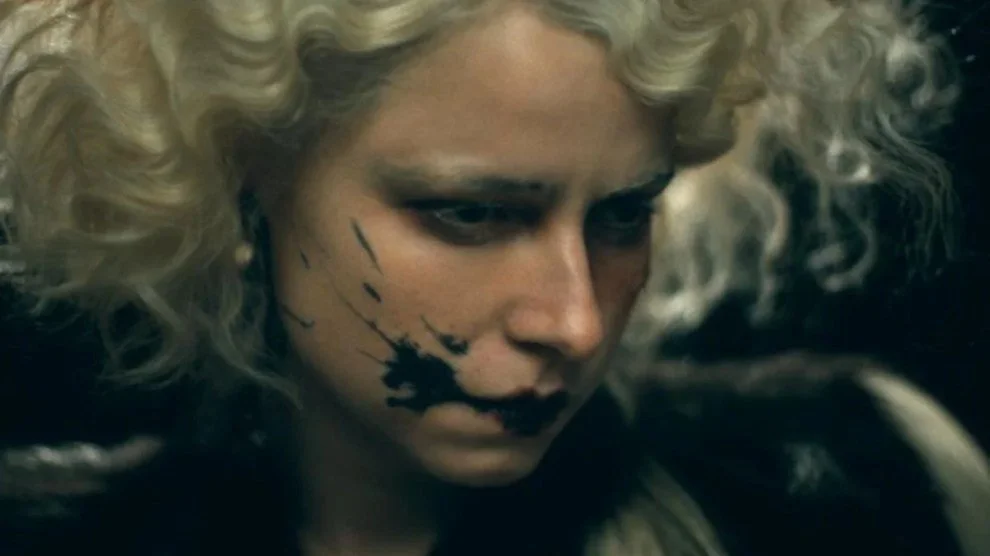
There are compelling ideas about men trying to take accountability for the pain they’ve caused women in their lives juxtaposed against fantasies of violent, justified revenge against men that cannot be redeemed. There are powerful moments of performance from Jessie Buckley where she speaks for other dead women who cannot speak for themselves since they were not reanimated like she was. There are a litany of horrific sequences where Ida faces cruelty and degradation at the hands of men and is punished for defending herself. Those are great ideas with teeth to explore, but they are often underdeveloped or shoved to the sideline as The Bride! overexplains its plot mechanics.
It also doesn’t help that most of those ideas are rendered through the aesthetic and tone of Todd Philips’ Joker in the most direct way possible. Not only does The Bride! feature Joker’s cinematographer, Lawrence Sher, it features Joker’s composer as well, Hildur Guonadóttir, and with Maggie Gyllenhaal referencing a movie they both worked on, the results feel derivative instead of inspired. When Sher and Guonadóttir are allowed to venture outside of Joker aesthetics and soundscapes, The Bride! does shine brightly. The black-and-white cutaways are starkly gorgeous, and a subplot involving a 1930s movie star played by Jake Gyllenhaal lets The Bride! indulge in inventive flights of fancy as Frankenstein’s Monster wishes he could sing and dance. The craft and art direction in The Bride! is its greatest strength.
Just like so much of The Bride!, the performances are a mixed bag throughout. Buckley will no doubt divide audiences with her go-for-broke insane performance, shifting and sliding through huge personalities as Ida searches for who she is after being resurrected. Bale’s interpretation of Frankenstein’s Monster is more straightforward and effective, though he’s being asked to do less by the script than Buckley. Anette Bening has a few inspired moments as Dr. Euphronius, but she doesn’t have much to do in the movie overall. And Sarsgaard and Cruz are fiercely mediocre, though each of them has a role so thankless that it’s hard to tell if their lacking presence is purely the product of the script.
The Bride! seems predestined for cult status. There is a clear ambition here that cannot be denied, and that ambition will no doubt win over fans of messy film curiosities who will flock to its defense. The mess is simply too much to ignore though, and the tug of war between surreal and hyper-literal storytelling snaps the whole film like a twig. At least if you dive into the mess, you will get to see some truly gonzo imagery funded at a blockbuster scale, and in 2026 that’s about the rarest thing anyone can get from an American studio film.
If you enjoyed this article, please consider becoming a patron of Hyperreal Film Journal for as low as $3 a month!
Jacob is a writer based in Austin, TX who loves giving infamous movies a chance, for better or worse. You can find him on Letterboxd at @Jacob_Ethington and on Instagram at @midwest_bummer.