
Weird Wednesdays: Spider Baby
This screening was part of the Alamo Drafthouse’s Weird Wednesday series. For upcoming shows, click here.
While his career in film only lasted for around 20 years, Jack Hill had one of the more fascinating runs of an exploitation filmmaker of his era. While his contemporaries during the heyday of the drive-in included names like Russ Meyer and Herschell Gordon Lewis, who respectively tended to bank on sex and gore to sell their tickets, Hill was more interested in finding a middle ground with sleazy women in prison films like The Big Doll House or exciting action in blaxploitation films like Coffy and Foxy Brown, giving cinema one of its earliest great female action heroes in the breathtaking Pam Grier. Regularly working with names like Francis Ford Coppola and Roger Corman, Jack Hill made a huge impact on the world of cinema during his relatively short time behind the camera, one that is very clear to anyone who has ever seen a Tarantino film.
Every director has to start somewhere though, and as is often the case with many up-and-coming filmmakers, the horror genre is the most accessible entry point. For Hill’s solo debut (he had also co-directed another horror film called Blood Bath, which had a very convoluted release history) this was Spider Baby: or, The Maddest Story Ever Told. A tall order to be sure, but in the cinemascape of 1964 (although the film sat unreleased until 1967), it really may have been as mad as any American movie released within the crippling grasp of the censor-happy Hays Code. The movie begins with a credits sequence featuring a theme song by none other than Lon Chaney, Jr., who also stars in the film as caretaker Bruno, promising a mad cannibal orgy juxtaposed against cartoony images that seem better suited to a candy commercial of the era, but this disparity is a perfect match to the oddball tone ahead.
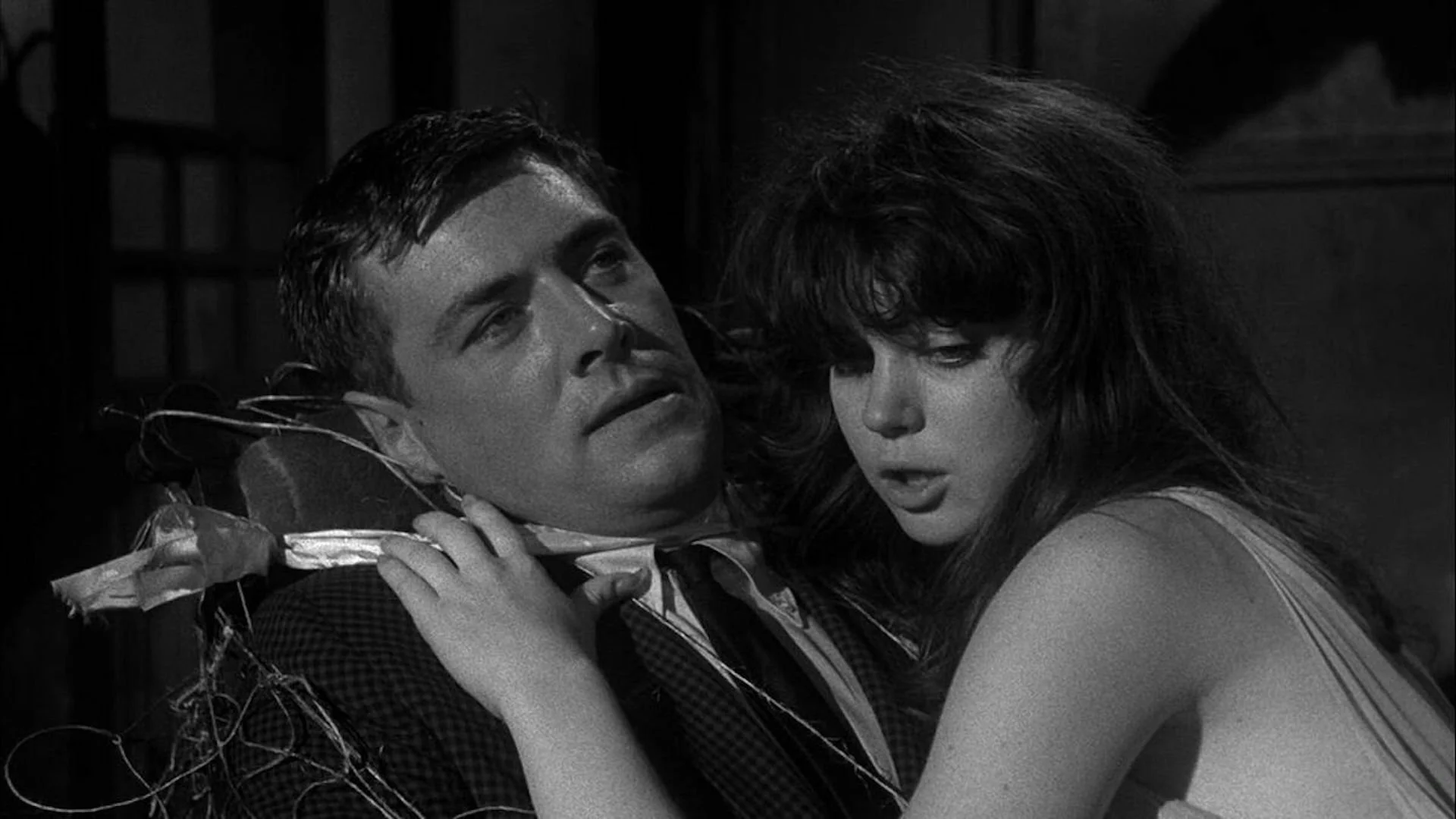
We’re introduced to Peter Howe (Quinn Redeker), a young, handsome man who talks directly to the camera about something called “Merrye Syndrome,” an affliction that is said to have only existed in one family, wherein the affected members regress mentally as their bodies age and mature, sometimes to a childlike state, and possibly all the way to pure madness, turning them into feral cannibals. He also assures us that this syndrome is no more and begins to tell of how it came into his life a decade prior. His tale begins with a messenger (Mantan Moreland) searching for the Merrye house, who finds himself trapped in one of the house’s windows and captured with a net by a young girl, only to then be told that he’s in her spider-web and about to receive her sting, which just so happens to be with a pair of kitchen knives. This is our introduction to Virginia, the spider baby herself, whose fixation on playing spider games always gets her into trouble. Soon we meet her sister Elizabeth (Beverly Washburn), who is clearly more responsible but is also obsessed with the idea of hate. Rounding out the trio of siblings is Ralph (frequent Hill collaborator Sid Haig), a bald simpleton who acts more like a dog than a human. In charge of their home is the aforementioned Bruno, a guardian in lieu of their parents who loves and understands them despite their proclivities for psychosis and violence. As he rushes to clean out the spider’s web, they discover their victim’s intent: he was delivering notice that they were to have visitors that same day, Peter Howe and his sister Emily (Carol Ohmart), who are distant relatives of the Merrye family and may be rightful heirs to the home, as well as his lawyer Schlocker (Karl Schanzer) and his assistant Ann (Mary Mitchel).
Soon we learn that Bruno never acquired legal guardianship of the Merrye children, nor did he send them to any kind of school, and that he promised their father to guard them for life, protecting them from the institutions they would likely be immediately committed to upon entering society. The four visitors want to remain overnight to examine things more thoroughly for themselves, but with only two rooms available, Peter takes Ann to the closest inn, while Emily and Schlocker stay at the house. As the night takes hold, things get properly mad, as promised by the title. Emily inexplicably decks herself out in full lingerie (Hill is an exploitation filmmaker first and foremost), only to be chased and caught by Ralph, the implication of which is rather dire, particularly in an era still brimming with censorship of all kinds. Schlocker investigates the house, discovering the pit of Merrye siblings who had regressed to their primal state, a discovery that of course leads to his demise.
Peter and Ann return, having found no rooms available anywhere nearby, leading to a climax filled with more spider games, psychosexual madness, and even a brief glimpse of the cannibal orgy that the opening theme promised, a climax that had to have been considered utterly unthinkable to the common filmgoer in a time when George A. Romero still had yet to make Night of the Living Dead.
Perhaps I’m overselling the insanity of the climax, but, for the time, it really seems truly bizarre and transgressive. A general synopsis of this plot doesn’t do justice to how Hill combines elements of horror with legitimate humor and camp, leading to many moments completely blurring the line between horror and comedy in ways that had never really been done before. The whole cast is game and sells their parts, from the most square to absolutely berserk, as believably as they possibly can. Unsurprisingly though, the true star of the show is Lon Chaney, Jr., who gives what is likely the last great performance of his long, storied career. He imbues Bruno with such warmth and affection for the Merrye children that the film can easily add a few moments of serious dramatic weight to its already heavy load of genres, making it even more of an enigma for its time.
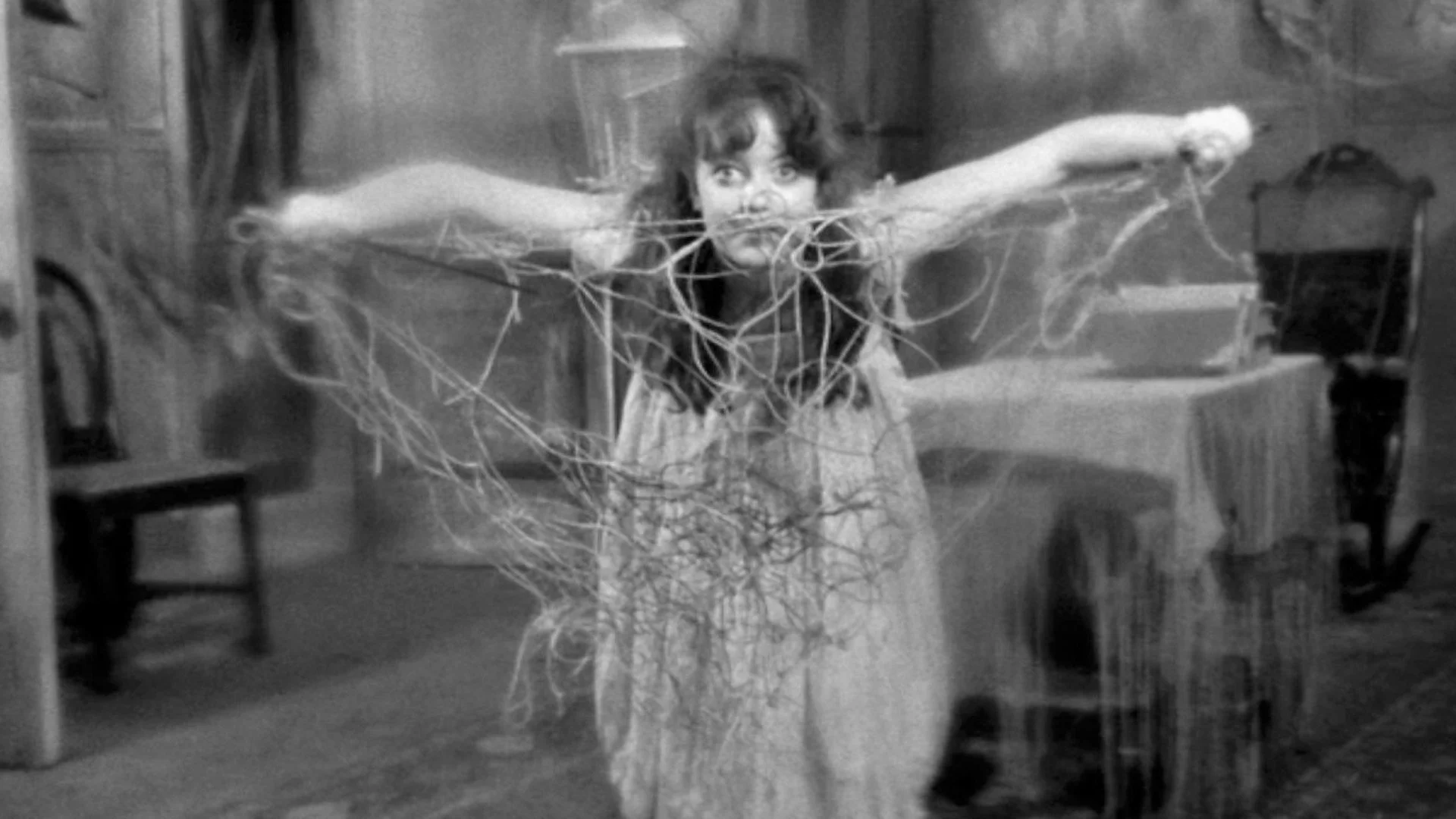
Unfortunately, the real estate company that financed (and therefore owned) the film went bankrupt, leaving it locked away for several years. It saw a release by the end of 1967, as well as a name change from Cannibal Orgy to Spider Baby, a no doubt more palatable title for the cinemas of the time. Over time, this wonderful little oddity of early horror-comedy, once thought lost until a print surfaced in the 90’s, became the very definition of a cult film, and one with a slow rise in cultural relevance within the genre community over the years. Eventually, it had a major rediscovery due to the film’s two major contributions to society, the debuts of Jack Hill as director and Sid Haig as an actor, found revitalized public interest thanks to names like Quentin Tarantino and Rob Zombie. The legacy of Spider Baby, now in the public domain, has led to a stage musical that premiered in 2004, as well as a remake (unfortunately from shlockmeister Dustin Ferguson, forgive me if I don’t have any hope for his vision) that premiered in 2023.
Despite being in the public domain, Spider Baby is best shared with a whole room filled with friends and strangers, a communal experience in beautiful weirdness before its time. It’s almost like Jack Hill dared to ask the question: What if the Addams Family were as dangerous as they were lovable? And thanks to our friends at Weird Wednesday, the communal experience brought us all together in a time warp to nearly 60 years ago, laughing and gasping in joy at something that we could have easily chosen to pay half-attention to on a smartphone via Youtube completely for free. Ease of access is nothing compared to the cinema experience, and I’ll be forever thankful that people in our community like Morgan Hyde and Laird Jimenez are keeping the dream alive.
If you enjoyed this article, please consider becoming a patron of Hyperreal Film Journal for as low as $3 a month!
Jackie Stargrove is a writer, singer, movie host, and the smallest pillar of the Austin film community.