
Sholay: The Final Cut Revitalizes a Classic
I distinctly remember the first time I heard about the Bollywood classic Sholay, though the incident itself was unremarkable. It was 2015 and, having just moved to Austin, I arrived to tour the apartment in which I’d be subletting a room. A piece of one of the current residents’ decor caught my eye: a teapot emblazoned with the film’s title, superimposed over dramatic-looking stills from Sholay. I was intrigued–surely a film that inspired kitchenware like this was a big deal for a reason. An internet search seemed to back up this theory; Sholay’s theatrical release poster declared it, “The greatest star-cast ever assembled! The greatest story ever told!” I tucked this information into my back pocket, adding it to my ever-growing watchlist of films.
Over the years, my knowledge of and appreciation for South Asian film expanded, and I gained a greater understanding of Sholay’s place as one of the most lauded Indian films of all time. But despite this, I never did get around to watching it–that is, until early March, when I attended a screening of Sholay: The Final Cut put on by Austin’s own Indie Meme at AFS Cinema.
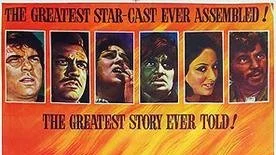
This new 4K restoration of the film (boasting the slightly tweaked tagline, “The Greatest Story Never Told”) is what Sholay director Ramesh Sippy’s nephew, Shehzad (who now helms its production company, Sippy Films, and was in attendance for a post-film Q&A at the screening I attended), has called “a milestone that finally presents Sholay exactly as it was intended to be seen.” That’s because, in addition to the meticulous work done to reconstitute the film from a hodgepodge of elements the restoration crew located around the globe, this version of Sholay contains its original ending, along with two deleted scenes–all of which were initially changed to comply with objections from the Indian film censor board.
Up to this point, I’ve said plenty about Sholay’s enduring legacy. But what is the film actually about? And does it live up to the hype?
Often referred to as a “dacoit Western” or “Curry Western,” and credited with inspiring a host of other films in the same genre, Sholay follows the exploits of two serial petty criminals: Jai (Amitabh Bachchan) and Veeru (Dharmendra). Jai and Veeru are a bromance for the ages–inseparable best friends who team up to pull off their jobs, seeming to communicate on a nearly telepathic level (to quote what the men sing to each other during the film’s iconic first song, “Yeh Dosti Hum Nahi Todenge”, “People see us as two people/but look, we are not two…We will live and die together/All our lives, forever”). The main thrust of the action starts when a figure from their past, former Police Inspector Thakur Baldev Singh (Sanjeev Kumar) recruits them for their most dangerous job to-date: hunting down and capturing notorious bandit ringleader Gabbar Singh (Amjad Khan) alive. You see, in addition to running a protection racket on his village in Ramgarh, Gabbar slew Thakur’s family and maimed Thakur himself years before–and Thakur wants his vengeance.
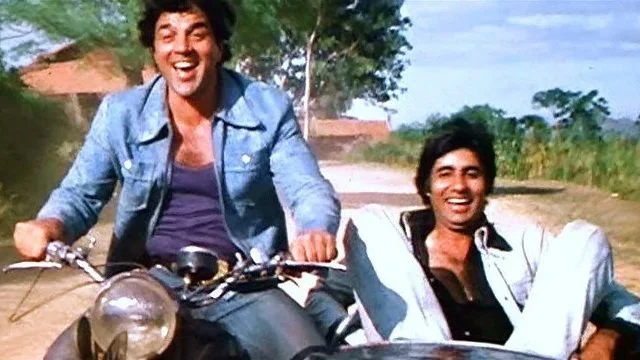
Veeru (left) and Jai (right). They stole the motorcycle they’re riding, by the way.
What follows is an action-packed three hours that manages to fit in a love plot for both Jai and Veeru, several flashback sequences and song-and-dance numbers, and plenty of laughs and quotable lines. For me, a person who is not always up to cinematic endurance tests, the runtime flew by (it also included an intermission–could all films over two hours long please take note?). I can’t think of one element of Sholay that isn’t well-executed and enjoyable to boot.
All of the film’s performances are memorable–even those characters that only appear onscreen for a scene or two. Bachchan and Dharmendra make a dynamic duo, with the former’s stoic badassery providing an often-hilarious foil to the latter’s goofiness and hopeless romantic tendencies. Kumar poignantly portrays Thakur as a man beset by tragedy with a stone-faced, hardnosed drive for vengeance at any cost. Khan’s Gabbar is a villain for the ages–a nasty, self-assured sadist who lords over the villagers as pawns, delighting in making his victims (and those who love them) suffer as much as possible. And I’d be remiss not to shout out Hema Malini’s performance as Basanti, the village’s chatty, spirited, take-no-shit horse cart driver (and Veeru’s love interest) who plays a pivotal role in Sholay’s final scenes.
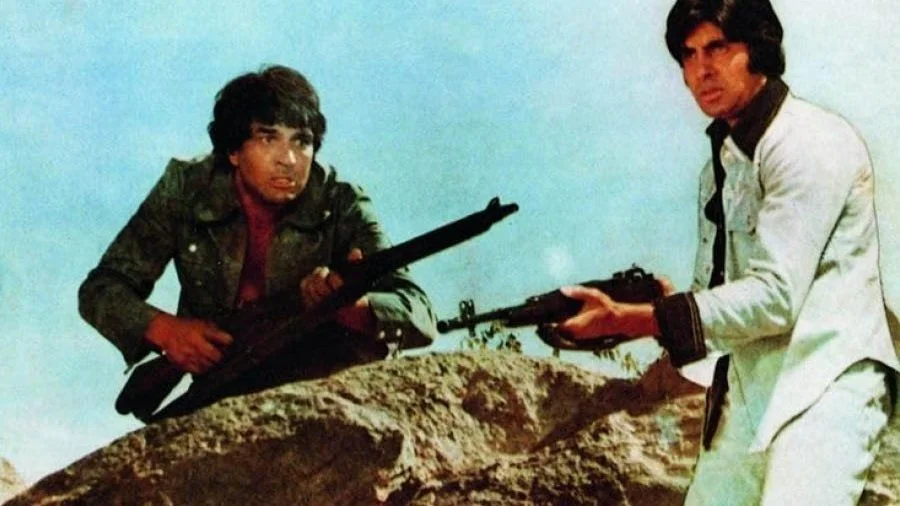
A moment of appreciation, please, for Jai’s impeccable style in this movie.
Of course, this being a spin on the Western genre, Sholay’s action sequences take center stage. Near the beginning of the film, we’re introduced to Jai and Veeru’s gunslinging prowess and quick thinking in a scene where they successfully save a goods train from an attack by bandits–running atop train cars, shooting men off of horses, engaging in close combat, and setting off an explosion. Seeing all this excitement early on, it’s hard to believe Sholay can top it…but the stunt people (and stunt horses, for that matter) are working overtime for the movie’s duration, giving us a dynamically shot and edited flurry of bandit ambushes, tense shootouts, high-speed chases on horseback, and a truly wild and cathartic finale that I won’t spoil here.
Given the strength of its parts, it’s no surprise that Sholay remains a hit. But, even so, how does one explain its unprecedented dominance in Indian film history? There are probably many ways to answer that question, but one that comes to the fore is its place in India’s postcolonial landscape. The film makes no bones about its feelings toward domineering forces of all kinds, from Jai and Veeru’s disdain for the law; to the portrayal of an incompetent, self-important jail warden (always outsmarted by Jai and Veeru) who brags about being “from the days of the British;” to a rousing speech delivered by Thakur to his fellow villagers likening their struggle against Gabbar’s reign to India’s history of resistance to tyrants (calling India, to roughly paraphrase, a country of farmers who have sharpened their sickles into swords in the face of attack). The film never directly references India’s struggle for independence, but the anti-establishment ethos shown through these instances makes the fact that Sholay was first released on August 15, 1975–the 28th anniversary of Indian Independence Day–seem as though it may not be a coincidence.
Having now seen Sholay: The Final Cut, I’m actually glad that I never got around to viewing the film before the screening I attended. Watching this lovely, faithful restoration in a sold-out theater filled with patrons of all ages cheering, singing, and quoting along feels exactly the way the epic was intended to be seen. Getting to hear Shehzad Sippy recount the three-year restoration process and family stories about the movie was the cherry on top. All in all, at least if the enthusiasm of my screening’s audience is anything to judge by, Sholay: The Final Cut’s restoration efforts were not in vain: 50 years on, the movie is as cherished, resonant, and exciting as ever.
If you enjoyed this article, please consider becoming a patron of Hyperreal Film Journal for as low as $3 a month!
Liz is a Chicago-based film enjoyer, crocheter, and Hyperreal Film Journal editor. Find more of her thoughts on movies (mostly those with killer soundtracks) @espieck on Letterboxd.