
Project Hail Mary Review
Eleven years have passed since Ridley Scott’s adaptation of the Andy Weir novel The Martian. A hit with audiences and critics alike, The Martian stands out in the late-career-catalog of Scott as a highly optimistic sci-fi tale about the power of cooperation and the endurance of human determination, making it essentially the anti-Prometheus/Alien Covenant. The Martian is also the kind of large-scale sci-fi standalone blockbuster that has evaporated out of Hollywood in the near-decade since, so it’s only appropriate that Project Hail Mary, another adaptation of a Weir novel, stakes its claim as both a literal and symbolic successor for that crown.
That is not to suggest that Project Hail Mary and The Martian are identical. The only personnel each film shares beyond being based on Andy Weir novels is screenwriter Drew Goddard. Project Hail Mary marks the feature-film directing return of duo Christopher Miller and Phil Lord, their last credited film being 22 Jump Street in 2014, just one year before The Martian released. Crucially, The Martian was far more contained, the tale of an entire world coming together to save one human being stranded in the most improbable of places. Project Hail Mary operates on a far grander scale as a globally funded mission into deep space that must succeed or all life on Earth as we know it will die over the course of several decades. As if that change in scope wasn’t massive enough, it turns out that mankind isn’t the only dying world on the same mission.
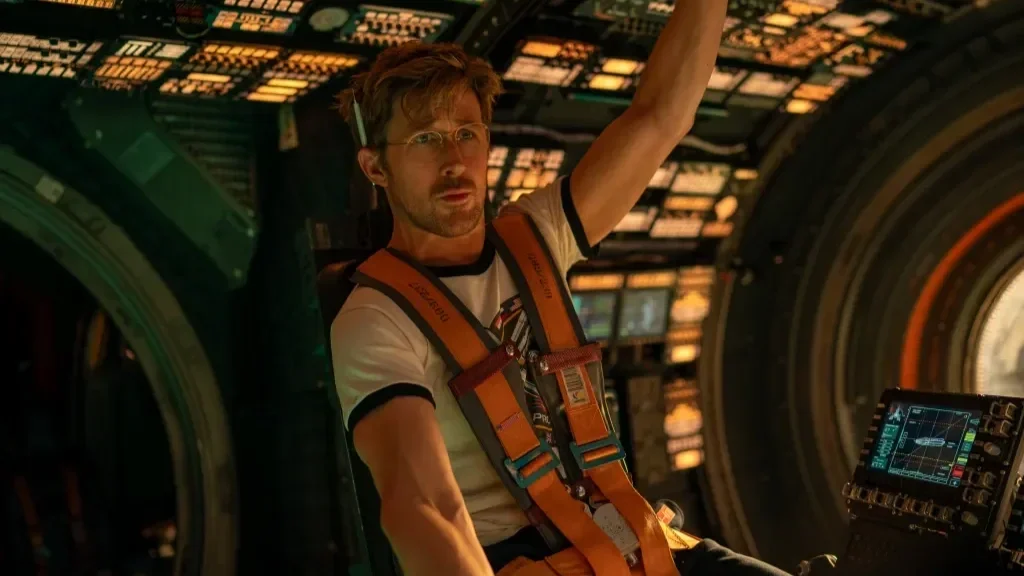
Ryland Grace (Ryan Gosling) is dragged out of a medically induced coma on a spaceship known as the Hail Mary. An onboard medical computer explains to Grace that the medically induced coma can cause a number of symptoms, including memory loss. That is exactly what Grace is facing, as he cannot remember who he is or what he’s doing on a spaceship. To make matters worse, his two fellow human crewmembers died in their comas. He slowly pieces together that he is a former molecular scientist turned schoolteacher recruited by the head of a scientific taskforce, Eva Stratt (Sandra Hüller), to investigate a star called Tau Ceti. Scientists on Earth discovered a strange form of life known as “astrophage” that slowly consumes stars, dimming their light and killing life on nearby planets. Tau Ceti is the only star unaffected by the astrophage, so the Hail Mary mission is to hopefully discover a way to save our sun.
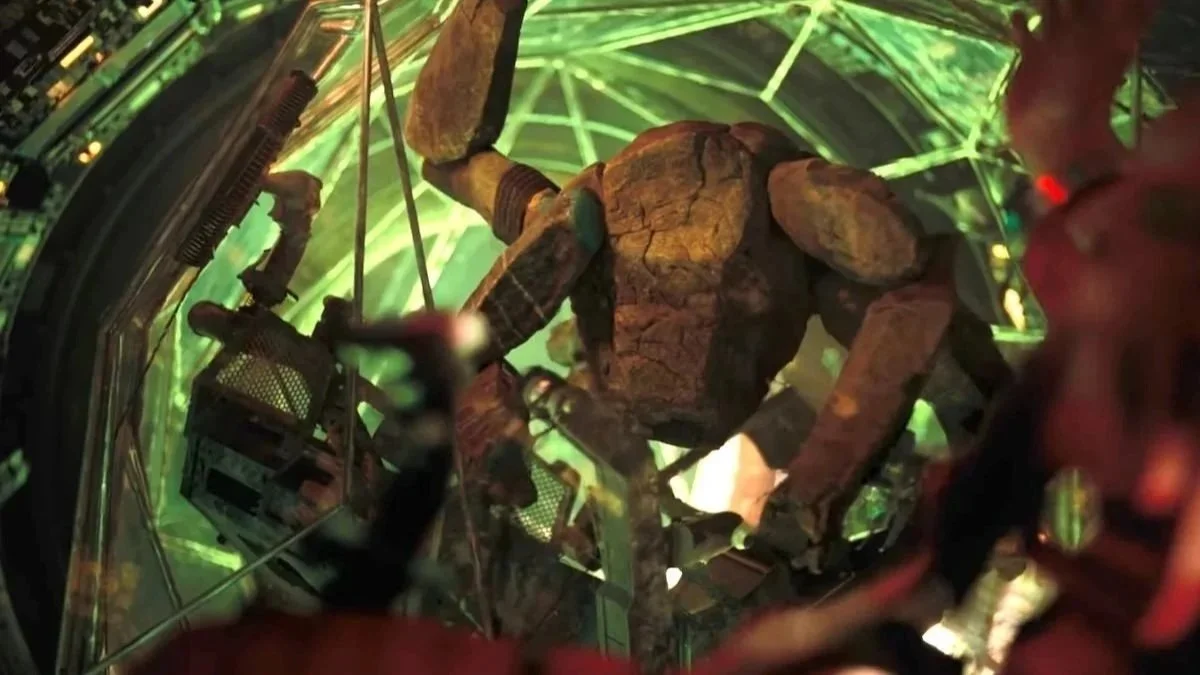
However, Grace is not alone on his mission. As if trying to slowly recover his memories in deep space wasn’t difficult enough, an alien spaceship appears. Grace finds that the ship, just like him, only has one surviving crewmember, an alien from a species that appears to be made of stone. Grace names the surviving alien Rocky (voiced by James Ortiz), and the two must learn to communicate and live with each other to save their worlds from the astrophage.
As dense as that setup is, Project Hail Mary is expertly paced to lay out its stakes. The runtime is a daunting two hours and thirty-six minutes, but only in the final stretch of the film do you remotely feel the length. The intercutting of flashbacks on Earth as Grace regains his memories is well-placed, though the film struggles to convey at times whether Grace is remembering what the audience is seeing or if it’s a moment where the audience knows more than the main character. Regardless of that issue, the cross-cutting creates a constant momentum without stepping on emotional moments that deserve time to sink in.
Ryan Gosling’s performance as Grace is what makes Project Hail Mary sink or swim. On paper, Grace is a type of character that, unless executed perfectly, is incredibly annoying. He is a schoolteacher because he was an arrogant scientist exiled by his community, and while he isincredibly intelligent, he constantly doubts his abilities despite his extraordinary contributions. He is alone in his personal life and awkward to the point of cinematic quirkiness. Grace is particularly playful in some of the Earth flashbacks where, in the middle of his research, he’s in a hardware store playing bowling with rolls of duct tape and boxes of aluminum foil. Grace also communicates through pop culture references to music and films in both his flashbacks and while aboard the Hail Mary, though these references aren’t constant.
As insufferable as Grace might sound, it is shocking how heartfelt and wonderful he is as a character, and that is entirely to the credit of Ryan Gosling’s performance and the screenplay by Drew Goddard. That last point about Grace’s pop culture references was true of Matt Damon in The Martian – it appears that one of Drew Goddard’s writing superpowers is making this specific type of character work onscreen. A great example of this is the naming of the alien Rocky, which is smartly built upon the longer the film goes on in both playful and meaningful ways. Gosling is delightful as a man way in over his head trying to do his best, but the character of Grace truly comes to life when Rocky is introduced.
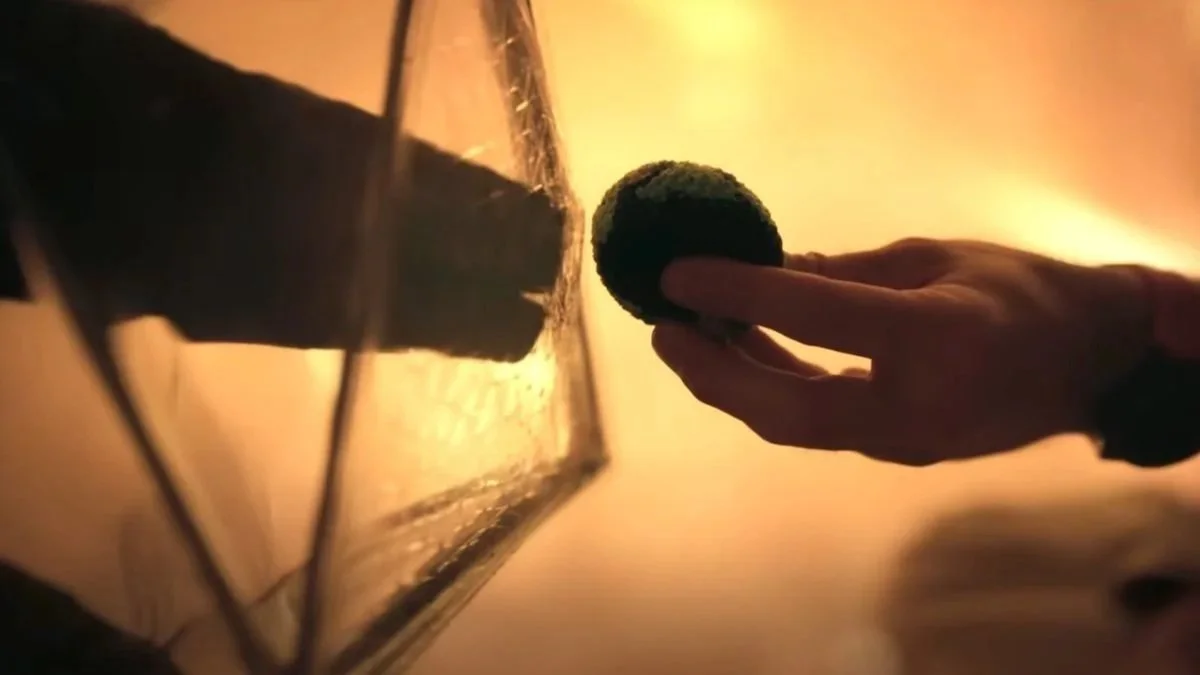
A description of “Denis Villeneuve’s Arrival, but it’s a buddy-comedy adventure” may sound galling, but that’s ultimately what Project Hail Mary turns into with powerful results. The rapport between Grace and Rocky is equal parts hilarious and emotionally harrowing. Once they figure out how to communicate with one another, their unusual friendship is totally believable. There are some slightly obnoxious translation jokes between them, but they end up having their own somber payoffs. It's worth noting that Rocky is an impressive combination of practical puppetry augmented by digital effects. Despite not having a traditional face on his body, there’s no mystery to how Rocky is feeling in his highest and lowest moments. As absurd as it may sound, be prepared for a faceless rock with legs to bring you to tears.
Rocky is far from the only impressive visual element in the film. The interior sets of the Hail Mary are absurdly detailed, and there is no question as to where the over $200 million spent on this film went. Project Hail Mary has some of the most jaw-dropping and colorful space-faring imagery in recent filmgoing memory, and not just because of its digital backdrops. The cinematography is from the one and only Greig Fraser, whose recent career highlights include lensing Dune: Part One, The Batman, and Dune: Part Two. It should go without saying that Project Hail Mary plays with textures and layers of focus in ways that will be immediately familiar to anyone knowledgeable about Fraser’s work up to this point.
Project Hail Mary has all of the trappings of a poppy science fiction adventure for the whole family from its visuals to its story, but it does introduce just enough darkness to counterbalance its hyper-optimism. In a flashback, Sandra Huller’s character coldly remarks that Earth may only have 30 years before a quarter of its population dies from the dimming of the sun, and that’s assuming nations will responsibly ration their food, which she believes they won’t. The plot contrivance of Grace’s amnesia also leads to a few shocking reveals, the final of which recontextualizes Grace’s entire journey as a character. There’s just enough salt in this film’s recipe to cut against its sugary sweetness. Considering that directors Christopher Miller and Phil Lord produced and co-wrote the Spider-Verse films, their expertise in balancing light and darkness shines through in Project Hail Mary.
The biggest issue with the film is its final stretch in which Project Hail Mary refuses to end. Just as it seems like the movie is about to cut to credits, it keeps going and going, to the extent that the final scene could have easily continued beyond that point and dragged the movie out even further. Project Hail Mary doesn’t completely overstay its welcome, and that final scene is a great place to end the story, but the last 10 minutes or so feel a bit disjointed in how it decides to get there. There are definitely nits to pick with Project Hail Mary, but it feels like it’s been ages since a four-quadrant-style blockbuster actually tried this hard to respect its audiences’ intelligence, isn’t connected to a larger franchise, and does real work to build an emotional core to latch onto.
Eleven years ago, when The Martian was released, there were more movies like this, and thefarther back you go into the decades from before 2026, you will find more and more relatively original Hollywood blockbusters with this level of production and care put into them. It’s arguable that some of the warmer feelings to be had for Project Hail Mary are because of the oasis in the desert it represents, but that oasis is a clear spring and not just any source of water in a harsh landscape. Project Hail Mary is an honest and successful attempt at a crowd-pleasing sci-fi blockbuster, and let us hope that it inspires studios to try harder at achieving the emotional spectacle all audiences crave.
If you enjoyed this article, please consider becoming a patron of Hyperreal Film Journal for as low as $3 a month!
Jacob is a writer based in Austin, TX who loves giving infamous movies a chance, for better or worse. You can find him on Letterboxd at @Jacob_Ethington and on Instagram at @midwest_bummer.