
Pink Cuts: Love Hotel
Slick city streets and vibrant neon fill up the background of Shinji Sōmai’s Love Hotel. I wasn’t entirely sure what to expect from the second screening in Austin Film Society’s Pink Cuts series, but to say there was a sharp turn from the joyful vibes of Love Me Hard, Love Me Deep would be an understatement. The story of a married man who loses his wife as collateral for his debts to the Yakuza (husband of the year he is not) and the sex worker he had a violent one-night tryst with, Love Hotel is unafraid to dig into thornier tensions than its predecessor. The film centers on an amour fou, and it’s unclear what will happen to our protagonists when they re-encounter each other in a taxi two years later.
Down on his luck, Tetsuro (Minori Terada) can’t stop thinking about annihilation. Thinking about nothing more than doing one last crazy thing before he kills himself after losing everything, he rents a room in a seedy hotel. Sex worker Yumi (Noriko Hayami) comes by his room, and the evening turns violent, quickly. Yumi ends up restrained, bleeding, and helpless. Tetsuro leaves before things can get worse. Years later, the pair reunite unexpectedly and are still drawn to each other, like magnets. They decide to recreate the night they first met, and as they get drawn back into each other’s orbit, it’s clear something has changed.
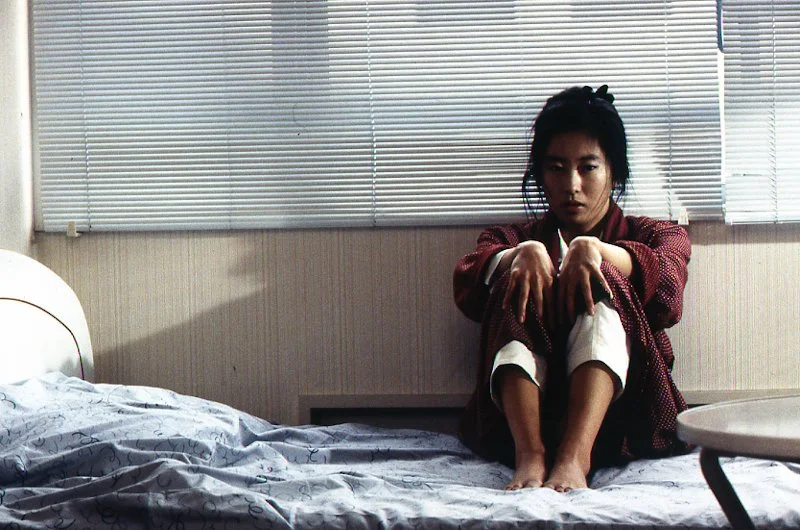
If Director Yoshimitsu Morita had a gift for capturing the vibrant beauty in the sexually charged pastel world that Love Me Hard, Love Me Deep existed in, Director Sōmai captures a different kind of beauty and sensuality altogether. Here, bright hues and playful pans are replaced by a moodier approach. Everything glistens under Sōmai’s camera: damp windows, rain-soaked streets, skin. It adds a different flavor to the explicit sexuality on display, coloring it all with an ethereal melancholy that pervades the film. The connection between Yumi and Tetsuro feels more like a doomed inevitability among the dark alleyways and damp cityscapes, like their reunion can’t escape the turmoil of emotions from their first meeting. It’s a darkness that blurs the motivations and desires of these characters, as well. The result is something tumultuous and fraught, but compelling nonetheless.
We’re left to wonder, what, exactly, do these characters want from each other? In their first meeting, the lines of desire were clearly drawn, with Tetsuro hungry for annihilation and Yumi forced into his orbit. Now, the tables seem to have shifted. Yumi is the hungry one, making the advances when the pair eventually makes it back to the very same hotel room they shared. The performances of Terada and Hayami help bolster the tension and connection we’re supposed to feel between our leads. Never lacking in intensity, this pair know how to play both their characters, even as their motivations and hunger for each other shift throughout the film. It seems like no matter how much they want their reunion to work, it just can’t shake the pain of their first encounter.
Mirrors are often used throughout the film to help expand the landscape of the shot -- like in one sex scene where we get to see both angles of our main characters. In one frame, we’re granted multiple perspectives, seeing things from both Tetsuro and Yumi’s viewpoints, widening the horizon of the bed they share while putting us in both of their shoes. What we see in these mirrors are two deeply broken and desperate people, trying to hold onto something solid in the uncertain push and pull of their lives. It’s almost sweet in a twisted way: two people trying to find something bigger than themselves and their circumstances in each other.
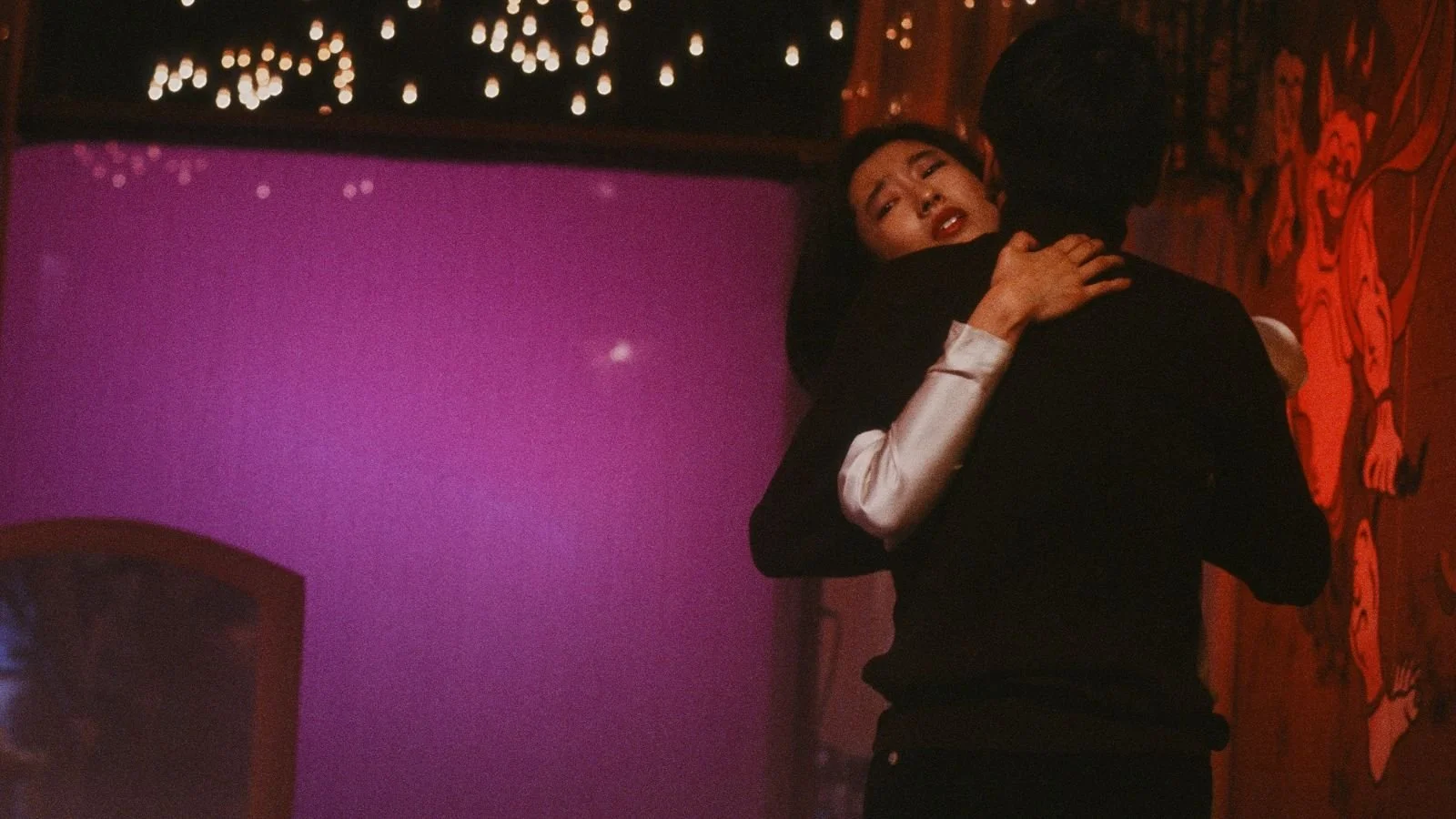
Love Hotel ends up not necessarily answering the question of what these two people want or need from each other, but it does leave a familiar bittersweetness in its wake. Anyone who’s seen In the Mood For Love, or any other movie where star-crossed lovers try to defy the odds, will know the score. Despite the sadness, there is something oddly comforting about being able to sit with the weight of an unresolved ending. Not every connection is meant to last forever, and not every story has a clean ending. It’s a truth that I’ve often struggled with understanding, but movies that confront us with it, like Love Hotel, have made me feel a little less alone in sitting with the uncertainties and darkness of this world. It might be odd to find something comforting to take away from a pink film, running over the incomplete ending like fingers tracing a worry stone, but that’s what makes film, and art in general, so important: there is something that can speak to anyone, even where you least expect it.
If you enjoyed this article, please consider becoming a patron of Hyperreal Film Journal for as low as $3 a month!
Alejandra Martinez is a Tejana archivist, writer, and film lover in Austin, TX. She loves coffee, David Lynch, and tweeting about everything under the sun.
Twitter: @mtzxale.