
Magellan: Jesus on the Mast Line
Ferdinand Magellan’s name is still remembered for his command of a sixteenth-century voyage that is credited as the first circumnavigation of the globe. This expedition’s goal was to discover new trade routes, in order to extend the power and influence of European culture to the farthest reaches of the world. But contact became conflict as Magellan’s quest for riches caused death for others through warfare. Lav Diaz’s Magellan (2025) is a historical drama with an emphasis on naturalism that heightens the violence of its titular character’s ambition.
Magellan is hardly the first historical drama to link the collusion of European explorers and their religious beliefs to their quest for dominance over the indigenous cultures they encounter. Werner Herzog’s Aguirre, the Wrath of God (1972) covers much the same thematic ground, even though its historical figures travelled several decades later and to an entirely different location in their pursuit of power. But all global quests first begin at home, where plans must be approved by the very source of authority these explorers intend to represent to the world.

Much of Magellan’s first half finds its Portuguese explorer submitting his proposal through emissaries of different kings (one Portuguese and the other Spanish) to find and establish a new trade route. Save for a few outbursts from his slave Enrique (Amado Arjay Babon), the film finds Magellan (Gael Garcia Bernal) in a repressed state. So much so that he prematurely ejaculates while being tended to by his nurse Beatriz (Ângela Azevedo), who is so flattered by the embarrassing moment that she later becomes his wife. Now married, Magellan has more motivation to explore the world to amass riches–not just for himself or his country, but to gain wealth for his family.
Magellan’s performances are purposefully muted, which, interestingly, heightens the film’s violence. It begins with Magellan recovering in a battlefield with bodies strewn around him. The image of recently slain corpses lying still in a forest is reminiscent of Renaissance paintings that artfully depict famed battles of conquest. The audience is not shown the fight in its occurrence, only its aftermath. From its carnage rises Magellan, who survives only to bring about a similar deathly combat somewhere else–all with the blessing of his era’s political powers, the Spanish state and the Catholic Church.
Bernal’s leading performance as Magellan effectively matches the film’s naturalism. There’s no overacting, even as he strikes down a colleague who believes their voyages are bringing evil upon an unsuspecting world. Watching Bernal and his co-actors is like viewing a painting’s subjects–we understand the emotional narrative, even if the historical figures within are still.
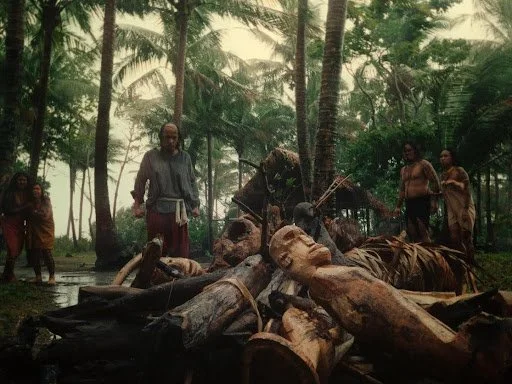
This naturalism is furthered in the film’s sound design and cinematography. Other than several moments featuring live music, Magellan’s sound is completely of each scene’s environment: the sound of rainfall on a river, a forest with its active creatures, and a ship with its ropes/wooden structure creaking upon the waves. As for the cinematography, the camera remains fixed and static in its capture of events. There are no camera movements; instead, the action often moves off camera, with participants committing to their chosen course of action (usually violence). The effect of such intended naturalism makes for a slow-but-patient viewing experience. Audiences have to earn Magellan’s epic expedition.
Though Magellan is a power-seeking explorer, one who will order his fellow shipmates’ execution, he is not presented as a complete antagonist. He is a determined leader, but one who is plagued with longing for his wife and newly-born son. He cradles his ornamental Christ Child as if it were his own infant. But when his soldiers confiscate wooden sculptures from the Filipino people they are colonizing, only to later set the depicted deities ablaze in a bonfire, it is clear that Magellan’s mission is to conquer rather than convert and ally with the indigenous culture.
Diaz’s film is revisionist; it suggests certain historical figures, like Datu Lapu-Lapu, the Filipino hero who defeated Magellan, are pure inventions. Lapu-Lapu serves here as a rumored, defiant figure to draw Magellan into attacking first against the supposed rebel–a fatal mistake for the explorer who intended to build community and commerce. Yet, Diaz’s revision creates an interesting counterpoint between the two warring cultures, asking which is more powerful: the Filipinos’ “ghost” (Lapu-Lapu) or the Portuguese/Spaniards’ Catholic “God”?
In a time when the world’s most powerful countries attempt to extract commerce with the threat of violence, Magellan prompts the question: has anything really changed all these centuries later?
If you enjoyed this article, please consider becoming a patron of Hyperreal Film Journal for as low as $3 a month!
Paul Feinstein is an arts professional who has produced content in different mediums including film screenings, live music, radio, and theater. He is a native Austinite.