
Starlet Shamans Steal the Show in KPop Demon Hunters
Never doubt the stans. For a year filled with half-hearted hurrahs and a handful of spectacular failures in the world of film, the cinematic event of last year was a straight-to-streaming Netflix original for tweens about… K-Pop! Indeed, KPop Demon Hunters is the most-watched original on the streamer’s site. Where to start, then, in dissecting a film that traverses and translates pop iconography and rhythms for a global audience? First and foremost is to recognize that Maggie Kang and Chris Appelhans’ film is, above all else, a triumph for all things human. It’s idiosyncratic. It’s deeply-felt. It’s fun! With an intelligent, empathetic, and engrossing coming-of-age story that works through thorny questions of self-doubt, family tradition, and massified music culture, KDH pulls off a balancing act that delights, dissects, and delivers us from our couches to self-knowledge.
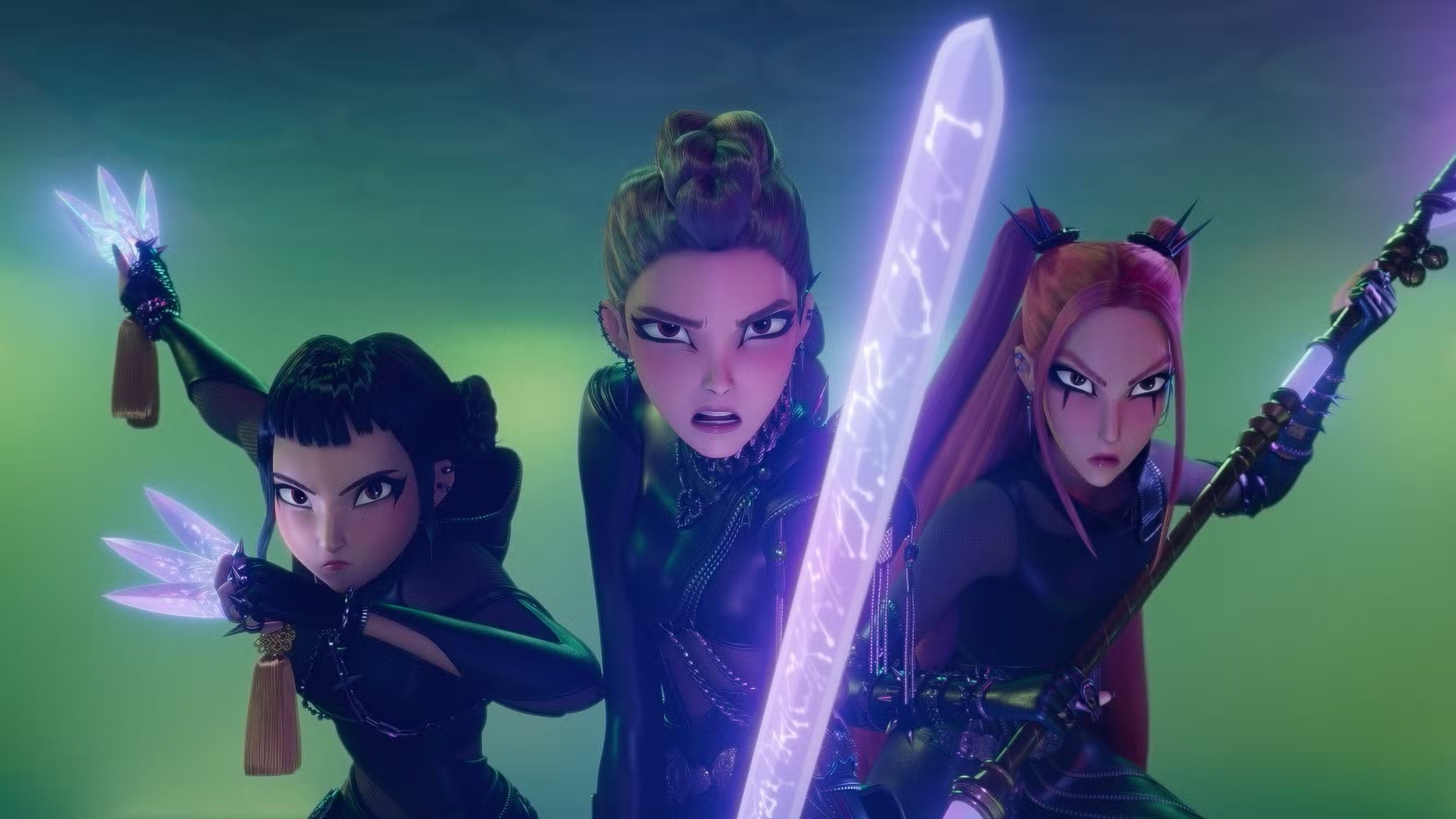
Which is to say: Doubt the stans, the fans, and the Man, man. The film's genius is in its lesson of critical reflection towards those things which we assume give us meaning, from wealth and tradition to social acceptance and celebrity worship. The ascendant K-pop girl group Huntr/x (comprising three sisters) is at the near apex of their power when the movie begins. The world waits on their every move and their fans are ready to die for them. What more could one want? Turns out: The picture isn’t as rosy as it appears. With so many eyes on them, the sisters are trapped in golden handcuffs. To start, idol training in the K-industry is notorious for its grueling conditions and expectations. Teenage girls are plucked from their regular lives (school, family, neighborhood) to live, breathe, and bleed in the name of perfecting themselves in day-in-day-out training programs. Only the cream of the crop can pass through the hallowed gates, meaning the pressure is incredible. (The co-writer of “Golden” and singer for eldest daughter Rumi, Ejae, was in the training system for over 10 years without ever being debuted by her agency.) And it only seems to ramp up once you’re in the hot seat of idolhood—suicide and depression continue to be major issues in K-pop world (notably Jonghyun’s death in 2017 and Goo Hara in 2019). With the latter, the pressure on women in regards to dating and the presentation of “purity” is especially stifling.
What’s lacking, therefore, is the space to make mistakes and to be oneself (towards authentic selfhood). In particular, Rumi of the Huntr/x sisters has the marks of a demon. While she and her sisters kill legions upon legions of underworld crawlers and aim to eradicate their kind from the world, Rumi is herself of demonic heritage. It keeps her from showing her skin to the world, wearing long sleeve shirts and never going to the bathhouse. The mix of parental and social pressure is encapsulated in the mantra taught to the girls as a way of hardening them against the world: “Our fears and faults must never be seen.” It’s classic tiger parenting. The kind of parenting that might ask, what more could you ask for in this world than financial security and social acceptance? The opening scenes of the film clearly show us the internal cost of this style of thinking.
Before we get ahead of ourselves—yes, there are demons.
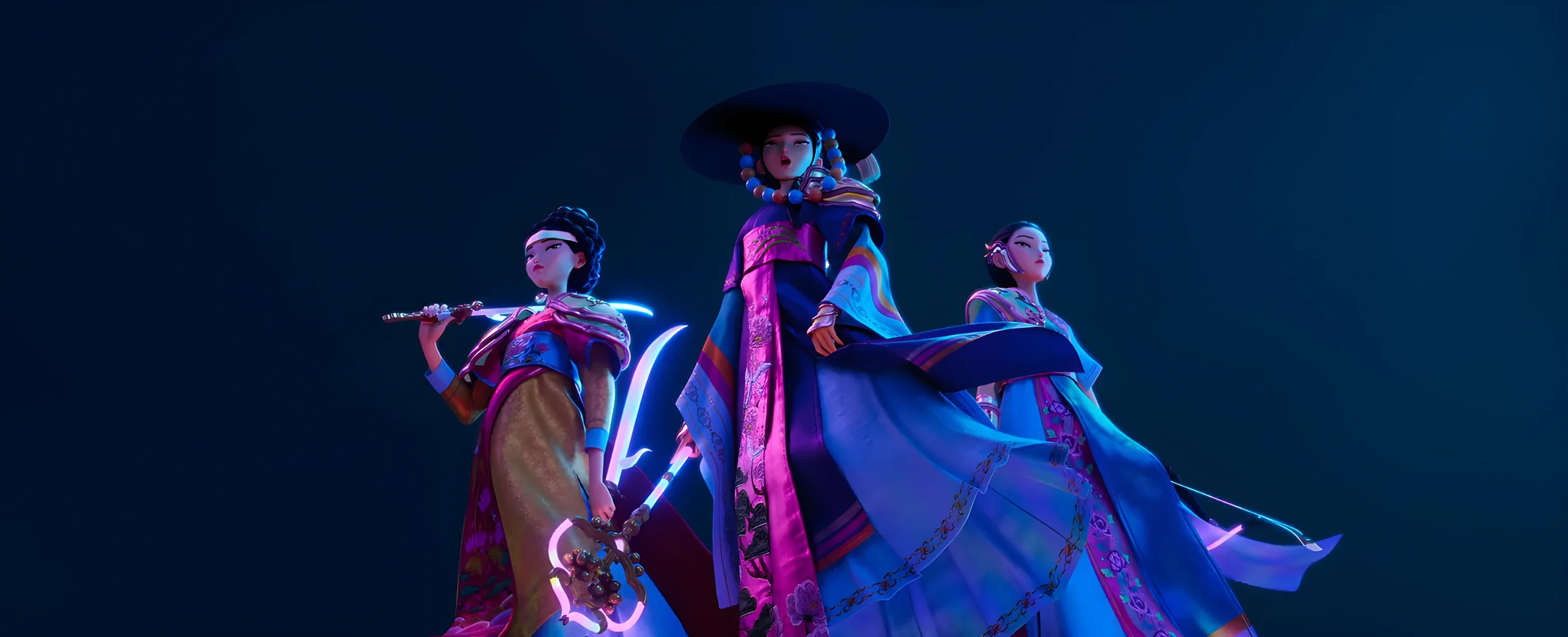
Without becoming awkward or self-indulgent, K-Pop Demon Hunters takes music culture and performance seriously as spiritual practice. In a gesture similar to that of Sinners (2025), the narration identifies contemporary popular music within a lineage of performer-shamans. In this case, Huntr/x is literally a reincarnation of an original crew of ancient Korean demon hunters. Indeed, the majority of Korean shamans (mudang) are traditionally female. In polychromatic garb, these women act as mediators between our world and the spirit world. During ritual performances (gut), the use of archaic chants, whirligig dancing, outstretched hand fans, and interlacing percussive beats (among other elements) allow the shaman to enter a trance state and engage with the spirit world. The styles and purposes of such rituals are myriad (and my above encapsulation misses much of the nuance in this ancient mystical tradition). Kang and Appelhans deliberately invoke and reinterpret these traditions as a way of approaching contemporary popular Korean music. As shamans on a global stage, the goal of the sisters is to create the Golden Honmoon (a portmanteau of 영혼 (yeonghon, or soul) and 문 (moon, or door): therefore, a spirit gate) which will banish the demonic forces of Gwi Ma (the demon lord) from earth forever. Here, musical performance can act as purification ritual, empowering us to banish demons (toxic exes, perhaps?) from our lives. The cathetic circuit of spiritual and emotional power from fan to performer back to the wider culture allows us to engage in a larger spiritual whole.
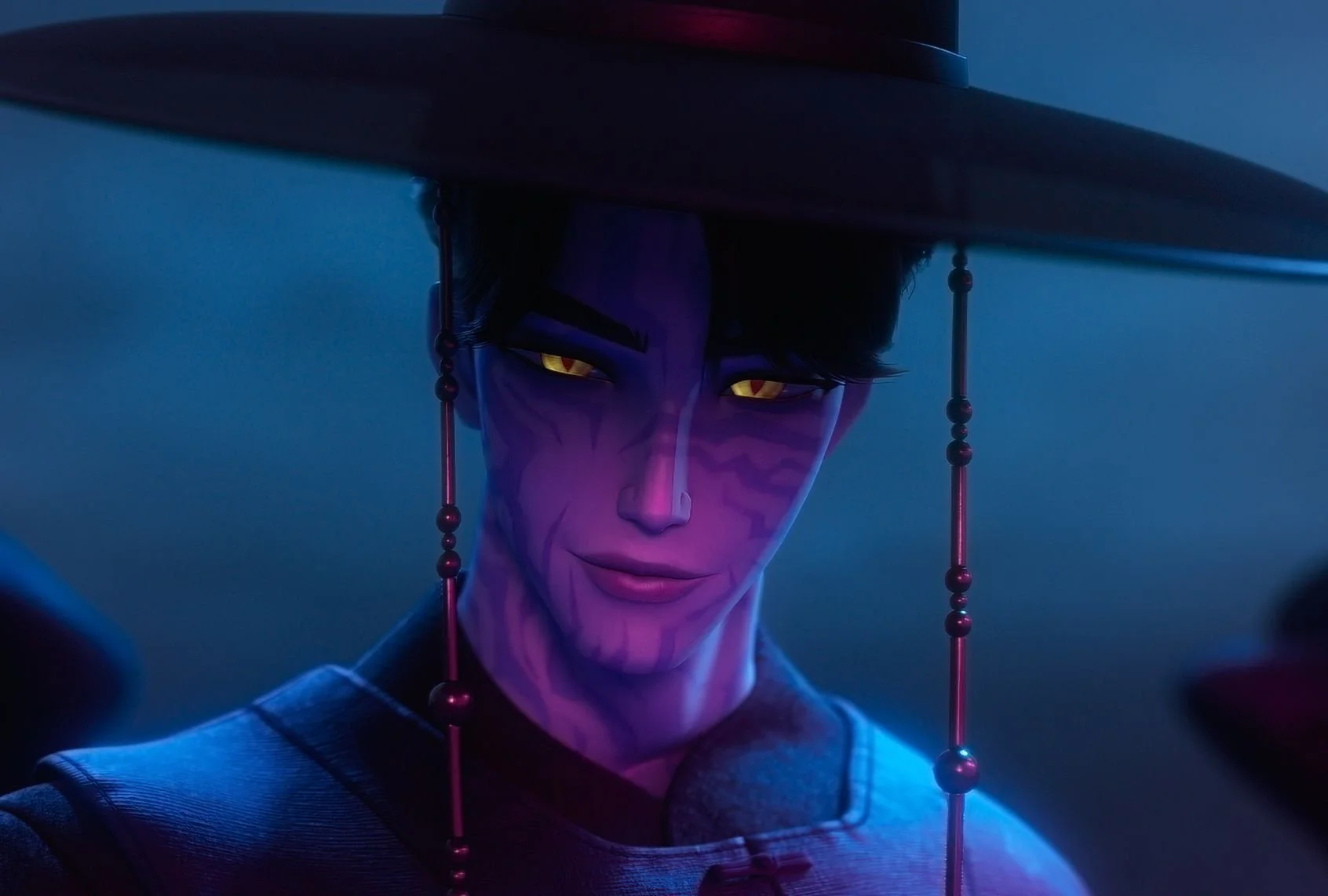
Taking seriously the spiritual power of music, however, doesn’t imply mass music culture guarantees a stairway to heaven. On the flipside of celebrity worship is the damage caused by imbuing harmful actors with power. The spiritual power and price of our attention is real. In a critique of uncritical fandom, KDH shows the emergence of a demonic boy band, the Saja Boys, as the inverse of Huntr/x. Based on the jeoseung saja (grim reapers) of Korean mythology, these attractive young men steal the hearts and minds of Huntr/x’s fans (and catch the eye of the sisters, too). Their song “Your Idol” says everything and more about how the business of obsession destroys us internally: “Anytime it hurts, play another verse, / I can be your sanctuary.” Or: “Your obsession feeds our connection. / So right now give me all your attention.” Building on a critique of addiction, the danger of Gwi Ma is that he promises safety, security, and a sense of belonging. For the afflicted and conflicted, these temptations lead us to making deals with the devil (whether it be slavishly adoring a celebrity or substance abuse). Jinu, the leader of the Saja Boys, gave his soul to Gwi Ma for the chance at riches, despite abandoning his family. Idol culture meets the critique of idolatry here—that good cannot come from sacrificing our values or our sense of self to a Golden Calf.
The film rejects, however, a Puritan binary of good and evil (or pure and impure). Whereas Huntr/x traditionally massacres demons without a second thought, Jinu provides a counterbalance. We learn more about how he became a demon, the guilt he holds over the betrayal of his family, and his genuine connection with Rumi is (seemingly) the start of a romance where she can truly be herself—demon-marks-and-all. Conversely, the girls discover limitations in their beloved parental figure, Celine, and her demands for perfection. Rumi’s difficulty with “coming out” has been read as a queer allegory. While this stands, I find the strength of the metaphor is its applicability to any sense of being Other or less-than (in terms of race, sexuality, gender, intelligence, appearance, disability, so on and so forth). Rumi’s flirtation with Jinu reveals that the difference between Us and Them is never so great as we imagine. Jinu’s sacrifice (spoiler!) at the end is a testament to our inability to judge properly based on appearances. Unfortunately, the other demon boys (as cute as they may be) still want to kill the Huntr/x sisters. To that end, the film navigates this lesson of moral ambiguity with striking moral clarity: Understanding that there is the potential for grace and humanity in everyone is not the same as succumbing to moral relativism or ceding our responsibility to fight injustice. Gwi Ma is a manifestation of evil. His influence (lordship, even) over the minds of demons and some humans can only be destroyed when the heroines forthrightly attack and dissemble evil. The fans of the Saja Boys are in need of deliverance from their emotional captors through direct action.
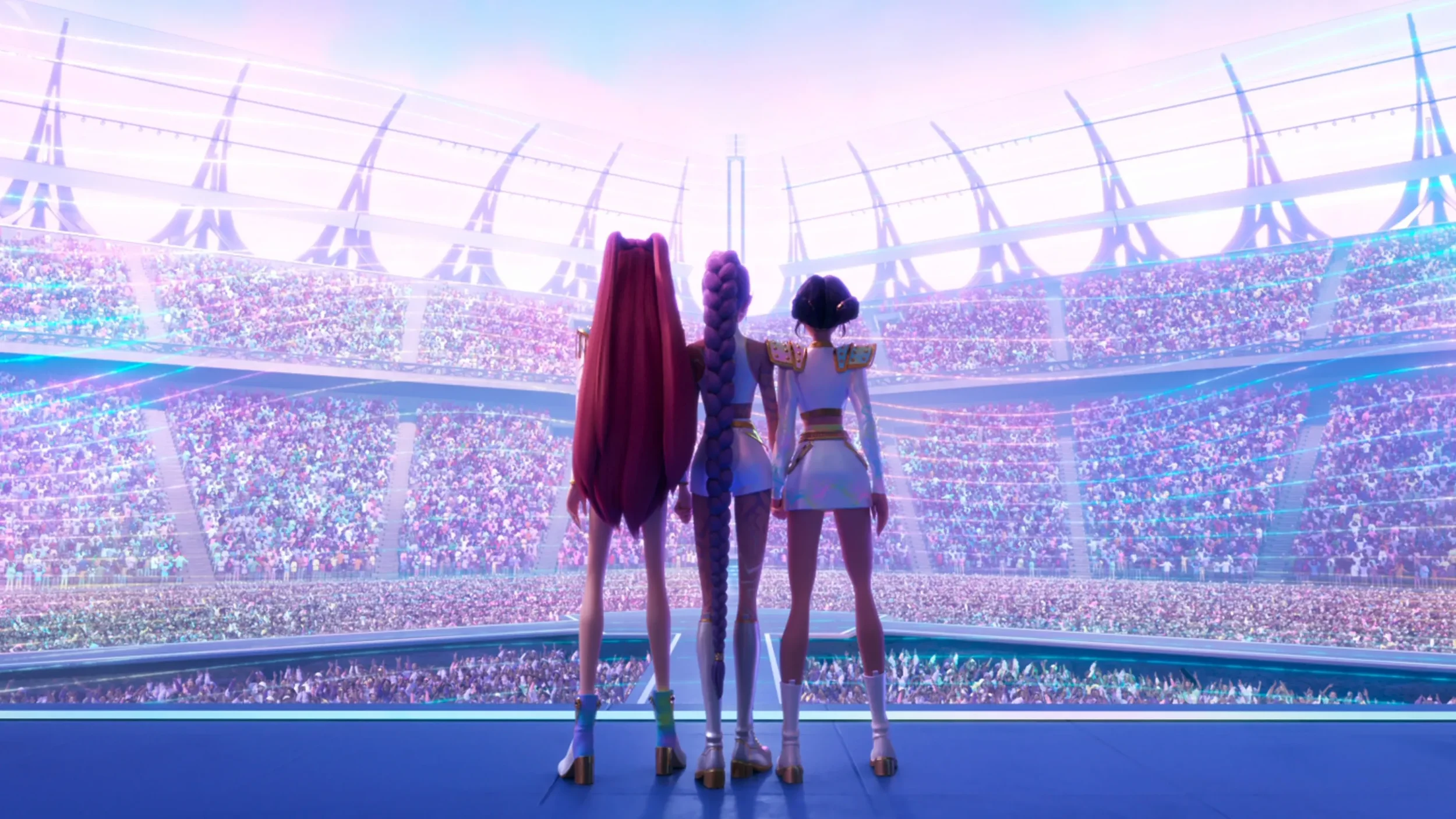
Already, we can see the film is a rich and complex text for a middle grade audience (though it resonates with folks of various generations). One of its most important tasks, however, was to give insight into the mechanics of the music industry writ-large. For impressionable (if intelligent) tweens, this is an incredible piece of media literacy. Huntr/x appears to be effortlessly perfect. Yet, we watch their anxious manager and a host of staff working constantly to maintain their high living standards and their public appearance. Ratings soar and crash capriciously. Fans impose their imaginations and desires upon the sisters. Sabotage leads to the sisters breaking apart in the middle of the film. All this to say: Appearances are not what they seem, especially when mediated through popular culture or your phone screen. Don’t forget that Gwi Ma’s power is intensified by his constant voice in the ears of demons (a bit like TikTok, say) that allow him to stifle their thinking and trap their souls.
The key, therefore, to navigating these difficult roadblocks of depression, obsession, and shame is self-love. Once Rumi is able to accept who she is (as part or wholly demon), she can finally have a true relationship with her siblings. When we reject the Other, we can quickly find ourselves under the same prejudiced attacks; love of difference allows us to love ourselves fully. Similarly, once Jinu is able to forgive himself for betraying his family, he is able to thwart Gwi Ma’s power. While the sisters assume that the Golden Honmoon is the only path to defeating Gwi Ma, it turns out that allowing the traditional system to break is necessary. Rumi must find her own voice to work alongside her sisters in fashioning a new Honmoon, one that is authentic to their spirits and not merely a copy of an ancient method. “I broke into a million pieces, and I can't go back,” says the closing track. Indeed, its powerful message continues: “Show me what's underneath, I'll find your harmony / Fearless and undefined, this is what it sounds like.” Unlike the traditional monochromatic Golden Honmoon, the final waves of harmony that radiate from the victorious sisters is polychromatic. It accepts people as they are without imposing a singular voice or singular structure upon them.
Before concluding: Let’s talk shop. The original music for this film has gone on to top the charts and become a milestone in this year’s music culture. While the lyrics are primarily in English, the rich songwork and thematic development across the different tracks stands out for a musical film. We get to see the sisters in modes triumphant in “How It’s Done,” vengeful and confused in “Takedown,” and refreshed and reconciled in “What It Sounds Like.” The Saja Boys are hypnotic and seductive in “Soda Pop” before becoming unabashedly demonic and menacing in “Your Idol.” The slower and romantic RnB style of “Free” brings a rich texture otherwise missing from the film. Last but not least, the cinematic sweep and grandeur of the lyrics in “Golden” is stellar. It is, by far, the stand out track of the film. The entire setlist, however, is representative of different elements of K-pop culture and leans in to the history and traditions of the genre.
KPop Demon Hunters is most incredible in its unabashed humanism. Whereas the major Western animation studios appear to be flirting with artificial intelligence or continuing to force feed us the third sequel to a remake of a beloved franchise, this film is anti-corporate, anti-clickbait, anti-AI. It is extremely idiosyncratic with each character replete with quirks, rough edges, and incredible facial expressions. It is full of genuine human emotion, bitch! Get used to it. (And yes, I’m swearing. This movie isn’t for kids. It’s for TWEENS.) Shame, mass media, social media, family expectation, feeling out of your body… all these emotions seem to be missing serious consideration in our current landscape. I’m sure Disney has a gaggle of scientists locked in a freezer currently dissecting each nanosecond of KDH with AI-powered microscopes in the attempt to find the secret sauce, the Code, the mysterious key to the film’s success which will allow them to mass produce clones for minimal cost and maximum profit. But that methodology will never, ever achieve the kind of phenomenon that KPop Demon Hunters has created. Because that remains the domain of humans, not cybernetic demons.
If you enjoyed this article, please consider becoming a patron of Hyperreal Film Journal for as low as $3 a month!
Akshaj is a writer-director from Dallas, TX. He's a lover of American popular music, New Queer Cinema, and global animation. Anything, really, to do with misfits, miscreants, and mise-en-scène.