
JAMESFEST #1: Saturday's Warrior
On Saturday, February 21st, local tastemaker James McDonald held his annual Butt-Numb-A-Thon, an event in which he assembles a marathon of truly deranged movies at his home with an open door policy and “anyone is welcome” mentality. For this, the 10th iteration, James rented out the Hyperreal Clubhouse for a slightly more official-feeling film fest. The movies were still deranged.
He started things off with Saturday’s Warrior (the original 1989 version), a confusingly titled offering from Mormonwood. During my time in LA, I used to live with a former member of the Church of Latter-Day Saints, so I was somewhat tertiarily aware of the vibrant-if-sequestered, genre of “by Mormons, for Mormons” films. Saturday’s Warrior is based on a stageplay and visibly shot like one, with barely-disguised fake sets and tightly controlled angles to cover up the seams between props.
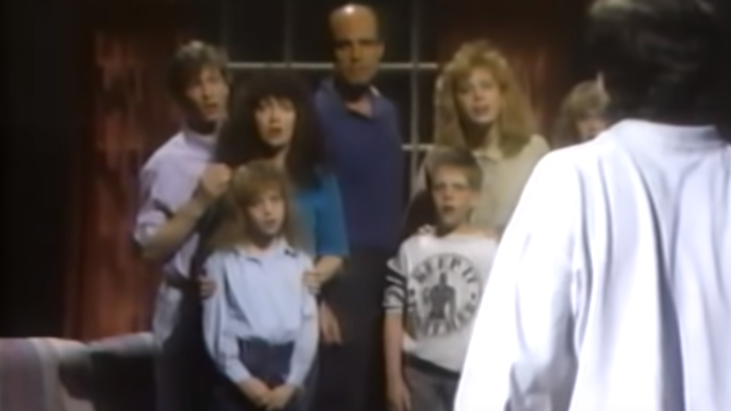
The plot follows a group of souls (angels?) awaiting their time to be born in the after/beforelife. Two souls are worried that they won’t still be in love while on Earth while a sizable half-dozen of soon-to-be siblings are in a rush to be born. Nearly 1/4th of the 2-hour long movie is spent in this foggy, empty heaven-y realm: long enough to convince an average viewer that the entire movie will be spent here. Every character is glacially introduced and gets a requisite song-and-dance number introducing their core traits—right, did I mention this is a musical?
Already, I could sense an issue. I’m only slightly more familiar with the style and signifiers of stage musicals than I am Mormonwood, and the fact that every single man in the film (save one, but we’ll get to him) looks like George Michael at various stages of life feels like an insurmountable hurdle. This is only the beginning of the dark cinematic cavern through which I’ll be traveling this day, and I’d been reliably informed by James that a later offering is so mind-melting that it qualifies as a genuine tragedy that neither Blake nor Morgan are here to join.
Either way, once every character has been introduced, we jump ahead 18 years so that the same actors who played the souls can reprise their roles as the living people. Very quickly, the movie lays all its cards on the table: This is not the kind of religious movie that is meant for anyone not already on board. The first musical number on Earth focuses on the glories of missiondom and how important it is to have a waiting wife at home for you to claim when you return. The bad kids tempting a young Jimmy away from the church espouse a life of birth control and environmentalism. One would expect the emphasis to be on how cynical, conniving, and ultimately evil the bad kids are, but they make compelling points. They’re against large families due to fears of overpopulation and the negative impact on the environment, and while they do mention abortion in one line in their big number, the larger point is on personal freedom and safe sex. Even musically, the vibe is safe and squarely within “after school special” mode—they’re simply wrong because we as viewers (and presumably LDS members) know they’re wrong.
Jimmy is sorely tempted, especially after feeling stifled by his giant family and the news that his parents are expecting yet another baby. This is the big emotional hook, but unfortunately it comes paired with the two most distracting aspects of the film. First is the appearance of the only non-George Michael lookalike. This would be the patriarch of the Kessler family, a man whose forehead looks like it’s trying to flee from the rest of his face. I promise that I am not trying to be cruel here, but he looks like that one fucked-up ICE agent. He looks like a Star Trek one-off character, Worf’s suburban cousin. I found myself fascinated, wondering if it was an ill-fitting bald cap or just a unique conglomeration of forehead wrinkles. It is, simply put, hypnotizing.
The other big distraction here is Jimmy bemoaning his lack of freedom to his wheelchair-using twin sister, Pam. Her use of a wheelchair is meant to be an ironic twist of fate as, unlike the rest of the family, she dances instead of sings while in the opening scenes in Heaven. Jimmy and Pam have such palpable, undeniable chemistry that the audience was clearly rooting for a swerve into incest. Their conversation/duet ends with Jimmy putting his hand gently on Pam’s thigh and the theater erupted into applause, hooting and hollering “KISS!” at the screen.
In fairness, this is not a problem unique to amateur or religious filmmaking. You put two young, attractive people in a scene together and tell them they have a decades-long bond and some actors (especially those who didn’t grow up with actual siblings) might play it romantically without realizing. Still, it’s unbelievably present in their scenes together, givingJimmy’s melancholic search for freedom and meaning a surely-unintended subtext.
The other main plot point of the film is about older sister Julie’s inability to choose between her fiance (offscreen throughout), her missionary boyfriend, or the George Michael lookalike she shared millennia with in Heaven pre-birth. No prizes for guessing how that plot turns out. Which is, ultimately, the biggest flaw of the movie. Both the film’s structure and the actual message of the film is so predetermined as to make all plot contrivances mechanical. It feels decidedly Calvinist, the joys of sex and physical touch obviously bad, but all personal freedom likewise reduced to nothing but the whims of an impulsive child.
Granted, I am coming to this film from a decidedly secular perspective, but it did seem strangely dark, especially when Jimmy is compelled to return home by Pam’s sudden death (and the poorly explained need of the unborn baby to have him return to the family unit in order to be born properly). Regardless, everything ends well, everyone is happy, (even Pam in Heaven who does pirouettes with her soon-to-be-born sister), and the family unit remains ironclad.
In keeping with the spirit of Mormon positivity, I will say that the songs and dance numbers aren’t bad! Nothing that got stuck in my head, but the dancers are clearly talented and committed to their roles. If the film was a tight 80 or 90 minutes, I think I would have walked away with a warmer opinion of Saturday’s Warrior, but at two hours, it felt exhausting.
In conclusion, this review goes out to George Michael and WHAM! “Last Christmas” is the only Christmas song I let play without changing the radio station.
This is Part 1 of Jamesfest.
Next: Junior High School.
If you enjoyed this article, please consider becoming a patron of Hyperreal Film Journal for as low as $3 a month!
Ziah is the founder and former editor-in-chief of the Hyperreal Film Journal. He can usually be found at Austin Film Society or biking around town.