
JAMESFEST #7: Prisoner of Love
The centerpiece of Jamesfest this year, the grand finale, the proverbial main course of this endlessly fascinating buffet of maggot cheese cinema, was Prisoner of Love. This, like Homocula, required an inordinate level of effort from James. PoL is a vertical mini-series available on TikTok that numbers 100 three-ish minute long episodes following the adventures of a group of German teens. The characters seem to be dubbed over by Chinese actors in English, some of whom seem to have only a phonetic grasp on the words that they’re saying. In order to get a file of this film(?) that he could play on a theater screen, James first found a Dailymotion compilation of the first eight or so episodes (about 24 minutes), and then downloaded a program that would trick TikTok into thinking that his laptop was a phone. Then he screen-recorded the other 75 episodes and stitched them together into one 3-hour long file, removing the commercials and ads in the process.
This is commitment on the highest level and something I behold with a measured sense of sincere awe. Why did he do this? I ask him and he responds with the same good-natured excitement that he always has when it comes to movies. Truly, he is Cinema’s Strongest Soldier.
There is no context I can add to this project other than what I’ve been given: I’m told this genre of hyper-disposable vertical dramas are common on TikTok, that it’s an active attempt by (mainly Chinese) companies to tap into the narrative rhythms of AI videos. Rationally, I understand this goal. Despite my hatred of AI and its marketing-driving push into narrative spaces, I would be lying if I said I do not understand its appeal or the types of content it could seamlessly replace. Take a glance at any number of X+Y=Profit isekeis, romance novels, YA Chosen One stories, etc., and it’s not unfair to say that there is an audience for a specific type of paint by numbers slop. The familiar rhythm of tropes and easy solutions to conflict serves a need in a populace that craves it. Any feelings I might have about that reality are subservient to the sheer fact of it; it exists, and I must accept it as such, and meet it on its own terms as a serious critic. To that end, Prisoner of Love.
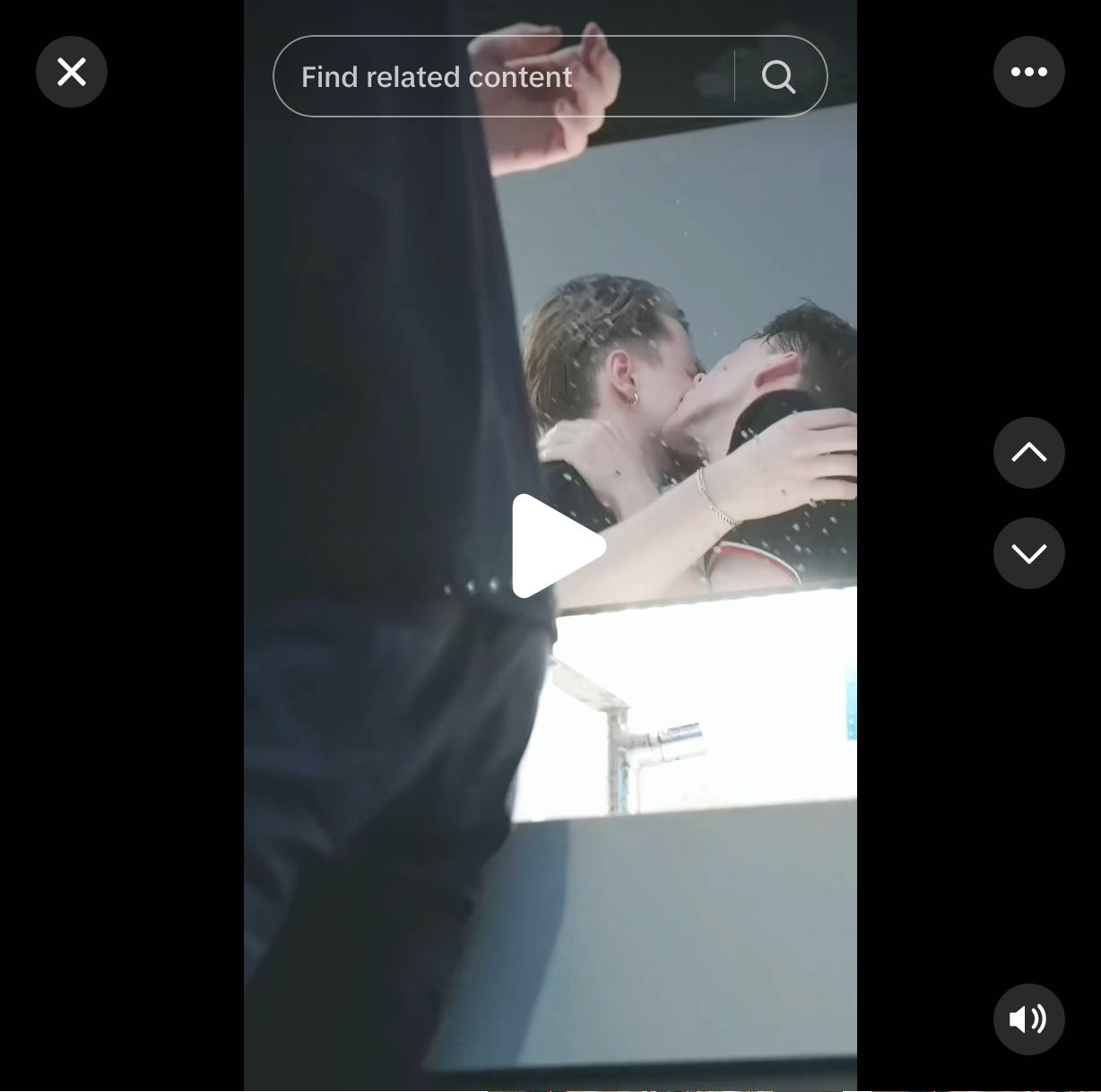
Screenshot from Tiktok user @btt54746d7o. I did my best.
The plot of PoL is both irrelevant and the most important part. It’s built to keep attention on a platform famous for a user base of ADHD-addled, easily bored viewers. Each episode ends on a cliffhanger the same way as a Goosebumps book—sometimes immediately diffusing the dramatic turn within seconds of the next episode, sometimes cutting away entirely to a different plot (which naturally ends with its own cliffhanger), sometimes, rarely, answering the question asked by the previous episode’s ending immediately. It’s dizzying and makes the act of writing any sort of plot summary feel pointless, but I will try.
High school student Joe is a top dog cool guy at a German high school, but after saving new transfer student Jason, finds that he’s starting to catch feelings for the sad, alluring new kid, despite ostensibly being straight. Joe and Jason attempt to deny their budding romance, dating women, fighting bullies, drinking milk, jumping off buildings, resisting the temptation of sexy hospital roommates, battling an escaped serial killer, helping an ex-girlfriend stop being bi and helping a murderous convict kidnap people, accepting that maybe Joe’s mom is so homophobic because she used to be a lesbian and is scared of her son having a tough time in an unfriendly world, etc.
Describing these events does not, in any way, convey the experience of actually watching this in one uninterrupted burst. It feels like putting a massage gun directly against the dome of your skull and letting it run for hours. One of my notes reads, “Zoomer Inland Empire” and that is honestly not far off from the sensation you get from watching it.
There are so many barriers against the average viewer understanding the meaning behind these choices that I couldn't even begin to guess at the filmmakers’ goals or creative inspirations. When Joe and Jason walk home after fighting a rapist in a night club and are accosted by an aggressive street drunk, are the giant flower streetlights present in the scene simply because that was the easiest place to film? Is a ghostly vision of Jason rising out of Joe’s nightly cup of milk in conversation with decades of cinematic language regarding ghosts and visions? I don’t know. My brain slides through the conveyor belt of content, pressed, squeezed, and contorted until the only thing I know is that I want to see how it ends.
I want to re-emphasize here an aspect that you might have skipped over if you’re just skimming through this review: The entire runtime, every single actor onscreen is dubbed over by a Chinese voice actor, sometimes in clear English with a Chinese accent, sometimes in loose approximations of the words written in the subtitles. It is a… creative choice(?) that never once stops being distracting, like hearing a car alarm down the block as you try to listen to music on your headphones. It never congeals into feeling normal, and as the cast expands for seemingly no other reason than to keep the show from ending, the range of acting and pronunciation skill between the various VAs gets wider. I think this would cause psychic damage to anyone watching this in a particular state of mind.
When I started the Hyperreal Film Journal, I had a few ironclad rules that I laid out for myself as Editor-In-Chief. Quite a few of those are irrelevant in this specific instance, but one of the most important rules I implemented was a ban on television coverage. My goal was to celebrate cinema, not just pop culture in general. After years of watching my favorite film sites turn into catch-all coverage for whatever people might click on, having a pure sense of focus was important to me. As our coverage grew, it became more difficult to define for writers, for editors, and for readers, what that ban specifically excluded. There are television series that feature the same ambition and cinematic richness of a movie, just as there are movies made to be as disposable as any number of the TV box sets you can buy for a few bucks at Half-Price Books.
I feel like I knew the difference, even if I struggled to define it for others. And yet, watching Prisoner of Love, I was left troubled. This is not a movie. PoL dodges satisfying endings like Neo dodging bullets in The Matrix, adding more subplots and characters whenever it seems like it's approaching a climax. It is meant to hold your attention, not necessarily reward it. And yet… James has seen more movies than anyone I know, and this played in a cinema on a big screen with an audience eating popcorn. It’s shoddy in many ways, but the filmmakers do offer some visual flair even within the tight parameters of a vertical screen. This is not a movie, but it might be the future of cinema. I think I’m troubled by that, but maybe that’s just the pain of the chrysalis forming around me. Maybe this is the beginning of a great becoming, and the change of cinematic language that Prisoner of Love heralds is a necessary evolution for a still-burgeoning art form. I don’t know any more than you do.
This is Part 7 of Jamesfest.
Previous: Homocula Likes White Blood, Aim for the Eyes! | Next: The Ultimate Masturbation
If you enjoyed this article, please consider becoming a patron of Hyperreal Film Journal for as low as $3 a month!
Ziah is the founder and former editor-in-chief of the Hyperreal Film Journal. He can usually be found at Austin Film Society or biking around town.