
In the Folds of the Flesh Review
This one is, to use a technical term, a doozy. The film I’m focusing on today, In the Folds of the Flesh, comes to us from Italian director/screenwriter/producer/actor, Sergio Bergonzelli.* Before Folds, he’d mostly directed Spaghetti Westerns, with a couple-odd tropical adventure films mixed in (these being the fashion at the time, in 1960s Italy). Come 1970, though, Bergonzelli took a departure.
In the Folds of the Flesh sits comfortably in the realm of giallo, a personal favorite of mine: the storied genre of garish blood-soaked murder mysteries, psychological thrillers tinged with eroticism, and whatever other handfuls of ideas appealed to the director at the time. This kitchen-sink approach permeated giallo films in waves, and arose from a sort of shock factor arms race, with films delighting in trying to one-up each other with narrative-straining twists and bright costume and set design contrasted with outrageous (for the time) content.**
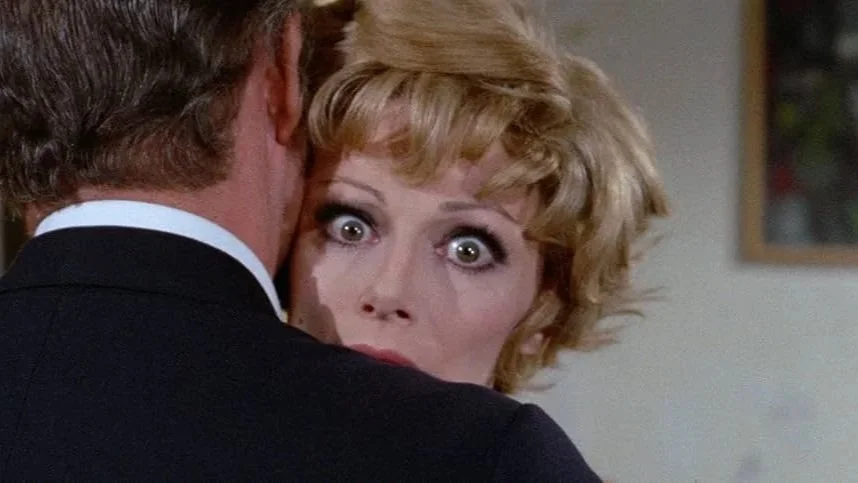
This competitive titillation is why many films in the giallo genre have long, abstract titles like Your Vice is a Locked Room and Only I Have the Key, or The Iguana with the Tongue of Fire. It also lends itself to many giallo films feeling full to bursting with striking visuals, labyrinthine plots, and heady or radical (again, for the time) psychological themes–with In the Folds of the Flesh itself being almost collage-like in the pure amount of ideas present.
To give you an example, the very first images the film presents are: 1. A (misspelled) Freud quote (“And then a sudden violent shock that left a deep impression on the mind and damagen [sic] it permanently.”), and 2. A severed head hitting the floor and rolling toward the camera, surrounded by three stock-still individuals we’ll soon come to know. Already, that’s a lot. The movie sometimes lets up from the dizzying pace established in these first few minutes, but never enough to truly let you, the viewer, feel like you have a handle on things.
We’re plunged from the opening scene into a manic car chase between the police and an escaped criminal on a motorbike. When the bike fails, the criminal (looking very Captain Lou Albano throughout) wanders down to the coastline and into the back of a property dominated by an impressively large villa with a central castle-like tower. He spies one of the figures from the beheading scene, a Morticia Addams-esque woman (sans Gomez, sadly) named Lucille, who appears to be burying a body–presumably that of the aforementioned severed head. When the police manage to catch up and question her, Lucille hesitates momentarily before pointing out the criminal hiding in the yard, who is promptly hauled away, taking her secret with him.
Cut to the second half of the Freud quote: “What has been remains embedded in the brain, nestled in the folds of the flesh. Distorted, it conditions and subconsciously impels.” After this, the film makes a thirteen-year time jump. Just roll with it.
Now, a decade-plus later, we catch up with Lucille, as well as her son, Colin (who was a child at the time of the prologue and is a young adult now), and a woman, Falaise (who was a teenager at the time of the prologue and is a slightly-less young adult now). Falaise is the heiress to a presumed-dead mafioso, whom Lucille and Colin ostensibly work(ed) for, and all three live uneasily together in said mafioso’s previously-seen beautiful coastal villa.
Falaise has a habit of seducing male visitors to the villa–exploits which invariably end with her being assaulted by these men, having a psychotic break, and murdering them. Lucille and Colin’s job mostly consists of covering up Falaise’s various murders, which she seems to forget immediately after committing them. The mother-son duo make a compelling argument for their continued employment until the mustachioed criminal from the opening segment returns, having finally been released from jail. He’s kept their secret all these years in order to cash in on what he sees as an easy way to blackmail some rich weirdos and take an early retirement.
This section of the movie, wherein the three main characters are effectively held at gunpoint for several days by this blackmailer, goes on for so long that it starts to feel like this must be the “main” plot, until Lucille manages to take him out in one of the most insane swerves I think I’ve ever seen in a film. The blackmailer (named Pascal Gorriot in the credits, though I don’t think his name is ever spoken in dialogue) treats himself to a luxurious bath, gun still in hand, while Lucille shows her son that she placed cyanide tablets at the door of a cuckoo clock on the wall above the bathtub. The tablets are knocked into the bath when the clock goes off, creating an enormous poisonous cloud that kills the blackmailer instantly.***
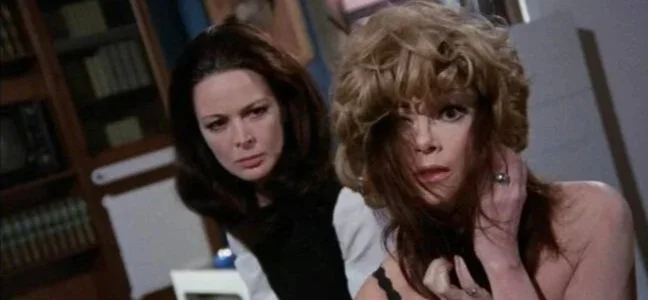
Believe it or not, that isn’t the part of the scene that left me legitimately gobsmacked; it was the part that follows, when Lucille explains to Colin how she “learned” how to kill a man like that. The film then segues into a black and white flashback sequence that takes place in a WWII Nazi death camp, where a younger Lucille is being led to a gas chamber along with about twenty other women.
It turns out that this specific sequence is fairly notorious, with stills of it even used on the VHS box art in some releases. It’s pretty uncomfortable, and is present mostly to serve as Lucille’s supervillain origin story, as the Nazi guards kill everyone but her while making her watch through a window. Before Lucille can be executed as well, she manages to escape the camp, which leads to her building her life in England, wherein she comes under the employ of Falaise’s father. The idea of someone having been in such a harrowing situation, then years later using the very methods of their captors on someone else, is an interesting one, but the execution is a bit too icky and leering here for it to really work.
From this point, the film starts to gear up for its final act, and all the lingering questions previously hinted at start to unfold in a rapid chain reaction. False identities, false recollections, faked murders turned to real murders…everything comes to a head in a whirl of accusations and dramatic reveals. Amidst the chaos, the motif of lingering trauma in all these characters’ lives comes into sharper focus: Lucille’s experiences in WWII coloring the rest of her life with violence, Falaise’s role in the murder all those years ago distorting her psyche to the breaking point, and even Colin’s dim recollections of the murder being the seed of his sardonic bitterness. These characters’ experiences all build on the idea laid out in the film’s introductory Freud quote; one sharp traumatic moment embedding itself in the mind like a splinter, warping the thoughts around it.
Spoiling everything that happens in In the Folds of the Flesh would be a disservice to the movie, and it’s hard to get across in words just how disorienting it is to watch for yourself as everything unravels. Suffice it to say, the conclusion is almost as abrupt as the film’s beginning, leaving us, like the characters, with a sudden violent shock.
Despite its grim themes and plot, Folds is an extremely busy sensory experience, full of gaudy fabric patterns in bright primary colors and set in a sunny seaside villa where pet vultures constantly chirp and warble. It all lends the movie an air of unreality, like a nightmare of noise and color happening in the next room while you’re dissociating in the bathroom. It’s a sensory overload, to put it lightly, but if you follow the film down its windy path, you’ll enjoy the sights along the way.
*Who sometimes acted under the name Siro Carme, which I only mention because it’s a kickass nom de guerre.
**Note: sex and violence and stuff.
***I actually have a friend who knows a fair bit about chemistry and when I asked her if this was at all plausible, her response was “No.”
If you enjoyed this article, please consider becoming a patron of Hyperreal Film Journal for as low as $3 a month!
Vivian Violet is a film freak, artist, writer, and general menace. Found on bsky and letterboxd @vivviolet