
The Door Ajar: On Old Dolio & Emily Dickinson
I. The Unyielding Self
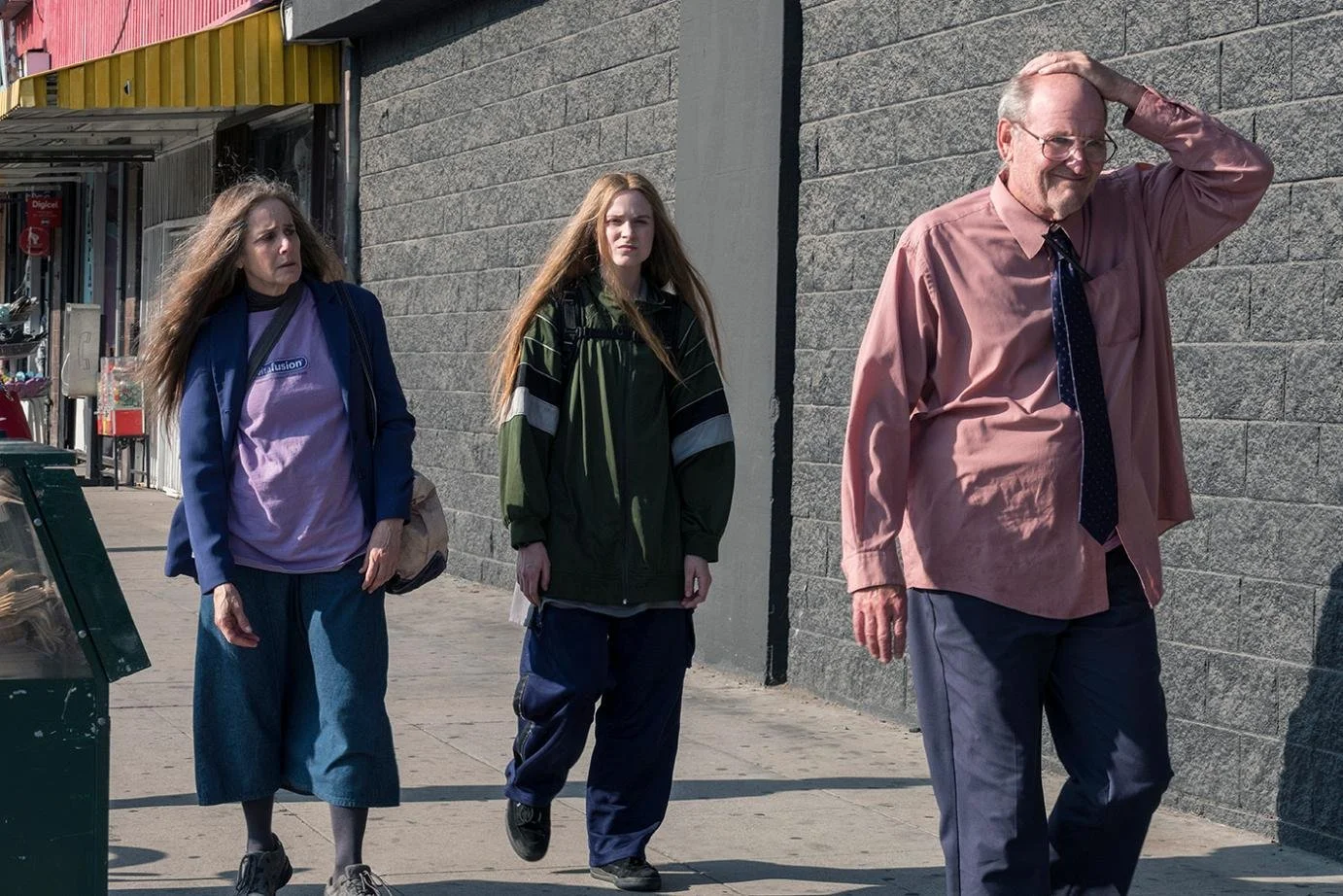
Old Dolio lurches and lunges. Green tracksuit jacket zipped to the chin, navy track pants pooling, shoulders curled forward, curtain hair obscuring her face. The main character of writer-director Miranda July’s Kajillionaire, she’s a 26-year-old woman in Los Angeles, raised by two peculiar, petty grifters who teach distance as survival. Emily Dickinson arrives here not through the film, but through the shared instinct between them. Dickinson, who hovers in her signature white dress with that slight, deliberate tilt away from the observer, was a poet in nineteenth-century Amherst who built her own solitude. Her gesture and Old Dolio’s are the same: reduce the surface available for contact. Two women, separated by centuries and circumstance, enact the same ritual: to remain nothing but themselves, no matter how lonely the weather.
“I wasn’t hooked on it, so that wasn’t a big deal for me,” Old Dolio says about life to her new accomplice, Melanie during a huge earthquake as they are locked in a dark gas station bathroom where Old Dolio will exit reborn. Dickinson, in Amherst, builds her refusal into poem:
“The Soul selects her own Society, / Then, shuts the Door,”
Not detachment, but authorship; both construct architectures around the self that make singularity possible. They refuse dissolution into what Dickinson calls “the admiring Bog.” They refuse to be anything other than exact.
II. Rituals as Architecture
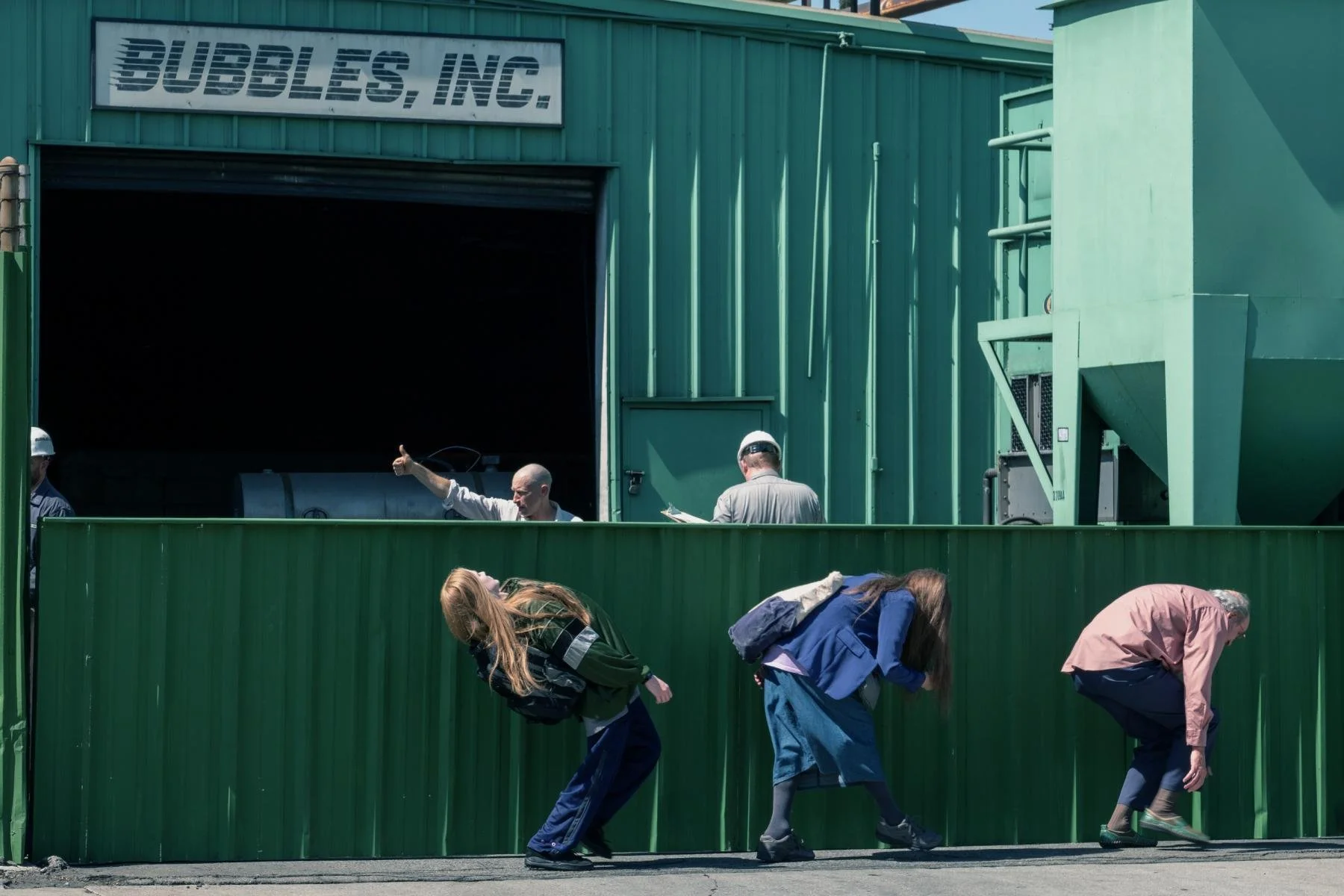
July builds Old Dolio’s world in Kajillionaire from structured rituals. Her family sleeps in a windowless office beside a bubble factory; several times a day, pink foam leaks through the back wall and the trio of mother, father, and daughter scoop it up with buckets in long, waving arcs. Every day is a dance choreographed around evasion, low-stakes scams, whispered rehearsals, and parental interaction strung together with disdain and square deals. Dickinson’s life in Amherst was similarly ritualized: mornings for language, evenings for correspondence, her white dress functioning as vestments rather than clothing. In both cases, life is staged deliberately as form.
Beneath Old Dolio’s green tracksuit jacket: a Catholic schoolgirl uniform, an easy-change double life folded into fabric (her parents sometimes use her as a teenager decoy for their scams), allowing her to slip into whatever identity is required. Uniform under uniform, self under self. Kajillionaire costume designer Jennifer Johnson intended the tracksuit to feel “a little like armor.”
Dickinson’s signifiers were no less tactical: white dress, controlled circulation of manuscripts, handwriting bent tight into a miniature topography. Sharon Cameron calls this Dickinson’s practice of “choosing not choosing” (Cameron 51): her refusal of the traditional literary marketplace became its own survival strategy.
Through handbound fascicles, Dickinson curated her poems as fragments, constellations rather than linear narrative. She authored her afterlife as much as her language. Old Dolio, born into an un-family of scams and detached absence, authors herself through subtraction: zipped jackets, silent walks, her curtain of hair. Both carve myth out of constraint.
Rosalind Krauss describes “repetitive structures” in visual art: form becomes liturgy, recurrence inscribes meaning (Krauss 56). Dickinson’s meters and slant rhymes, Old Dolio’s leaking walls and soundtrack of the song “Mr. Lonely” on loop, all stage repetition as devotion. These rituals stabilize identity, but they also limit it.
Ritual can’t contain everything. On the flight that sets Old Dolio’s family up for their latest scam, Melanie—the seatmate they meet mid-air—slides into their pattern. She becomes the first outsider to see how their cons work: luggage lost, claim filed, insurance money promised. Old Dolio has always been the body in the machinery, never the beneficiary. Melanie watches. She leans in. This new woman, Old Dolio; a different look at the same setup. When the airline’s check arrives—made out to Old Dolio—the shock is small but seismic. For once the con doesn’t just flow through her parents’ design; it belongs to her. Ink fixes what has never been claimed: a name, a hinge between containment and agency.
III. Refusal as Authorship
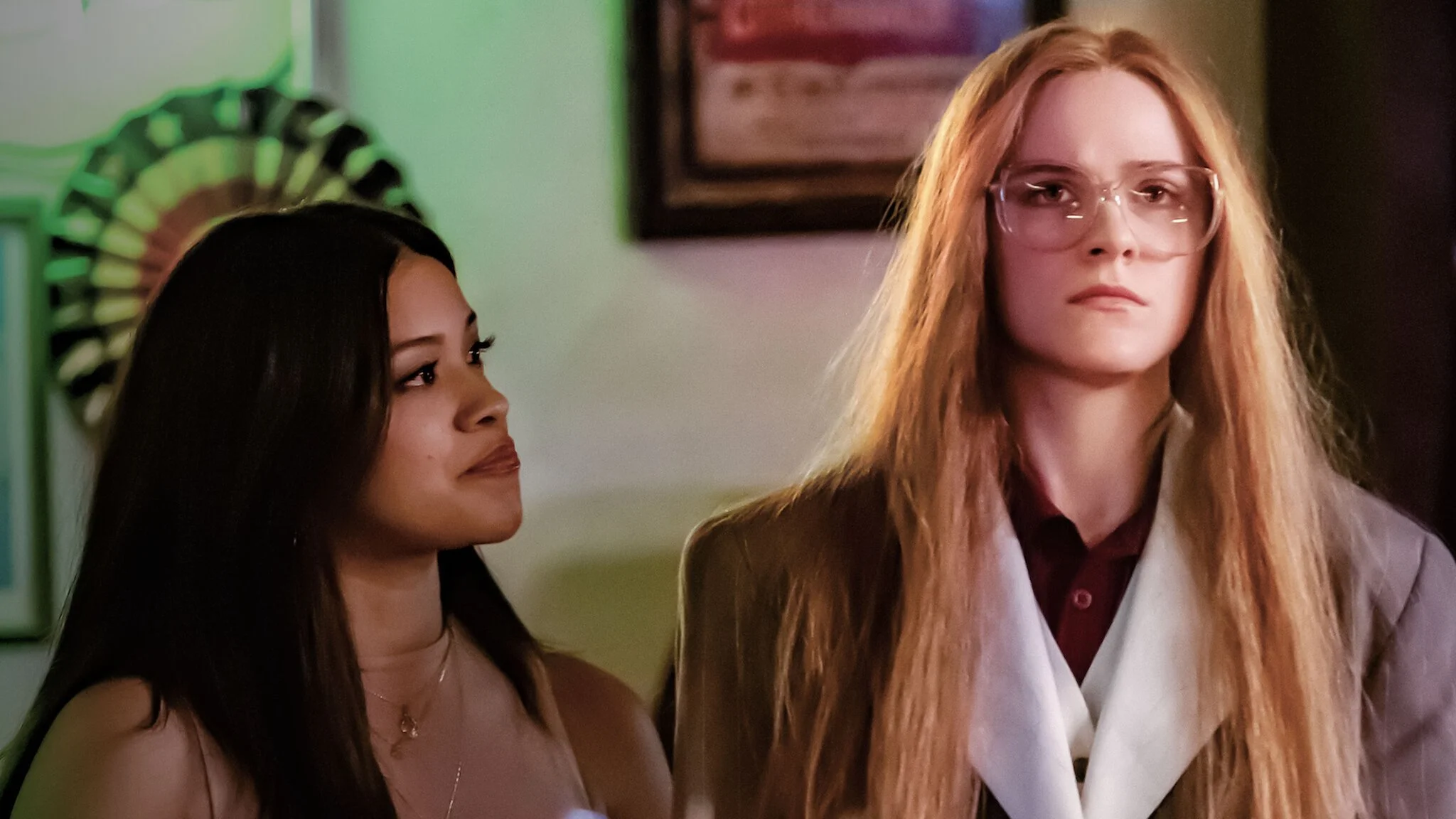
Old Dolio’s body writes itself in absence: unclaimed, unornamented, hovering purposefully outside spectacle. July’s camera refuses cinematic desire; Laura Mulvey’s notion of the “male gaze” is inverted here, the frame containing Old Dolio but never consuming her (Mulvey 17). Vivian Sobchack calls this embodied withholding: the refusal to perform produces a different kind of presence (Sobchack 109).
Dickinson enacted a similar withholding in Amherst. As Cameron argues, Dickinson’s choice to circulate poems privately, by hand, sidestepped nineteenth-century publishing economies. She authored not just language but context, readership, and her own exposure. Her refusal produced an archive of intimacy: poems allowed to breathe without public negotiation. Dickinson authored her myth through deliberate absence.
Both women move through their worlds in bodies others try to read and categorize, but neither fits cleanly into the roles projected onto them. Neither Old Dolio nor Dickinson inhabits a binary: not tomboy, not femme, not androgynous.
In Melanie’s apartment, Old Dolio calls the Publishers Clearing House line, the one she always dials but never reaches. “Mr. Lonely” loops on her cell phone as she plays it for Melanie, letting the music fill the space she cannot cross herself. Even her longing must remain private, contained in someone else’s melody.
Refusal here is not passive. It is agency.
IV. The Armor Leaks
Containment cannot hold forever.
Melanie arrives, an outside rhythm testing Old Dolio’s edges without breaking them. In her apartment, she asks Old Dolio to dance. The request hangs in the air like a dare and suddenly, Old Dolio moves, punching and stabbing at nothing, sleek as a cat breakdancing, joyous and terrified at once, her body exceeding the containment it’s always known. The scenes between them hum at low amplitude: a hovering hand, a throttled voice, July’s camera holding still. Sobchack writes that embodiment surfaces when “the body exceeds the frame” (Sobchack 113); Old Dolio’s dance is exactly that, an eruption of agency.
Dickinson stages this same slow breach in “Come slowly Eden”:
“Lips unused to Thee, / Bashful, sip thy Jessamines / As the fainting Bee,”
Desire does not dissolve discipline; it reshapes it. The bee counts first, waits, then enters. Dickinson and Old Dolio each measure longing against structures designed to contain it.
Dickinson leaves her own door “ajar”, not to abandon privacy but to choose which currents enter. See, there is nothing surrendered here. It’s authored.
At Old Dolio’s birthday dinner, rupture arrives insisting. Her parents stage the meal as the eighteenth present in their ruse, a birthday experience she does not yet know is part of the con. They’ve promised her eighteen presents to make up for each missed birthday, each “gift” matched to the age she would have been at the time, but the presents are all scams disguised as care—nothing freely given, everything extracted. Melanie’s cocktail dress hangs off Old Dolio’s thin sloping shoulders. Her fingertips pick Melanie's acrylic nails on the white tablecloth, the touch awkward and seismic.
July literalizes containment’s limits through production design: Baker-Miller pink foam swelling through walls, leaks on schedule, bailing performed as liturgy. Krauss’s repetitive structures return here; collapse becomes ritual too. Containment falters, but authorship persists.
V. Building the Self as Myth
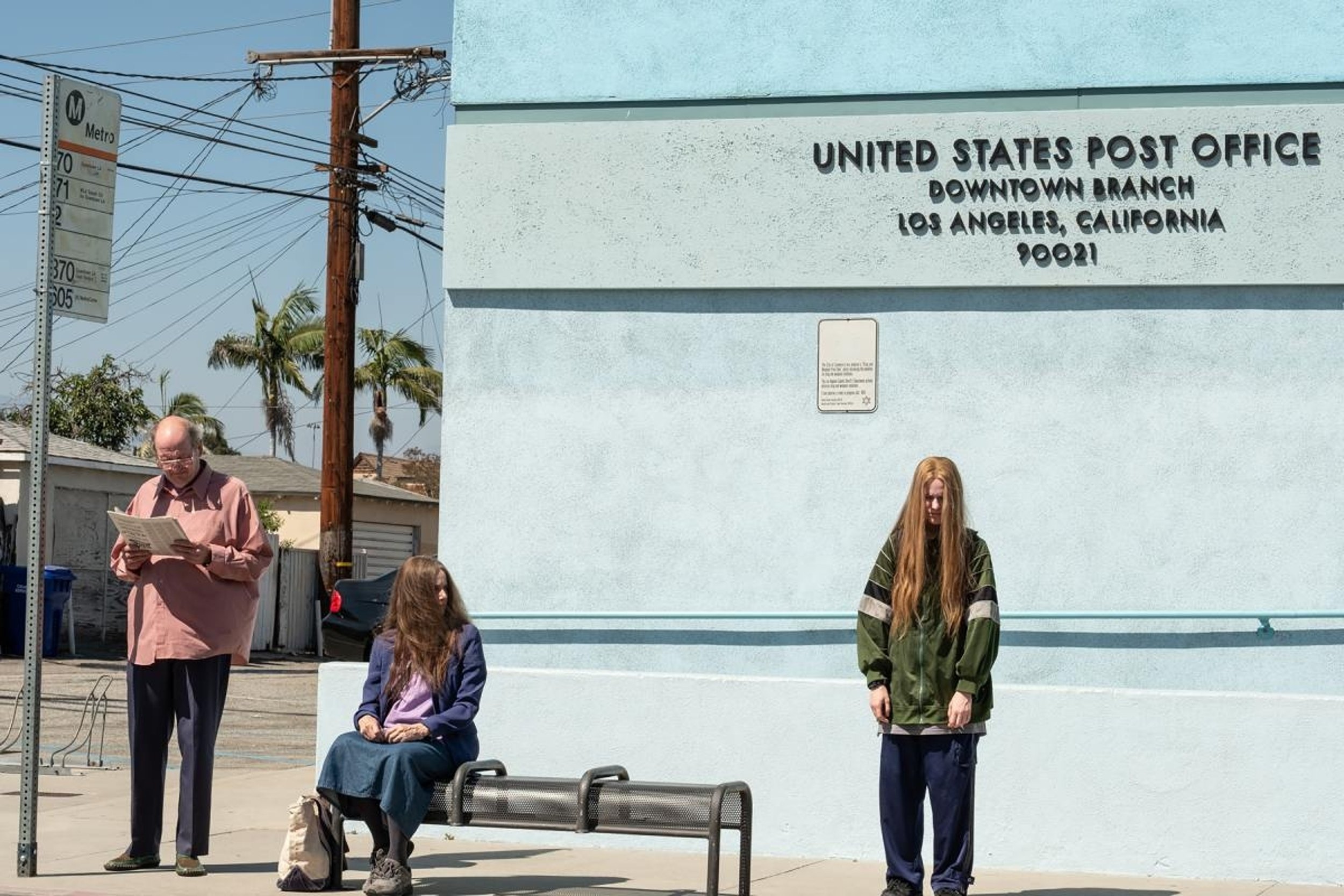
Refusal is only the beginning. What both Dickinson and Old Dolio create is something beyond protection: a self built from the fragments they choose, the gestures they withhold, the rituals they repeat. Dickinson’s 1,800 poems were less correspondence than constellation, an archive made to be encountered in pieces. Old Dolio, shaped by familial performance, authors herself through erasure: zipped jackets, withheld gestures, collapsing presence.
This is not rejection of desire but redirection of it. Dickinson’s “I cannot live with You” ends with the door “ajar,” leaving her imagined lover “just the Oceans are, and Prayer.” Old Dolio crawls back to Melanie to complete the small mothering gestures she invents in real time, trying to feel what she was never given, reorienting devotion without discarding it. Devotion, here, is a choice at a fork in the road.
Krauss’s theory provides the frame: structures repeat until they rupture, and from rupture a new myth emerges. The leaks, the foam, the rehearsed cons, Dickinson’s fascicles, Old Dolio’s choreography of absence—all operate as systems designed to hold, yet known by what escapes.
VI. Singularness, Costed
To be nothing but yourself has a cost.
In her apartment, Melanie has tucked the airline’s check into the fuse box before Old Dolio’s parents tuck her into bed on the floor beside Melanie. In the morning, Old Dolio and Melanie awake to an empty living room. The check is gone, the room is pristine, and in one straight line are all seventeen birthday presents. Together, they return the gifts. The total is $525, exactly Old Dolio’s share of the scam she devised and had a check in her name for: Old Dolio Dyne.
Dickinson spent nearly her entire life in Amherst, in the Homestead she rarely left. By her mid-thirties, she saw almost no one face to face, speaking through a cracked door, her friendships carried in letters. She published fewer than a dozen poems in her lifetime. She chose what entered, who entered, and how her words moved. The boundary is the work. The threshold is the authorship.
“How dreary, to be, Somebody! / How public, like a Frog,”
Old Dolio zips the green tracksuit jacket. Dickinson lifts her pen. Neither collapses into the crowd.
The pink foam rises, floods, recedes. Rituals persist; containment bends; devotion mutates. What endures is authorship: choosing what enters, choosing what remains closed. The door stays ajar.
Works Cited
Cameron, Sharon. Choosing Not Choosing: Dickinson's Fascicles. University of Chicago Press, 1992.
Dickinson, Emily. The Complete Poems of Emily Dickinson. Edited by Thomas H. Johnson, Little, Brown and Company, 1960.
July, Miranda, director. Kajillionaire. Focus Features, 2020.
Krauss, Rosalind E. The Originality of the Avant-Garde and Other Modernist Myths. MIT Press, 1985.
Mulvey, Laura. “Visual Pleasure and Narrative Cinema.” Screen, vol. 16, no. 3, Autumn 1975, pp. 6–18.
Sobchack, Vivian. Carnal Thoughts: Embodiment and Moving Image Culture. University of California Press, 2004.
If you enjoyed this article, please consider becoming a patron of Hyperreal Film Journal for as low as $3 a month!
Shannon Ratliff essays in Austin. Her work has appeared in Seneca Review, Joyland, Pleiades, Gulf Coast, Hippocampus Magazine, and more. She writes weekly essays at www.analoglavalamps.com.