
AFF '25: Do No Harm
It’s no secret that US healthcare is in a crisis. Affordable access to quality health services is unavailable to many Americans and there is no sign it’s going to get better any time soon. Many hospitals nationwide are understaffed and underfunded and no one at the top seems to want to make viable decisions that would help solve this crisis. It’s a daunting issue that affects almost everyone in the country. In writer/director Chris Hartwell’s new film, Do No Harm, he attempts to address some of these issues by telling the story of one very bad day for a committed, overworked home health care worker who makes a fatal error on the job. It’s a tense, tightly crafted little thriller that expertly draws audiences into the high stakes world of people who work in healthcare and how top down decisions about staffing and funding can cause catastrophic outcomes for people who are just trying to do their best and get the care they need.
From the moment Do No Harm opens, it doesn’t stop moving. We begin with the aforementioned home healthcare nurse, Sam (a mesmerizing Harry Shum Jr.), who is at a late night home visit that wasn’t exactly approved by his boss, Hector (Ronny Chieng). He is covering for an alcoholic, single father of a young girl with heart disease. It’s late at night, Sam is overworked and exhausted, and he should have found someone else to cover the shift so he could go home and rest. Instead, he goes to the home and tends to the girl and also helps the father into bed after he passed out drunk in the living room. As we are starting to learn, Sam lives to go above and beyond the call of duty. His patients are his whole world and he makes it a point to always be there for him – even when he is sacrificing his own mental and physical well-being.
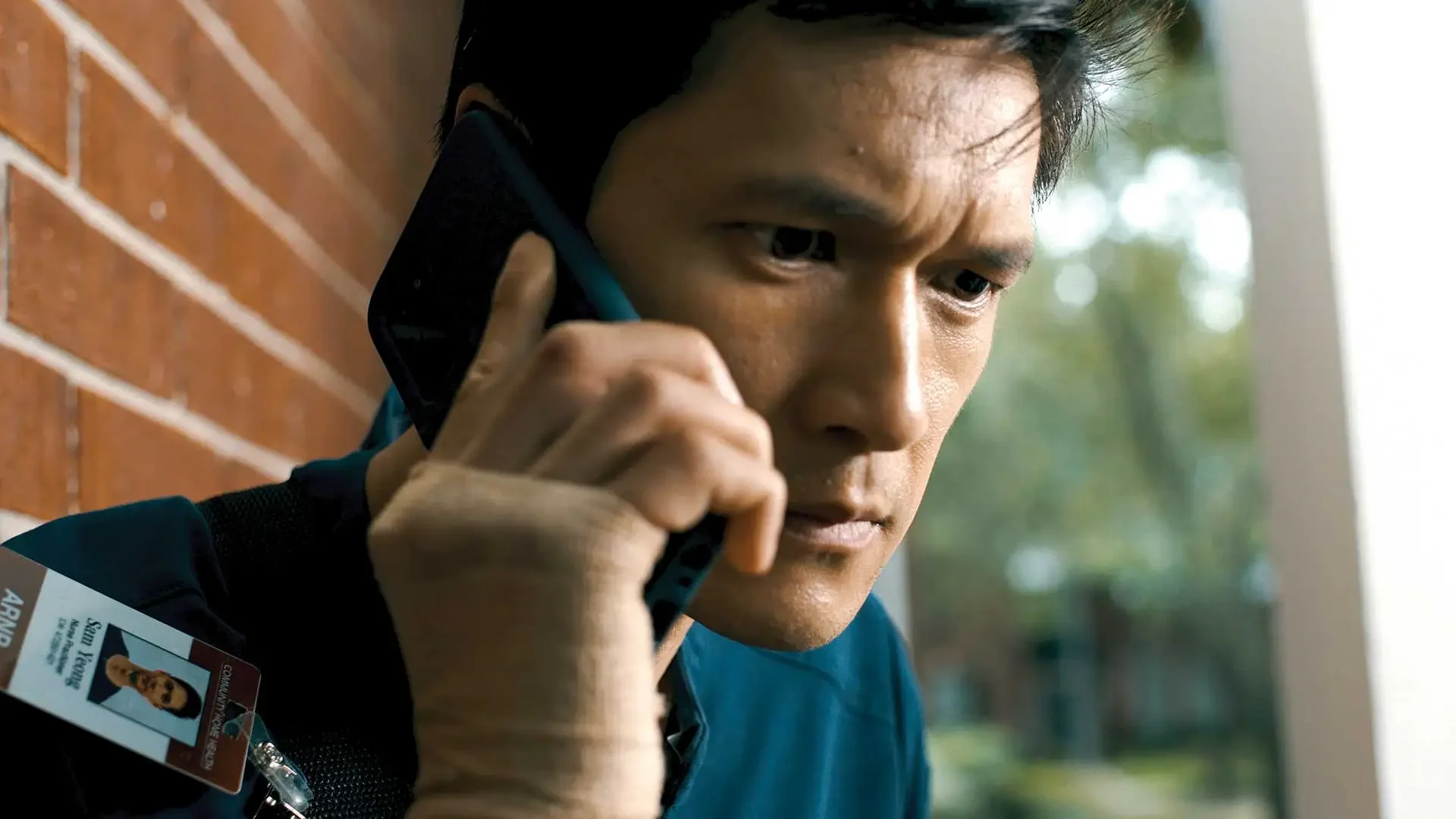
Still, given this is a film that addresses the shortfalls of the US healthcare system, Sam’s selfless decision doesn’t come without consequences. In his exhausted state, he makes the mistake of doubling the dose of heart medicine he gives to the young girl and she soon has to be rushed to the emergency room. This inciting incident sets up a very tight, tense, emotionally-taxing 90 minutes of film. As soon as Sam learns of his mistake, he immediately goes into damage control mode and attempts to cover his tracks so his mistake doesn’t get discovered by his employer and ends up losing his beloved job that he is usually very good at. All the while, Sam still has to work a full day and attend to all his regular patients at their respective homes. He is juggling a lot and it’s clear something is about to break. Do No Harm does a great job of showing audiences the different kinds of patients and their families who rely on these home nurses for care. Among these patients: there is a father who is wheelchair-bound but afraid to rely on his family for help because it will show weakness when he’s supposed to be the provider; a tired, single mother of two boys who is terrified of using needles to give her son his medicine; and a mother living out of a motel who is knowingly giving her addict son her pain medication. As Sam zooms from one visit to the next, all while making panicked phone calls to his boss and coworker/girlfriend trying to cover up his mistake, you almost forget to breathe. The tension builds beautifully as we join Sam in his panic.
As an audience member you want Sam to make it out of this mess unscathed, but director Hartwell makes it clear that things are going to have to get worse before they can get better. Shum expertly plays a man on the verge of a nervous breakdown – even as he’s trying to tell himself and those around him that he has everything under control. His cool, confident facade that he portrayed at the beginning begins breaking fast as he realizes that people are going to find out about his mistake. He starts losing it in front of his patients and his anxiety is making it near impossible for him to function as his normal self. The tight, panicky close-ups on his face and shaking hands and he runs from appointment to appointment help to really sell the building tension inside Sam. At one point, he is literally running to a patient’s home, trips and falls, and badly hurts his hand. This man is fighting for his life and the film never lets us forget that. The kinetic way the camera whips from shot to shot is the perfect way to sell the anxiety that’s living inside Sam. The camera is forcing us to feel how he feels.
The influences on Do No Harm are obvious as there is a long line of films that center on a single character anxiously moving through a crisis while having a mental breakdown (Uncut Gems, Good TIme, Black Swan). What sets this movie apart is that it is grounded in something that affects everyone – the healthcare system. Seeing the effects of a broken system through the eyes of a home nurse trying to do his best is heartbreaking. In the post-screening Q&A, Hartwell talked about how he drew inspiration from his wife (a home health care nurse) and his father (a doctor) while writing the script for this film. It mattered to him to authentically portray the reality of what healthcare workers are faced with on a daily basis – structurally and personally. That authenticity comes through in the portrayal of these characters and nothing in the film ever feels especially cloying or emotionally manipulative. Sure the circumstances that Sam faces are extreme and dramatic, but his interactions with his patients, boss, and coworkers feel true. Do No Harm is a wonderfully crafted thriller that is set in something that induces anxiety in almost everyone – dealing with healthcare. I strongly recommend this Texas-made,indie film for anyone looking to sit on the edge of their seat for a tight, anxious, thoughtful, and moving 90 minutes. Small but powerful movies like these are a gift and deserve to be seen by a wide audience.
If you enjoyed this article, please consider becoming a patron of Hyperreal Film Journal for as low as $3 a month!
Hannah Dubbe lives with her cat in Austin, TX. When she’s not watching movies, she’s running. Movies change lives.