
FF '26: A Prayer for the Dying
Death isn’t too far from sheriff and pastor Jacob Hansen (Johnny Flynn) in 1870s Wisconsin. In his dreams, filled with shadowy figures hued by hellish oranges and reds, to the encroaching wildfire heading toward his small town, the former Civil War soldier is surrounded by threats to his post-war life of peace. Then a mysterious plague arrives, striking down neighbors and loved ones alike, setting off A Prayer for the Dying’s intense portrait of collapsing society.
In her feature film debut, director/writer Dara Van Dusen adapts Stewart O’Nan’s novel of the same name into a work of foreboding doom. Making its North American Premiere at Fantastic Fest, Van Dusen’s film slowly turns the theater into a silent mausoleum as audiences watch a man unsuccessfully grapple with forces beyond his control.
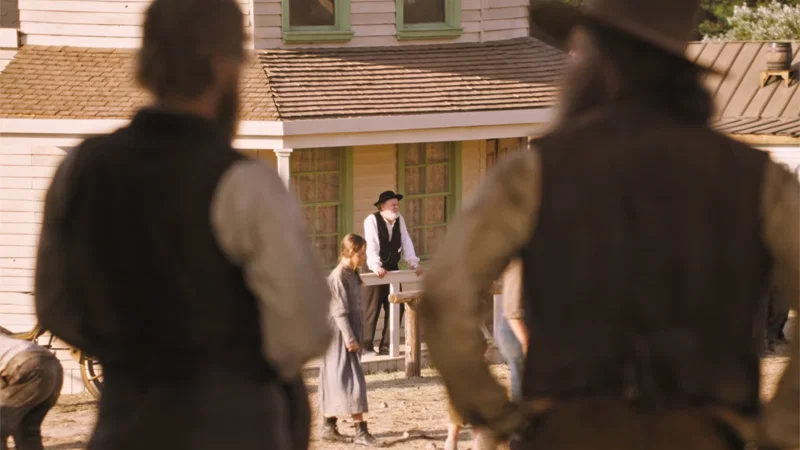
Crammed between a narrow Academy Ratio frame, and constantly centered by Kate McCullough’s camera, Jacob’s ordeals never leave our sight. As sickness spreads and the smoke of the wildfire grows nearer, Van Dusen’s movie always looks great even as it barrels to an apocalyptic finale. The filmmaker shows a fondness for minimal cuts, instead letting her actors, and particularly Flynn, grapple with their characters’ situations in long takes punctuated by abrupt camera pivots and turns that reveal off-screen horrors. The result is as if Wes Anderson’s camera crew came down with a heavy dose of nihilism and used their quirky camera movements to unnerve, rather than entertain, the viewer.
As the film’s cursed protagonist, the bearded Flynn sells Jacob’s descent into doom. With sad, full eyes and a somber expression, Flynn showcases his character’s growing frustration and depression as the town and its people succumb to illness and fear. Switching between looks of despair, frantic mutterings, and defeated preachings, Flynn sells his journey from a soft-spoken family man to a desperate, pained husk trying to survive. Van Dusen’s script doesn’t delve much into the people around Jacob, save for his worried wife (Kristine Kujath Thorp), and the town’s sole doctor (John C. Reilly). Thorp’s role never leaves the trappings of the doomed wife overwhelmed by tragedies, but the actor nonetheless makes the audience feel her pain and sorrow as her situation grows more dire. Reilly gets a slightly meatier role as the man of science facing an unstoppable plague, acting as a calming voice to Jacob’s growing worries. Despite his character’s abrupt departure in the last act, Reilly provides a warm, confident performance that acts as buoy in the face of an unrelenting plague.
These performers bolster Van Dusen’s firm control over the film’s surprisingly shifty mood. It can all get a bit too doom and gloom in parts, but the filmmaker shows a dark sense of humor in unique moments such as when, in the middle of frantically quarantining the town, Jacob comes across a lively traveling circus filled with elephants and excited clowns. Even in the face of collapsing society, Van Dusen finds the tricky, complicated humanity bumbling its way to the abyss. Tackling religion, self-preservation, pandemics, PTSD, and paranoia, A Prayer for the Dying covers a lot of interesting territory in just 90-ish minutes. It may not cover each of those topics in-depth in its light runtime, but it’s impressive to see Van Dusen reach for so many interesting thoughts in such a compact movie.
Despite an ending that’s a bit too mysterious and open-ended, A Prayer for the Dying succeeds in capturing a riveting end-of-days vibe. It can be a bit slow and maybe even a tad pretentious as its finale enters a dreamier pace and tone, but the result is a mesmerizing watch that will leave you as rattled and dazed as its doomed main character.
If you enjoyed this article, please consider becoming a patron of Hyperreal Film Journal for as low as $3 a month!
Hailing from Dallas, Texas, Justin Norris lives and breathes for one thing: movies. When not constantly telling people he’s “working” on a script, film review, or novel, he’s actually really trying to work on those things, guys, just trust him! Anyway, he’s also into casual reading, being an intense New York Jets fan, playing pickup basketball, and of course, catching a flick at the local theater.
To get more personal, follow the jabroni at:
Twitter: @DaRealZamboni
Instagram: justinnorris12
Letterboxd: DaRealZamboni
Medium: https://medium.com/@justinnorris12