
Lights, Camera, Praxis - Analyzing Labor, Gender and the Partition in Meghe Dhaka Tara
“Cinema to me is a means of expressing my anger at the sorrows and sufferings of my people.”
- Ritwik Ghatak
Ritwik Ghatak’s Partition Trilogy (Meghe Dhaka Tara [1961], Komal Gandhar [1961] and Subarnarekha [1962] is some of the finest-ever South Asian filmmaking. It grapples with the split of Bengal into the Indian state of West Bengal and the sovereign nation of Bangladesh across two bloody conflicts in 1947 and 1971, respectively, without ever depicting it. The films instead show the tragically fractured lives of millions of post-partition Bengalis who lost their homes due to borders arbitrated by officials–circumstances entirely out of their control.
Ghatak spent his life yearning for his lost homeland and chose to dedicate his career to making films that captured this emotion. In addition to being an auteur filmmaker, he was a playwright and actor in the Indian Peoples Theatre Association (IPTA), where he met many of the recurring actors he cast in his features. The IPTA was the arts wing of the Communist Party of India (CPI), of which Ghatak was also a staunch member. He used his films as vehicles of political dialogue, from semi-autobiographical features that discuss the Maoist ideas of Naxalism (Jukti Takko Aar Gappo [1974]) to full-fledged documentaries on communism in India (Amar Lenin [1970]).
The Partition trilogy is ostensibly Ghatak’s most political work, as it subsumes all theory in how it presents the reality of post-partition Bengal. The aesthetic depictions of displacement and societal rot make these films the most cogent cinematic analysis of capitalism in a postcolonial world and the agonizing oppression of nation-states.
Meghe Dhaka Tara is the first film in the trilogy, and possibly the director’s most widely-renowned work. It follows Neeta, a refugee woman from East Bengal living in the outskirts of Calcutta with her struggling family, providing for her three siblings and mother with money she earns tutoring schoolchildren while she finishes her MA. She wants to start a relationship with an aspiring scientist named Sanat, but he is also facing financial instability and constantly asks her for money. She is forced to give up her education and work a corporate job when her father, the only other earner in the house, falls prey to a debilitating bone fracture. Throughout the film, she is exploited and betrayed by both her family and Sanat, who leaves her for her sister Geeta. She plays the good daughter and goes along with this abuse despite the family accepting their complicity and asking her to leave them behind. Overworked and emotionally battered, she develops a severe case of tuberculosis and tragically lives out her remaining days in a sanatorium.
The film is best understood by viewing Neeta's tragedies as a synecdoche for those of the Partition. Women in post-partition Bengal had an extremely complex relationship with employment, where it was often an additional burden to provide for their family rather than any form of liberation from traditional gender roles. Poverty and famine brought about by the split had a harrowing effect on those still in the process of mourning the loss of their land. The foundation of Meghe Dhaka Tara is the immensity of these struggles and the propensity for them to be put mostly onto women laborers. Neeta's multifaceted tragedies make this film among the most intersectional looks at the Partition; every identity is given equal weight, as they are the very injustices that Marxist, feminist and postcolonial theories look to analyze and answer. Ghatak frames it all within the context of a reeling society, a solemn realization of these schools of thought.
Director of Photography Dinen Gupta, who also worked with Ghatak on Ajantrik (1958), adds an incendiary flair that accentuates the daunting melodrama of the script, drawing on stylistic elements from the films of Varda, Godard and Kurosawa to tell an unbelievably incisive tale of grief and dislocation that could only be told by Bengalis. Ghatak and Gupta use recurring imagery to great effect in this film. This method is set up from the opening shot of the film, a gorgeous composition wherein Neeta looms over her older brother Shankar. There are only a few elements present here but they are brought back in later shots with new visual relationships that mirror the story and the characters’ journey.
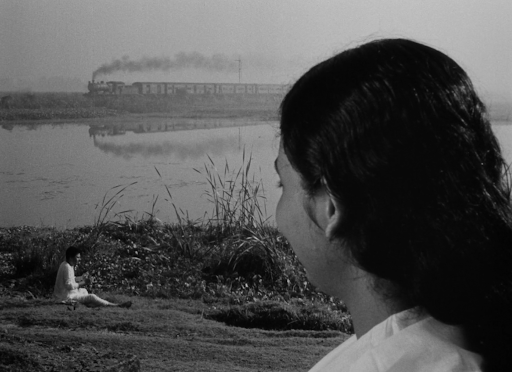
Trains are a dynamic force across cinema. They are sociopolitical iconoclasts of movement, creating class divides by their mere existence as one of the earliest products of the Industrial Revolution. Meghe Dhaka Tara uses their presence subversively, another reminder among many of the fractured future of the subcontinent. These normally lumbering locomotives appear blazing fast in a still shot, a warped emblem of progress going past the frame while characters outside of it are stuck within its tribulations. It bifurcates the frame in an obvious motif for Partition and serves as the backdrop for the film's many conflicts, creating a dialectic that asks poignant questions about what has been lost.
The Partition trilogy is special because it speaks to much more than just mourning of the split itself. It depicts the complex clashes of ideology along the lines of class, gender, caste and religion within the material conditions of its characters. It blends the realities of millions who had their lives upturned by hastily-drawn cartography.
Shankar is an aspiring musician that relies on his sister for all his financial needs, including 10 rupees every week for a shave. He is well aware of the toll he exerts on his sister but learning Bengali folk music like bhatiyali requires extensive practice, so he cannot afford to work. The dependence of the artist on a source of capital, often someone in their life, is the main theme of this framing. The train of civilized capitalism chugs along in the background, unrepentant for all the strife it has brought. Ghatak, for all his political action, often ruminates on the vulnerabilities of creating art in such times within his films. In his essay Cinema and I, he writes that “Our responsibility is not to manufacture illusions. It is to show how truth trembles. That trembling—call it myth, music, montage—is where real cinema begins.” Constant struggles for a livelihood, political upheaval and the lack of a place to belong were the truths looming over every artist in the subcontinent for many years after the Partition. How can one create while fearing for their life? How can anybody find beauty without joy to which to relate it? These questions have permeated the very fabric of creation for decades since the split; perhaps the only way out of the generational rot in attitudes. A wholesome image of a sister admiring her brother's melody becomes haunted in the spectator's memory as the characters' spirits are broken over and over again, joyfulness spoiled by the specter of desperate need in a land sagging under the weight of its own recent history.
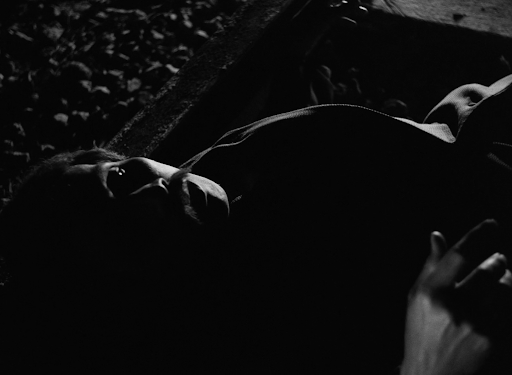
Neeta's father Taran is a character that represents a benign hope, perhaps naive in his trust that everything will be okay. A teacher like Neeta and the only other earner in the family, he speaks of Keats and Federico Fellini and dotes on his family. He wants Neeta to finish her MA, in contrast to the rest of the family’s selfish motivations to want her to work. The train tracks are where he faces a blow to his very existence, sustaining an injury that forces him out of his job and leaves Neeta as the sole caretaker of the family, leaving her no choice but to give up her education and hobbies. It's the very erosion of her as a person, brought about by the figurative death of her father.
Through this injury, Ghatak also laments a loss of community and empathy that was forced upon him through decades of chasing a colonial idea of "civil society". The train tracks are the foundation for the symbolic carrier of progress. The bedrock of measuring this progress is technological; unfeeling and cold, borne of colonial violence. It poisoned the notions of our society at large and created barbarous conditions that caused tragedies like Neeta's. Taran is markedly different after the accident. He is always hand-wringingly remorseful about the family’s treatment of Neeta, but unwilling or unable to do anything about it. Multiple close-ups of gaunt faces and empty accusations make him emblematic of how Ghatak viewed the inert denizens of Bengal, inching towards an even harsher future riddled with strife because they only confront societal problems through an excessively academic lens rather than with the empathy they once possessed. Much like how Taran lost his ability to walk or work, such people perhaps lost this empathy after their land and connection to it was torn asunder multiple times. Ghatak was skeptical about the future of the Bengali identity in light of such apathetic attitudes, and chose to express it through characters like Taran.
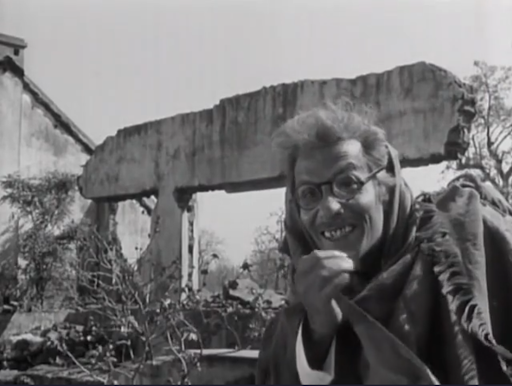
Interestingly, the actor who plays Taran, Bijon Bhattacharaya, plays the thematic inverse in the Partition trilogy’s final film, Subarnarekha. Subarnarkha’s Haraprasad is an impish, haggard old man run ragged by his attempts to combat injustice, resorting instead to alcoholism and debauchery. His inadvertent look to the camera in one shot is chilling imagery for the ways both apathy and unrealistic hope can exact a toll.
Neeta's former lover Sanat is also a shell of himself by the end of Meghe Dhaka Tara, abandoning his goals of getting a PhD and using it to improve society. He succumbs to the allure of both being the urban bourgeoisie and of Orientalism, where his connection to his own culture and country is rendered ornamental by the upward socioeconomic mobility he gains from his corporate job. His fancy apartment, where the decorations are much closer to what one might have found in a hawker's cart in the Calcutta town square rather than local artisans in their village, is the materialization of this.
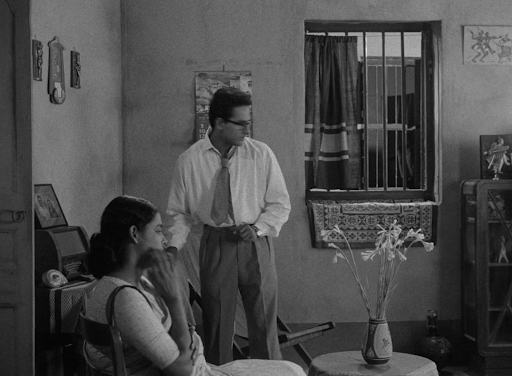
The suffering and violence of the Partition cannot be entirely attributed to British colonial rule, as there were already systemic examples of deep-rooted misogyny, casteism and communal tensions across the Indian subcontinent. Sanat's movement throughout the movie explores this difficult yet important truth. He is always asking Neeta to stay as she starts to leave the frame, a visual force that creates progressively more oppressive circumstances, denying Neeta agency and self-actualization much like these longstanding problems have halted growth for all three nations to this day.
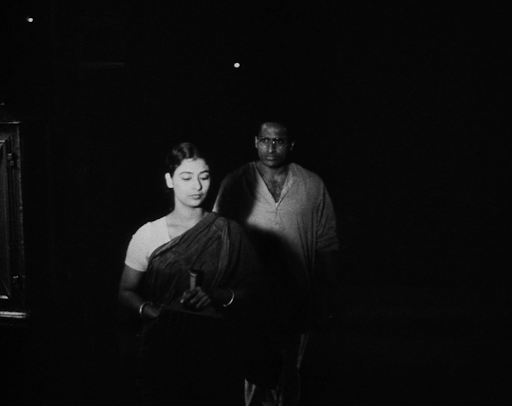
Sanat is presented in a very awkward light throughout the film. He rarely offers much in the form of either love or financial support, and even betrays Neeta by marrying her sister Geeta. It's no surprise that he is the film’s vehicle for chauvinist attitudes amplified by colonial rule. Neeta does not seem to harbor any affections for him by the end but her connection to him is one that will sadly endure. This is illustrated perfectly through the following two shots, one towards the start of the film and other the end.
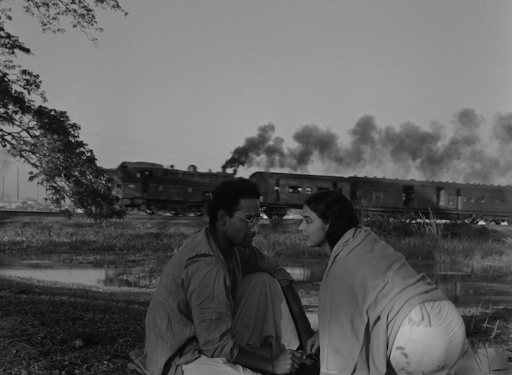
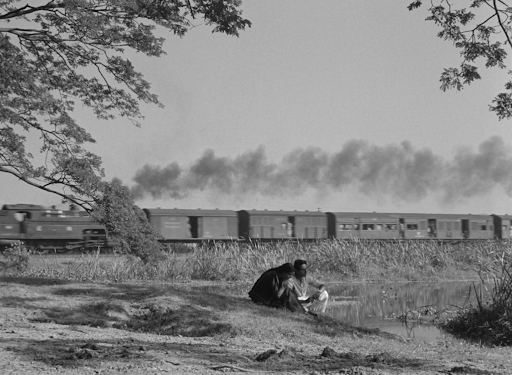
The camera is much tighter on the characters in the earlier shot, a representation of the way that Neeta, along with the spectator, can't see the bigger picture of her entanglement with Sanat at the start of the film. Despite both shots having very similar elements, their difference in framing is what evokes the realization of the damage that was done by Sanat, examining the complicity of a postcolonial society in the tragedies that befell it. By the end, this exploration is almost moot, a miniscule aspect of the longstanding damage that has already been done by the Partition.
Ghatak's Marxist ideologies were central to his artistic statement in the Partition trilogy, so the films’ striking visuals of alienation and estrangement from nature as a result of a wage-labor dependent livelihood is hardly surprising. He always claimed that his films were illustrative rather than instructive, and showing the painful effects of capitalism compounded with the grief of a land lost forever is arguably the most poignant argument he as a communist could make. Both of the following shots show sprawling expanses of the world and its endless beauty, and our characters in the pits of despair in these settings.
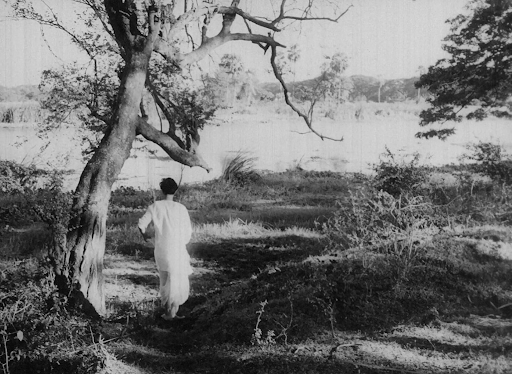
Shankar is in a perpetual state of immobility for much of the film as he’s aware of his burden on Neeta. Creating art is a noble goal but he can't do it without beseeching financial aid for his survival. He is trapped by his own inaction regarding his sister, reflected in the vast horizon awaiting him yet him being held back by an invisible harness of guilt.
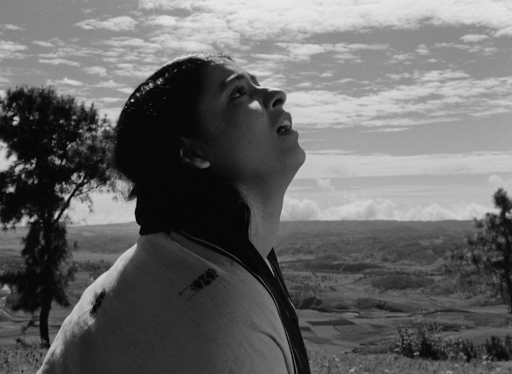
This image of Neeta is one of the final shots of the film and represents its entire thesis writ large. When Shankar checks her into a sanatorium in the Shillong hills for tuberculosis treatment, she feels truly alone and unable to access the beauty around her–much like millions of Partition refugees stuck in terrible anguish among some of the most beautiful sceneries in the world, from valleys of Sylhet to the rivers of Punjab. This ecological space is for habitation outside of any concepts of ownership or property, but foreign arbitration of a border forged it into a prison.
Neeta is shown to have an almost spiritual connection to nature. She walks into the first frame of the movie under the canopy of massive banyan trees paving a path for her. Her voice is sweeter than chenna when singing about the rivers. She is referred to as the titular Meghe Dhaka Tara (Cloud-Capped Star) throughout the film. She dwarfs the rising sun when she talks about her dreams with Sanat.
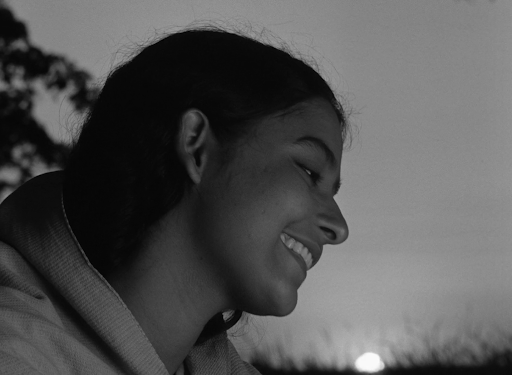
Contrast the frame above of Neeta at sunrise to this iconic shot of her below, wherein she wails “I really did want to live!”. She’s smaller in the frame, no longer a divine feminine towering above the horizon but rather a hostage engulfed by rolling hills of a non-life.
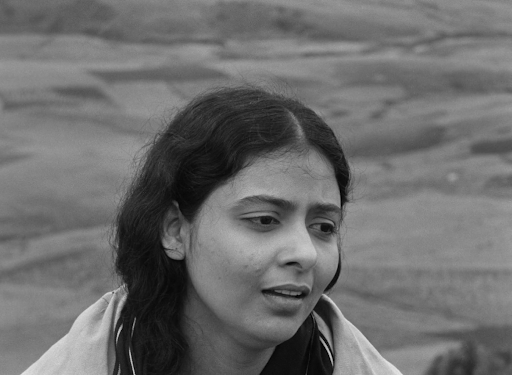
Every identity–a waged worker forced to sacrifice her education, a woman forced into eternal domestic care, and a refugee that lost her land–blends together into a suffocating miasma of complete estrangement. Neeta’s labor is what allows the family's incessant financial suffocation of her, but also what causes her aloofness starting at home as well. Her illness is almost secondary to the slow poisoning she experiences from the constant need for capital to survive. See this shot from the first act when the family gets the news that the father will be bedridden and unable to work:
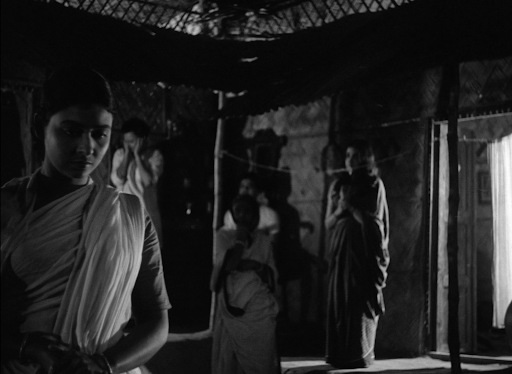
Neeta stands by herself, separated from the very family she has centered her life around. There is great care in how Ghatak and Gupta use both the camera and storytelling to depict the emotional toil of fracture. Composite frames, split diopters and shifting focus constantly put communities and loved ones in conflict with each other. Both parties experience the same grief that stems from external factors but cannot disentangle their personal resentments from it. This is a heartfelt examination of the needless personal discord borne from the Partition, of people turning on their own because of colonially constructed tragedies and oppression. Take this shot of Neeta and her mother, wherein the latter laments the cruel streak within her created by poverty but simultaneously guilt-trips Neeta into staying in this abusive situation.
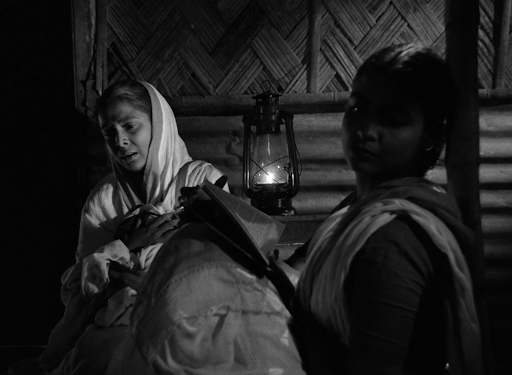
The lantern illuminates the mother and her tales of the past but also silences Neeta visually. Not only is she out of focus--the light from the lantern never quite touches her face, effectively erasing her from the shot despite her being in the foreground. Neeta has an inescapable gravity in this movie, her troubles holding a mirror to those Ghatak saw plaguing the subcontinent far into the future. Gendered violence colored much of the partition, and women who escaped it often had to face the servitude of dependence like Neeta. There have been walls of text written about these hidden stories and whether they are allowed to come to the forefront; Ghatak cleanly synthesizes them all into this horrifically tragic character. This claustrophobic shot is the final manifestation of Neeta's silencing, as her tuberculosis causes her to cough blood, inches away from the camera but with the sound of her coughs drowned out by an unsettling metallic ringing noise. This combination is a recurring surrealist motif within this film and the trilogy at large.
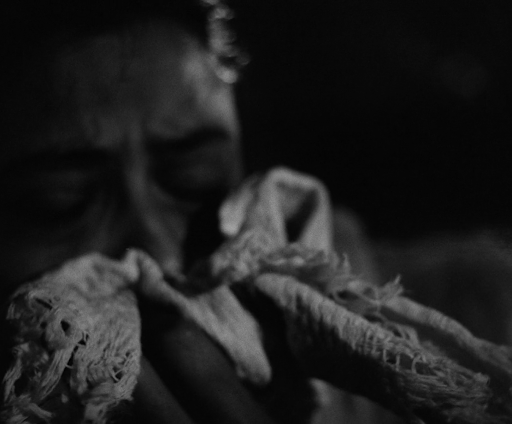
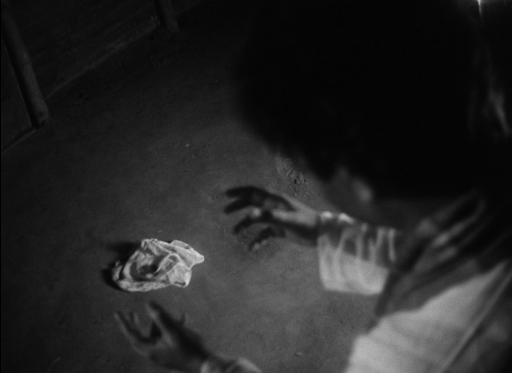
Neeta bears the brunt of the Partition like no other character in the trilogy, for she is the very spirit of Bengal personified. The richness of her thoughts never materializes like Shankar’s honeyed words, and her labor never amounts to Sanat’s. It all reduces down to a blood-soaked rag that everyone looks at with pity but never touches for fear of having the same fate befall them.
Works Cited
Ghatak, Ritwikkumar. Cinema & I. New revised edition, Dhiyanbindu in association with Ritwik Memorial Trust, 2015.
If you enjoyed this article, please consider becoming a patron of Hyperreal Film Journal for as low as $3 a month!
love to eat spaghetti the same way my father does
Links: dhruvbaronia.com