
TIFF '25: The Ugly
Writer/Director Yeon Sang-ho has spent the better part of the last decade reinventing the commercial possibilities of South Korean genre cinema, from the pulse of Train to Busan to the apocalyptic Hellbound series. Sang-ho’s newest film, The Ugly, which premiered at TIFF 2025, draws his focus away from large spectacle to the quiet horror within.
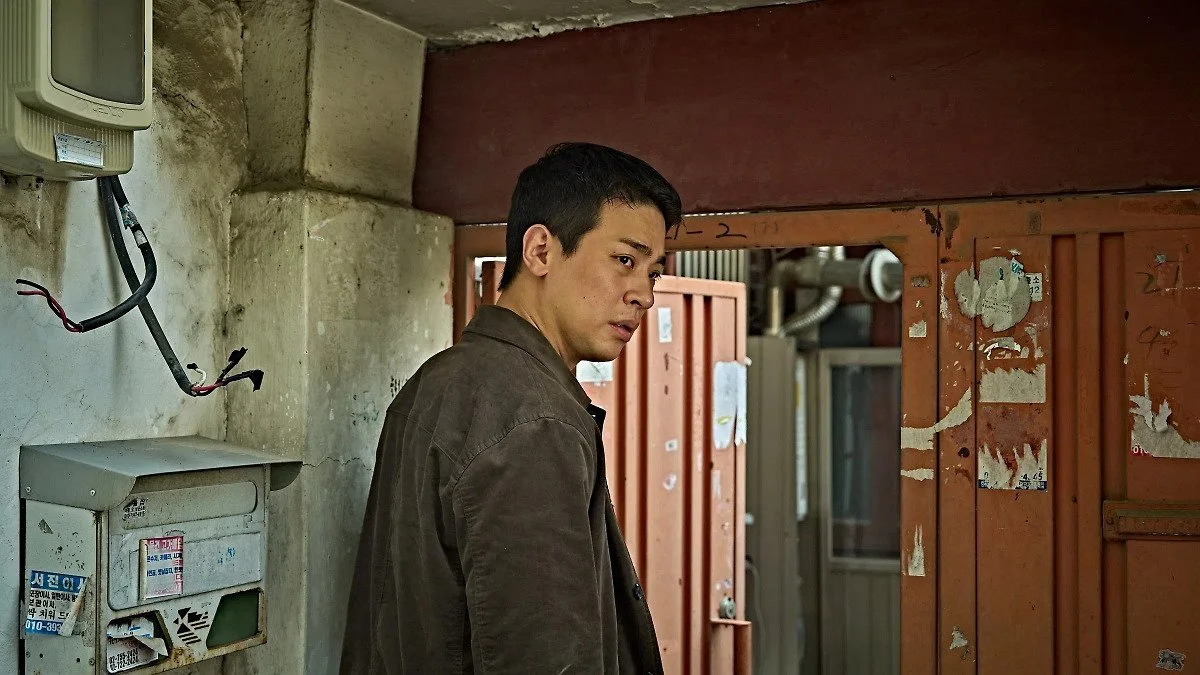
At the center is Im Dong-hwan (Park Jeong-min). While supervising a documentary crew filming his blind father (Kwon Hae-hyo), a highly respected stamp-engraver, Dong-hwan receives news that his mother’s remains have been found 40 years after she vanished. What follows is a painstaking excavation of family history: interviews with former colleagues, distant relatives, and memories and fragments of a life erased not only from records, but from empathy.
The woman at the heart of the case, Jung Young-hee (Shin Hyun-been), was treated as a pariah long before she disappeared. Her co-workers at the factory where she worked nicknamed her “dung rag,” mocking and ostracizing her for a single humiliating accident. The cruelty she faced in the years before her vanishing is justified by everyone Dong-hwan speaks with simply because of her appearance. Even at her funeral, her own relatives speak of her as someone “too ugly” to deserve memory.
The film oscillates between past and present, slowly revealing details about Young-hee’s tragic life. In the present, Dong-hwan is accompanied in his amateur investigation by documentary producer Kim Su-jin (Han Ji-hyun), self-motivated by her gut feeling that there is a better story to tell under the surface than Dong-hwan’s father’s celebrated legacy. The parallel storytelling and pacing may seem restrained and frustrating for some, but it prevents us from sensationalizing the horrors done to Young-hee.
Watching The Ugly, you can’t help but feel that Sang-ho is quietly declaring a second act for himself. He strips away spectacle and overt horror in favor of human stories and lower budgets. He adapted the film from his own 2018 graphic novel, committing his budget of around 200 million won ($143,972) to lean production design and intimacy. The production reportedly ran with a crew of around 20 shot over only three weeks. Sang-ho hopes this can become a “new normal” for filmmakers not relying on big budgets. And with the recent news of Netflix’s purchase of Warner Bros., we at Hyperreal are grateful for directors keeping the focus on creating art and not profit.
A surprising element that makes this film work is Jeong-min’s dual casting. He plays both the son in the present and his father in the past. “The film is essentially a story of different generations and for the father and the son to really resemble each other is a very important motif for the film,” says Sang-ho in conversation with Hammer to Nail. Jeong-min grew up with a father who is visually impaired (as noted in the Hammer to Nal interview), so while ambitious, his own life experience really added depth and reality to both characters.
And despite only catching glimpses of her face the entire film, Hyun-been’s portrayal of Young-hee evokes sympathy and frustration. I do not have a personal understanding of South Korea’s beauty standards 40 years ago, but I do know that in the present day their skincare and beauty products are in high-demand because of the “glass skin” showcased on social media. And in fact, South Korea has the most plastic surgeries per capita on Earth. Despite this, these challenges aren’t unique to Korea. And by withholding Young-hee’s appearance from us the entire film, the audience is left to assume what she must look like based on their own country’s or personal beauty standards, often rooted in external or internal misogyny.
One thing I’ve noticed reading Letterboxd reviews, is that many people’s critiques and lower ratings focus on this misogyny of the characters. But it’s one thing to have your characters be shallow and evil, and another for it to feel like the director is co-signing that. At no point during my viewing did I think Sang-ho was trying to pile on Young-hee with the rest of them. But he definitely doesn’t shy away from showcasing their ugliness towards her to uncomfortable heights. Like Bong Joon-ho’s interest in class or Park Chan-wook’s fascination with repression, Sang-ho turns cruelty into cultural criticism.
By the time the credits roll, the horror isn’t a great shock or jumpscare, but in the reality of how long suffering can be ignored. It asks viewers to reckon with the fact that violence isn’t always loud, and injustice isn’t always documented.
For this reason, The Ugly feels like one of the most unsettling films at TIFF. In an industry saturated with tropes of redemption and spectacle, Sang-ho offers a story that insists on remembering the erased. He offers the uncomfortable truth that remembering someone is radical, that bearing witness is work. It makes you wonder what horrors might still be buried in plain sight, waiting for someone to care enough to look.
If you enjoyed this article, please consider becoming a patron of Hyperreal Film Journal for as low as $3 a month!
Jenni Kaye is the co-founder of Hyperreal Film Club and Content Producer at Mondo. In her free time she’s making TikToks, roller skating, and convincing more people to watch BREATHING FIRE.