
The Samurai and the Prisoner: A Dark Dive Into the Human Psyche
Contemplative mysteries may not be the first thing that comes to mind when one thinks about Kiyoshi Kurosawa, the prolific Japanese filmmaker best known for his horror films such as Cure, Pulse, and recent thrillers like 2024’s Cloud. His latest film, however, makes a turn away from the expected by using his incisive perspective as a filmmaker on the murder-mystery genre. The Samurai and The Prisoner is a contemplative murder mystery set during the Sengoku period of Japanese history. While the film may take its time rolling through its four seasonal vignettes, there are elements that will satisfy both fans of good, Columbo-style mysteries and Kurosawa’s dives into the darker parts of the human psyche.
Set during the siege of Arioka castle in 1579, The Samurai and The Prisoner follows Lord Araki Murashige (Masahiro Motoki) as he locks himself away from his enemy Oda Nobunaga (Bando Shingo), in the castle and takes the warlord’s military strategist, Kuroda Kanbei (Masaki Suda) as a prisoner. We follow Lord Murashige across Winter, Spring, Summer, and Fall as he tries to solve the suspiciously rampant murder mysteries that imbue the castle with a haunted melancholy—usually with the help of Kanbei. The period setting of the movie lends a classical air to the film that helps build a sense of familiarity.
The proper titles and larger historical period The Samurai and The Prisoner takes place in can be intimidating for a viewer with no prior knowledge of the period or history that the film takes place in. However, once you tune into the film’s true frequency: period piece murder mysteries that have a similar structure. The potential confusion of titles and larger wartime strategies fall away and the familiar tropes and trials of any good mystery come into the light. Each segment finds a neat structure: Murashige briefs his men on a strategy or dilemma, a body appears, Murashige seeks counsel from Kanbei, and thanks to this counsel, the murder is solved. While the structure largely remains the same, different shades of melancholy start to appear with every murder solved. Season by season, the mysteries are solved, but more intrigue around the castle builds, and an atmospheric melancholy builds around the film that feels both fresh and classical.
Pacing of murder mysteries can be snappy and a-revelation-a-minute, but here Kurosawa has opted for a slower, at times dread-inducing pace in keeping with much of his other work. While it might not conjure up the same enormous amounts of inescapable dread that a film like Cure does, there are pieces of it in each mystery. Indeed, the many deaths that happen around Castle Arioka don’t shy away from the brutality of his earlier films. There is child death, beheadings, and other acts of violence that a more reserved murder mystery might shy away from actually depicting on screen. Where most murder mysteries are determined to gloss over murder and violence as mere moving parts of the story instead of driving incidents that move the plot forward, Kurosawa doesn’t let his viewers off so easily. While we don’t see every death on-screen, what we do see is enough to instill a sense of unease and danger. Indeed, without spoiling everything, even the end of the film feels grounded in Kurosawa’s sensibilities. There is a sense of satisfaction in one sense, but also of deep isolation and loss in another.
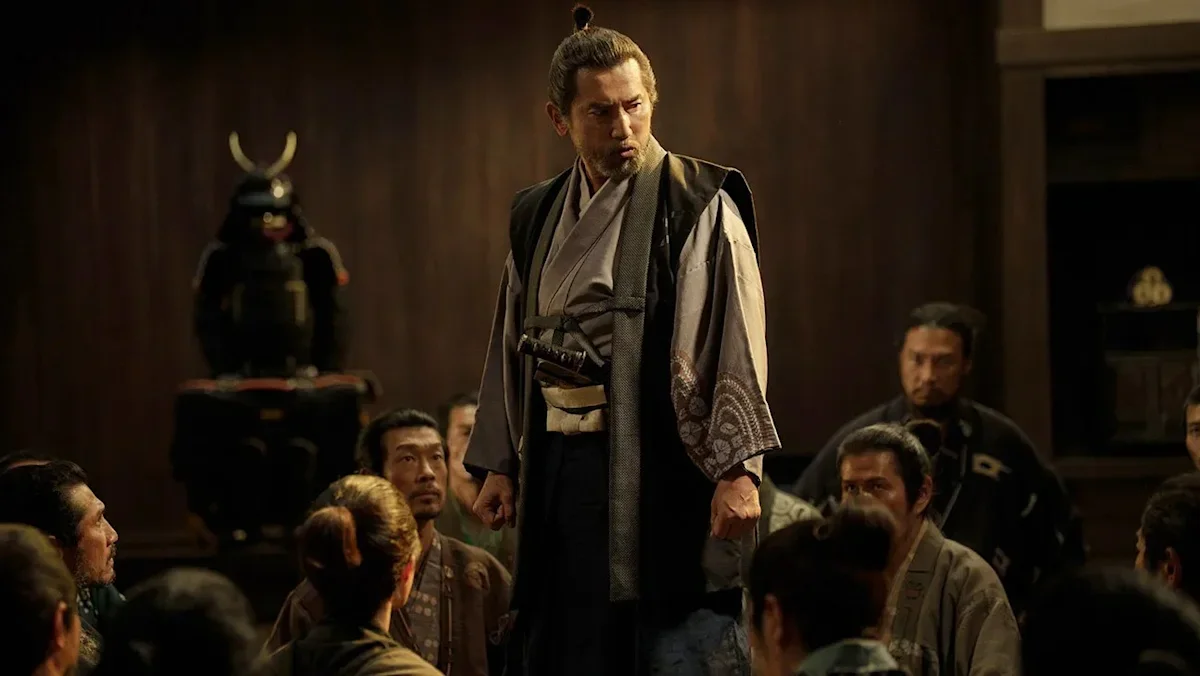
It’s still an overall change of gears for Kurosawa, the committed performances at the heart of the film help with the transition. There is Motoki’s turn as Lord Murashige, creating a portrait of a man who is battle weary, who can deeply worry about his men in one scene, and then have the same level of concern over an expensive tea urn in the next. This likeable performance makes it easy to follow the Lord into battle, or a castle full of mysteries. Actor Yuriko Yoshitaka, who plays Chiyoho, Lord Murashige’s wife, is also worth spotlighting here. In a role that might otherwise be considered auxiliary, but then becomes something more complicated, Yoshitaka adds a level of sincerity and intensity to Chiyoho that draws you in.
Overall, while some might find The Samurai and The Prisoner to be an odd switch-up for Kurosawa, the end product is still a compelling time at the movies. It won’t work for everyone, but for fans of the director and those who can follow the new path that Kurosawa is charting out here will find a new sensibility towards a tried and true genre. The film is a meditative, melancholy build to a lonesome end.
If you enjoyed this article, please consider becoming a patron of Hyperreal Film Journal for as low as $3 a month!
Alejandra Martinez is a Tejana archivist, writer, and film lover in Austin, TX. She loves coffee, David Lynch, and tweeting about everything under the sun.
Twitter: @mtzxale.