
Hitchcock, Hedren, and The Birds
Alfred Hitchcock is cinema.
In an age where popular entertainment is designed to not offend or challenge, in thematics or esthetics, it’s hard not to look back on the work Hitchcock, which spans 50 years, and not feel at least a twinge of jealousy. This was a filmmaker who operated without a peer and created the highest level of mainstream films anyone could enjoy, while pushing the boundaries of what was viewed to be publicly decent, in an era where the studios had stringent controls on what could or not be depicted. Plenty of great filmmakers came out of the studio system, but on some days, I’d declare him the best to ever do it.
Hitchcock was never one to slow down. After the success of 1960’s Psycho (ever heard of it?), the master of suspense was already on the prowl for a new project, including a potential film taking place in Disneyland, and came across Daphne du Maurier’s short story “The Birds”. Originally, the director felt it lacked the bones of a good film. But, as detailed in Tony Lee Moral’s “The Making of Hitchcock’s The Birds,” he became fascinated with real life stories of bird attacks. In Santa Cruz on August 18th, 1961, “Residents were awakened about 3am by the sound of birds slamming against their homes…the birds, blinded by heavy night fog, flew into rooftops, poles and other obstructions.” One couple’s living room was destroyed after a giant flock of birds came through the chimney and even got entangled in the wife’s hair (two images copied into the film).
While eating breakfast with his wife Alma at their Bel Air home, Hitchcock saw a commercial for a meal replacement diet drink Sego that starred a 31 year old Tippi Hedren. The product was of very little interest to him, but the actress did. In his book “Spellbound by Beauty,” Donald Spoto writes that Hitchcock found Hedren to be “a blonde model with a good figure, sensual but not brassy, and obviously so successful (in) her Sego regime that men and boys alike whistle as she strolls along.” Over the phone with his agents at MCA, Hitchcock referred to Hedren as “the girl” and requested a meeting.
When meeting Hitchcock, Hedren was under no impression it was for a movie. She had no training, was currently divorced, and a single mother to her daughter Melanie, who’d become a famous actress in her own right. “I had no thought of becoming an actress — much less a star,” she said. No matter what she thought, the filmmaker saw something that she couldn’t perceive.
Hitchcock proved his obsession with Hedren early on. After three days of rigorous screen tests, where the actress performed scenes from his various films, Hitchcock had costume designer Edith Head create clothes for Hedren’s personal life. He became a tutor about a variety of aspects of life, including that of wine and food. He wasn’t simply hiring an actress for a part; he was molding an actress into the perfect image. Reading about their relationship, I couldn’t help in reflecting in the ways Vertigo mirrored it. In that film, James Stewart’s character becomes obsessed with Kim Novack and begins to control her life in a similar fashion, even down to picking out the clothes.
The film, funnily enough, opens with a recreation of the Sego ad. Melanie Daniels (Tippi Hedren) walks across a San Francisco street in a set of matching black heels, skirt, and jacket. A young boy whistles at her, which leads her to stop and see a gathering of gulls circling in the sky. But Melanie isn’t here to hawk a diet drink, she’s here to pick up a bird from the bird shop.
From the get-go, Melanie doesn’t feel like the average Hitchcock blonde. We quickly learn she has a lying streak and enjoys playing pranks; the director himself was known for pranks, many downright cruel. She meets handsome and chiseled lawyer Mitch Brenner (Rod Taylor), and pretends to be the owner of the shop as he wants to buy a pair of lovebirds for his young sister Cathy (Veronica Cartwright).
All of the action takes place in Bodega Bay, a small shore side village 67 miles north of San Francisco. It’s a picture perfect place, a community right out of a classic sitcom where everyone knows everyone. Melanie, charmed by Mitch, makes a trip to drop off the lovebirds. She meets the matriarch of the Brenner family Lydia (Jessica Tandy), whom in Hitchcock fashion, has a fixation on her son’s love life. She also befriends the local elementary school teacher Annie Hayworth (Suzanne Pleshette), and the two share an undeniable flirty discourse.
Hitchcock creates dense confections of symbolism. The stuffed birds in Psycho, the train in North by Northwest, the camera lens/binoculars in Rear Window, the unseen antagonist in Rebecca, and, well, everything in Vertigo. His films are laced with double meanings, as the Hays Code prevented him from being as explicit as he wanted. Because of this, there is often a sense of something being unspoken, although strongly hinted at. Mind the phrase, but The Birds is a different animal, in that it avoids direct messages or symbolism in the ways Hitchcock obscures what the attacks mean. Is it the end of the world? Is it revenge on mankind?
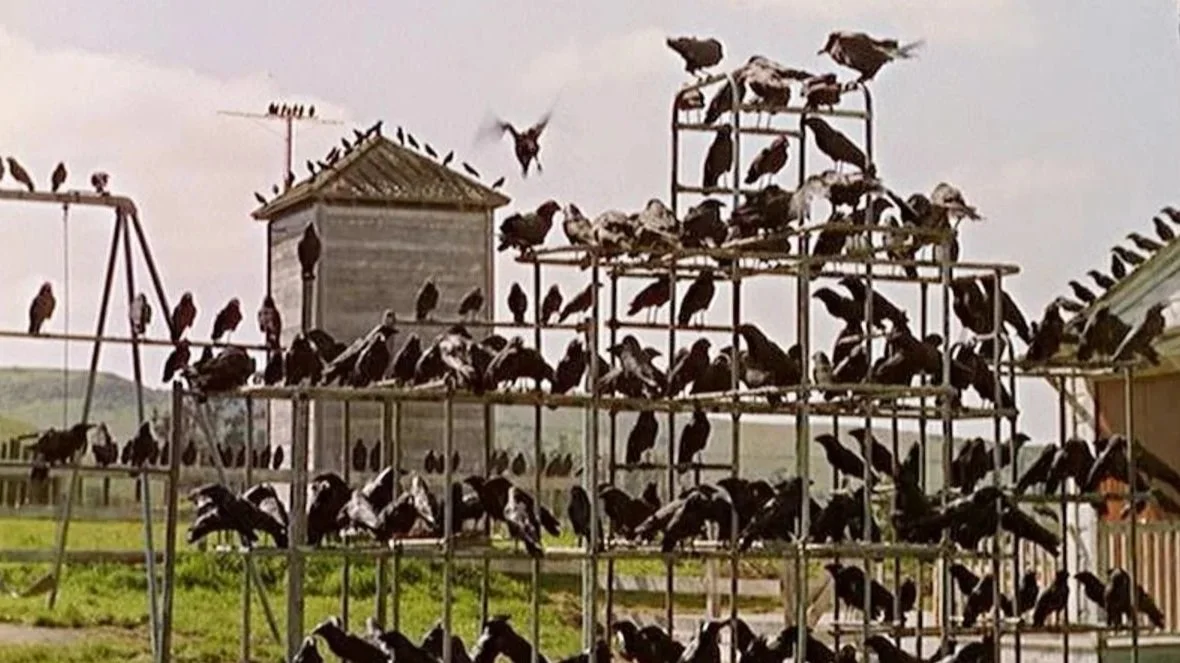
Foremost, The Birds is a technical masterpiece. In 2026 the special effects aren’t going to fool anyone, but the tactility of what the crew accomplished comes through, and gives the attack sequences an arresting quality: existing between the boundaries of real life and a nightmare. My father, who was born in 1959, recalls seeing the film in theaters and was terrified. “I’d never seen anything like it.”
What made the production so headache inducing was that Hitchcock insisted on using real birds. Although over 200,000 dollars were spent on creating mechanical birds, Hitchcock and others failed to be convinced by them. Despite this, mechanical and fake birds were used in a few key shots, such as when the seagull dive bomb Melanie; this was accomplished via wires that a fake bird was attached to.
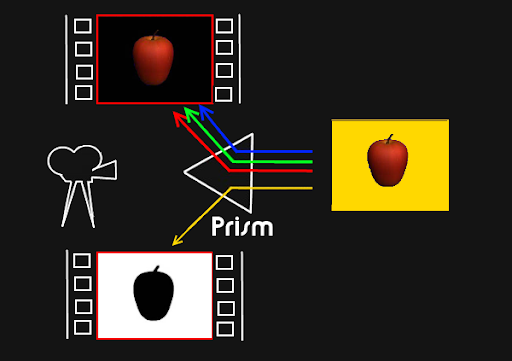
The problem with using real birds is the task of filming them. At the time, the blue screen process was far from sophisticated. When a figure appeared on screen, it “often resulted in lines around the figures, like a rather disturbing fringing or a halo in hair,” writes Moral. “If we’re to shoot these small birds with fast moving wings, (it) would be a messy blur,” said production designer Robert Boyle. The production used what was called the sodium vapour process, which had been pioneered by the Walt Disney Company; used in films like Mary Poppins and the original The Parent Trap. Along with traditional matte paintings, a camera used would contain two different strips of film that were sensitive to different colors and lights, resulting “with no discernible traces of separation between the photographed elements.” However, this wouldn’t work for every sequence or shot. More often than not, the actors interacted with trained birds, that on command would know when to dive bomb or peck at them. According to Tandy, by the end of the first week, she and the set were covered in bird shit.
If one were to pull out a theme from The Birds, it’s that of chaos. In discussing the look of the film, Hitchcock said “(it was an) attempt at realistic photography, to make it look as real as possible, because the effects themselves are actually quite bizarre.” The best example of this realism occurs early on, when Melanie has shown up for dinner and is talking to Mitch in the background, while in the foreground, Lydia is talking on the phone, concerned her chickens aren’t eating; the dialogue overlaps and it all happens in one medium wide shot.
The first hour can be a struggle for modern viewers as it lacks an obvious hook, more so considering the audience bought a ticket to a film called The Birds and expect blood shed. What they get instead is a lot of time devoted to the relationship between the characters; how the film leads you into thinking Lydia’s fixation on Melanie is sexual in nature (she brings up to Mitch how it was reported Melanie jumped into a Rome fountain naked) but is more about the fear of loneliness, caused by the death of her husband some years earlier. The emotions of these people are influx, not fully resolved.
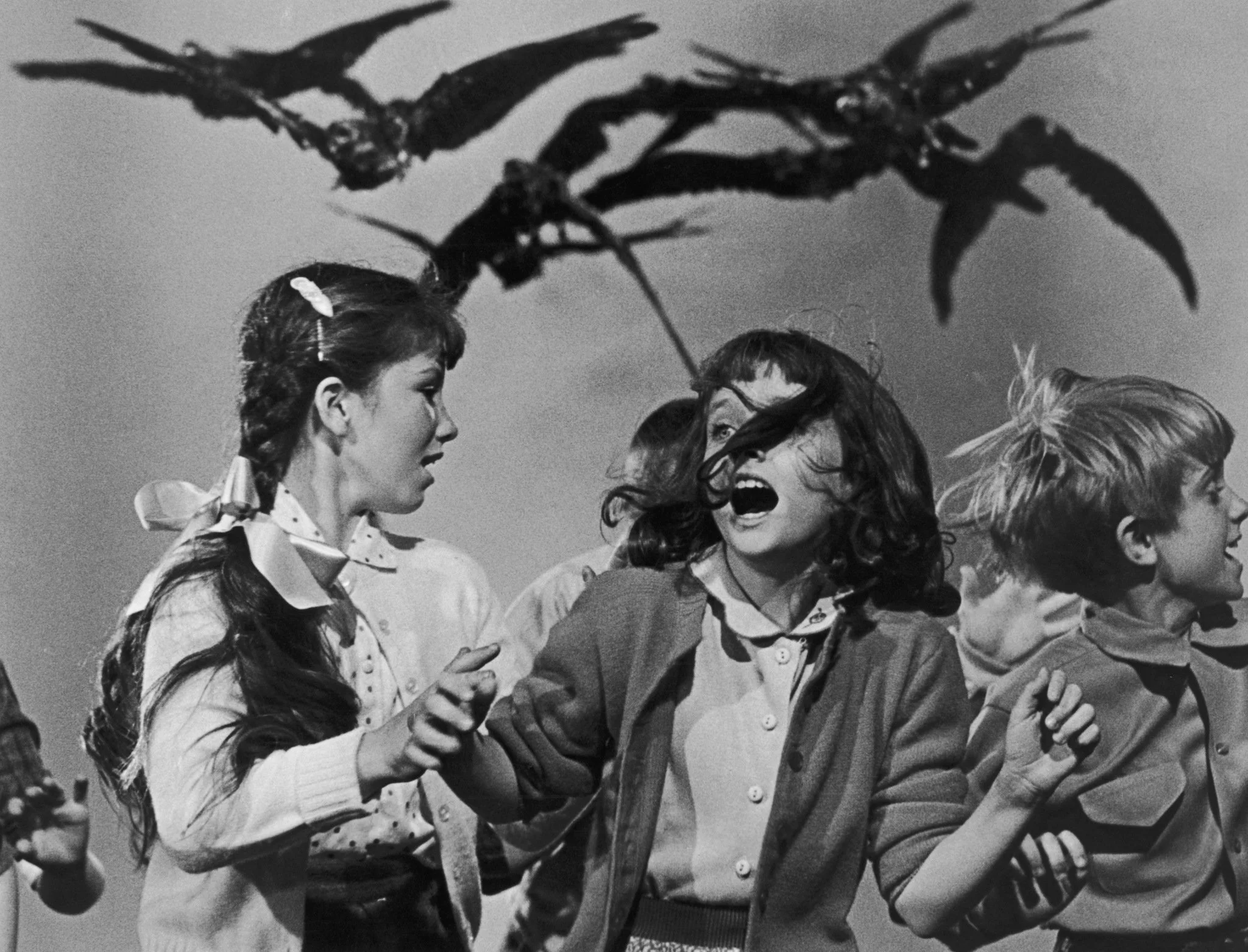
The first hour should be viewed as a red herring. Not for its lack of importance, but rather, how the presence of the birds interrupts it all. Famed film critic Robin Wood wrote in “Hitchcock’s Films Revisited” how little the attacks correlate to concrete meaning. “What happens to Melanie is neither the chastisement of the guilty nor the martyrdom of the innocent, for she is very carefully depicted as neither,” wrote Wood. If someone wanted to suggest that the attacks are a response to Melanie’s or any other character’s actions, why do they attack the children? The script by Evan Hunter goes out of its way to point out the children didn’t provoke.
Compare the film to Jaws where the victims of the great white shark die because of venturing into the animal’s home: the water. Of course, those who get eaten are, broadly speaking, innocent. The skinny dipping Suzy at the beginning of the film cannot be faulted, as how could she know a shark was inches away? Same goes for the little boy. And the boater who is eaten is aware of the shark attacks, but the Mayor assured everyone the beaches are safe, itself a comment on how capitalism can lead one to overlook danger. Steven Spielberg isn’t using the shark as one blunt metaphor, but allows the character's actions to color the symbolism. Hitchcock rejects this method. In the eyes of the narrative, the birds are birds. Characters are attacked because they are in Bodega Bay.
The shooting of the film wasn’t easy for Hedren. Rod Taylor recalled, “She was like a precious piece of jewelry he owned, and little by little, no one was permitted to come physically close to her during the production.” Taylor alleged that Hitchcock demanded he not to touch Hedren after the word cut was called.
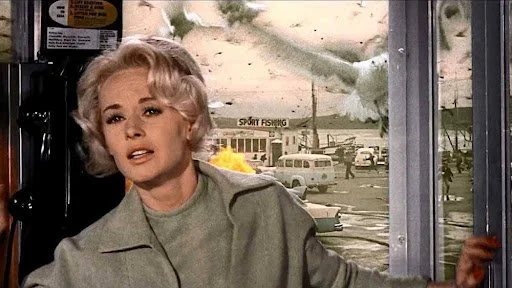
The most iconic shot of the film is a bird hitting the phone booth while Melanie is taking cover inside; it’s a good example of the usage of matte paintings designed by Albert Whitlock. To achieve the effect of the seagull hitting the glass, Hedren was put behind “shatter proof glass” and a dummy bird would come crashing down from the heavens by a wire. Unfortunately, the glass broke and shards of glass sprayed all over her face. Hedren would sustain more injuries when filming the nerve shredding attic sequence.
Hedren questioned why her character would travel to the attic and Hitchcock said, “Because I tell you to do it.” She was led to believe mechanical birds would be used for the sequence, but when arriving on set, she discovered the opposite was true. “For the first four days, birds had swept around her, pecking and nipping. Pauses were called; her costume was torn a bit more; make-up artists created facial gashes, lacerations and the impression of terrible wounds; stage blood was dripped — and then filming resumed.” After a bird scratched her lower eye lid, “(Hedren) collapsed, sobbing hysterically and shouting that she could do no more — that the birds had to be taken off her, that this had to stop at once.”
A chilling passage in Spoto’s book details how Hedren was carried off to her dressing room and became unresponsive. A doctor ordered her to rest for ten days and Hitchcock was irate. “But we can’t do without her! We need her on Monday for the last few shots.” The doctor responded by asking, “Are you trying to kill her?”
The catatonic state of Melanie after the attic attack uncomfortably mirrors the reality of Hedren’s state. Her face bloodied and lips drained of color, Melanie is laid down on the couch. When she wakes up, she returns to a state of wordless panic, her arms stretched out, blocking birds that aren’t there. “It’s alright,” Mitch reassures. It’s perhaps the most distressing moment of the film.
The ending was constantly changing throughout production. According to Hunter, oddly enough, Hitchcock wanted to give it a more overt meaning, something the final product refuses to do. It was going to end with a final shocker moment of the crows attacking the car, a psychological linking between Lydia and Melanie, the latter screaming, “Let me out, let me go back! Mother, I want you, I want you. Come back to me, please, please come back to me.”
Instead, the ending is beautifully inconclusive. Mitch and the others gather in the car, the wind drowning on, the birds chirping. They drive away into an uncertain future.
If you enjoyed this article, please consider becoming a patron of Hyperreal Film Journal for as low as $3 a month!
Hayden Claborn is a film writer based in Austin, TX. He began writing about cinema in high school and was the film critic for his college newspaper. He loves a variety of genres, but his main area of interest is horror films and can talk your ear off about the greatness of Judy Garland. Depending on what day you ask, he’d say his favorite movie is either The Exorcist or The Apartment, with his favorite filmmakers being James Cameron and David Lynch. He goes by He/They pronouns.