
Teenage Sex and Death at Camp Miasma Review
Since their YouTube-analog-horror-inspired 2021 debut We’re All Going to the World’s Fair, Jane Schoenbrun has rapidly established themselves as an auteur with a sharp eye for what I’d describe as a distinctly Millennial malaise. World’s Fair, 2024’s I Saw the TV Glow, and now Teenage Sex and Death at Camp Miasma all take up specific forms of media as their focus, from the aforementioned internet horror to ‘90s supernatural teen dramas to Camp Miasma’s subject: slasher franchises. Think Friday the 13th and Nightmare on Elm Street and, maybe most relatedly, Sleepaway Camp, with all of the gender troubles the genre brings.
Camp Miasma stars Hannah Einbinder (Hacks) as Kris, an emerging queer director taking on the rotted corpse of Camp Miasma, a formerly wildly successful ‘80s slasher franchise. The film’s Camp Miasma is framed as a contemporary of Friday the 13th and Nightmare on Elm Street, with a similar trajectory of increasingly terrible sequels before fading into irrelevancy. Kris’ job is to relaunch the franchise by tackling the, ah, problematic origins of Camp Miasma’s villain, Little Death (Jack Haven, who previously starred in Schoenbrun’s I Saw the TV Glow.)
We meet Kris in the small town in the Pacific Northwest where the first Camp Miasma was shot, on her way to meet Billy Presley (Gillian Anderson), the original final girl of the franchise. Billy is glamorous and reclusive, living, as it turns out, in the camp that served as set for Camp Miasma—the Camp Miasma Camp, if you will.
What unfolds from there is a rich, heady examination of desire: the stakes of desire and the ways we mediate it. It’s not just teenage death, it’s teenage sex; playfully underlining the sexually exploitative nature of the genre (Little Death doesn’t just kill you, he penetrates you), and where that, let’s say, exploitative depiction of sex collides with the real embodied desires of the watcher. Like all good films about film, Camp Miasma is obsessed with looking: who's looking, and how they’re looking.
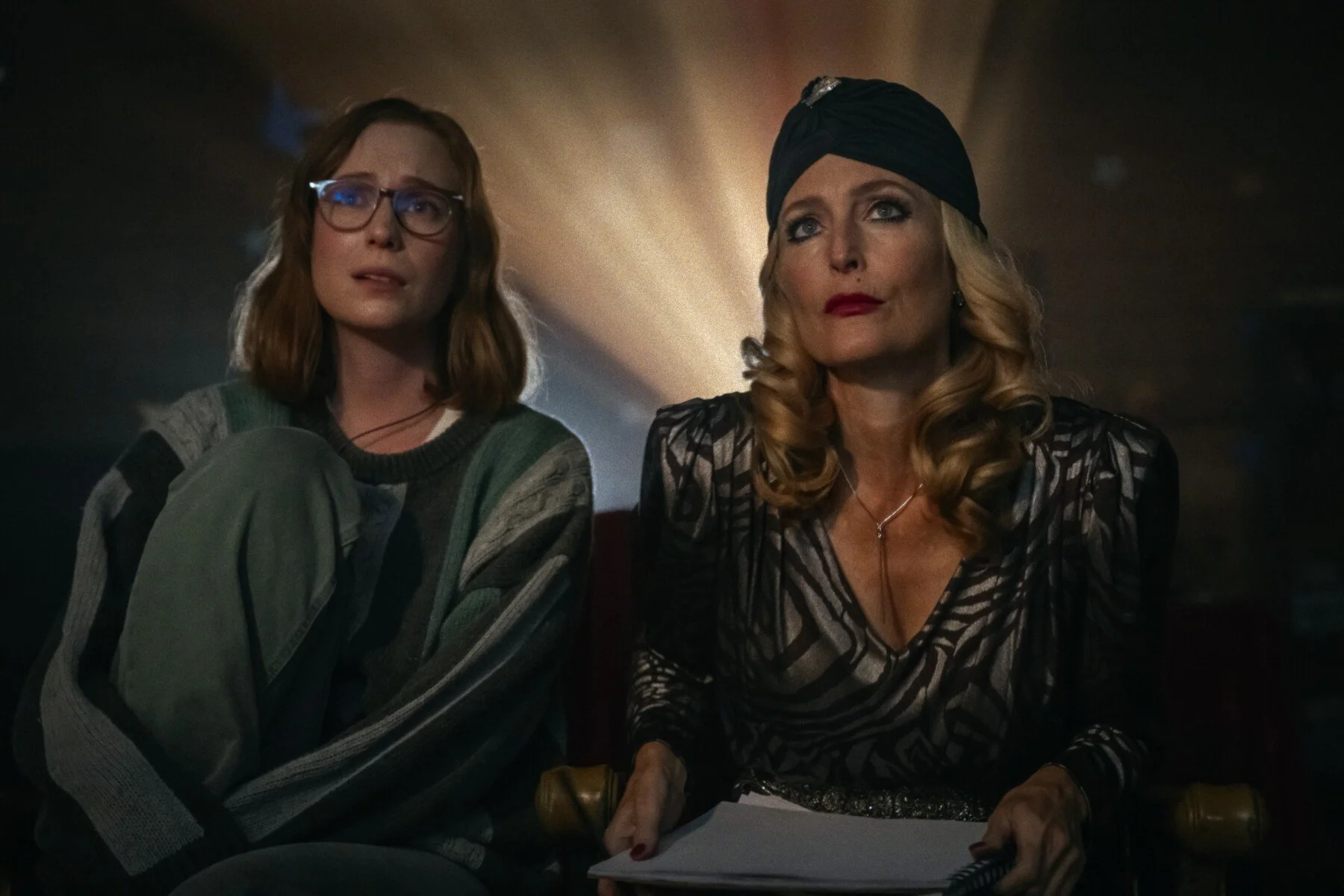
And Camp Miasma does not let you forget that it is a film about a film. Kris and Billy move across painted backdrops; the sound of Billy’s film reels crackling mingles with the cracking of the lake’s ice outside, the cracking of fire they burn inside. Sequences of the Camp Miasma films-within-the-film appear on older, grainy film stock, only to become clear as the world Kris and Billy inhabit takes on that graininess instead. The line between what’s film and what’s film-within-a-film is playfully blurred as Kris and Billy grow closer. The surreal dreaminess is reflective of Schoenbrun’s previous work, part of what I would describe as their visual language of shimmer.
Where Camp Miasma distinguishes itself from Schoenbrun’s previous work is in an absolutely delightful lack of subtlety. It’s a very funny film, buoyed by Einbinder’s unfortunately-incredibly-personally-relatable performance as a deeply, deeply repressed queer intellectual Artist-with-a-capital-A, and Anderson’s sensual, weed-smoking, slightly menacing aura works as a perfect counterbalance. Haven’s Little Death is the right amount of goofy for an ‘80s slasher franchise—maybe he was really scary in the 80s, but from our contemporary point of view, the effects just seem a little silly.
And we really lean into silly for the slasher effects: each thrust L.D. (as he is almost affectionately referred to) makes is accompanied by a truly astonishing amount of blood. Just absolute fountains of blood. Picture the bed moment from Nightmare on Elm Street but literally every time anyone gets slashed. It rules. It’s a playfulness that’s always been present but subdued in Schoenbrun’s work, now made central. And Camp Miasma’s exercise in desire is playful: giving into what you want, admitting you even have wants, means being willing to look silly. Silliness is a kind of vulnerability. It’s Kris softly saying “do you think I’m disgusting" as she finally owns what she wants. The over-the-top slasher gore works with the film’s ultimate thesis by drawing us into the fantasy, too.
Slasher films—and their queer troubles—are not new territory to tread. But Camp Miasma is a fresh take, not flinching away from that history but complicating it, and doing so in the same slightly goofy, slightly self-serious register as the best slasher films it pays homage to. As the Camp Miasma home VHS release promotional materials say: Remember, it’s only a movie. If it gets too real, you can just turn it off.
If you enjoyed this article, please consider becoming a patron of Hyperreal Film Journal for as low as $3 a month!
remus is a cartoonist and phd candidate at the university of florida, living in austin. their favorite movie is cats (2019). unironically. you can find them on letterboxd @threewolfmoons