
Post-Nut Pessimism: The Socio-Political Weight of Threesomes in Y Tu Mama Tambien and The Doom Generation
The portrayal of sex in Hollywood is a frustrating polarization, stuck in a back-and-forth between conservative censorship and sensationalization. Ultimately, both these choices reduce sex to erotic fanfare, not granting it the power to seep into the plot. When we observe the complexities of sex, its encapsulation of desire, its outlines of gendered dynamics, its lens into character interiority, we begin to recognize there is a rich narrative staying power to the erotic far beyond its physical manifestation. I want to look at two films I believe take this in stride, working with the rich sexual connections between not two, but three of their lead characters, to deliver a memorable coming-of-age drama. The threesome of Y Tu Mamá También and The Doom Generation defines these films far beyond the actual act itself; we can feel the groundwork being laid, and sit in its reverberance after it takes place. Through their interaction with filmic genre and political timeliness, their sensuality inspires us to look outside ourselves and shudder.
Both The Doom Generation and Y Tu Mamá También exist as road trip films, a genre fascinating for its inherent symbolic contradictions. In his essay “WHAT A TRIP: THE ROAD FILM AND AMERICAN CULTURE,” David Laderman dives into the genre's interesting existence between traditionalism and resistance. On one hand, the road trip film as we know it today comes about in an era of post-war progressivism and youth counter-culture, with the automobile becoming a dialectical device for suburban youth to self-actualize outside structured society. Conversely, it taps into the expansionist values that the American state holds dear: Manifest Destiny and its later maturation to imperialism. As the road trip film develops, traditionalism shifts from a thematic backbone to an encroaching antagonist. It is at this point that we find Y Tu Mamá También and The Doom Generation, where the characters' path down social rebellion ultimately leads to disillusionment and tragedy.
An integral aspect of the road trip film is the party which embarks on the journey, and Landerman calls attention to this genre's frequent intermingling with the “buddy film,” often between two males, or the female-male couple, which comes with its own traditionalist confinements: “...the road film set in motion its basic gender pattern: The women as either a passive accomplice to the man or a threat to him, part of the road that lures him to his downfall” (Landerman 1996). For Y Tu Mamá También, the film can fit into both types of buddy films: With their literally dictated, sexually driven partnership, Julio and Tenoch seem to be the more apparent pairing, fitting into a genre of male buddy films; however, in keeping with Landerman’s critique, we can also view them as a singularly masculine unit in relation to Luisa. With Luisa, Curon plays with Landerman’s later female characterization, flipping it on its head. In a literal and figurative sense, Luisa actualizes positive maturation for the boys, reflected in the road trip's conclusion at Heaven’s Mouth. Unsurprisingly, space, specifically the destination, is a critical thematic element of the road trip film, with characters' arcs often coinciding with their journey. In Y Tu Mama Tambien, the destination is transformed from a fabricated concept for the boys to win Luisa’s affections to a real space of harmony, albeit fleeting. It is here that the two versions of the “buddy film” come to a head and intertwine with thematic space. The “threat” Landerman lays out takes the form of Julio and Tenoch's sexual selfishness and inability to healthily contend with their attraction to one another. At their destination, and through their relationship to Luisa, they are able to embrace their attraction to one another and approach sex as an act outside of themselves.
For Landerman, 1972’s Bonnie and Clyde marks a turning point in the road trip film, that point where traditionalism becomes oppositional. This is undoubtedly a legacy Araki is aware of; in fact, he outright states this within his 2023 interview with Letterboxd discussing The Doom Generation's inspiration from “my background in film school and studying film and film history and everything. Couple-on-the-run movies in general are the story of this romantic love that’s too pure for this world…There’s a world that’s trying to destroy them. They Live By Night and Bonnie and Clyde and all those movies, that’s what they’re about.” Again, gender and queerness complicate this dynamic between character and world. In both films, the characters' crimes spur their journey on the road, making their trip defined by societal rebellion and concluded by fascist punishment. But in The Doom Generation, it is not the trio’s hit-and-run of the gas station that brings a tragic ending; it is homophobic, patriarchal violence. With each stop on the road, Amy becomes a symbol of shallow male infatuation, with various men falsely mistaking her for their exes. Simultaneously, the lines of attraction between Xavier, Jordan, and Amy begin to blur into a love triangle only possible with sexual fluidity. This climaxes in their threesome in an abandoned warehouse, where, unbeknownst to them, one of Amy’s disgruntled followers, a neo-nazi and his company, has followed them. It is here that tragedy befalls the trio, with Jordan brutally murdered by their nazi pursuers, and the fantastical escape exemplified by the road comes to an end. Like Bonnie and Clyde, by-products of fascist society, the road fails to lend lasting escape and fulfill self-actualization, but through making gender inescapable and punishing queer love, Araki communicates that our world is strictly in opposition to these definitional identities.
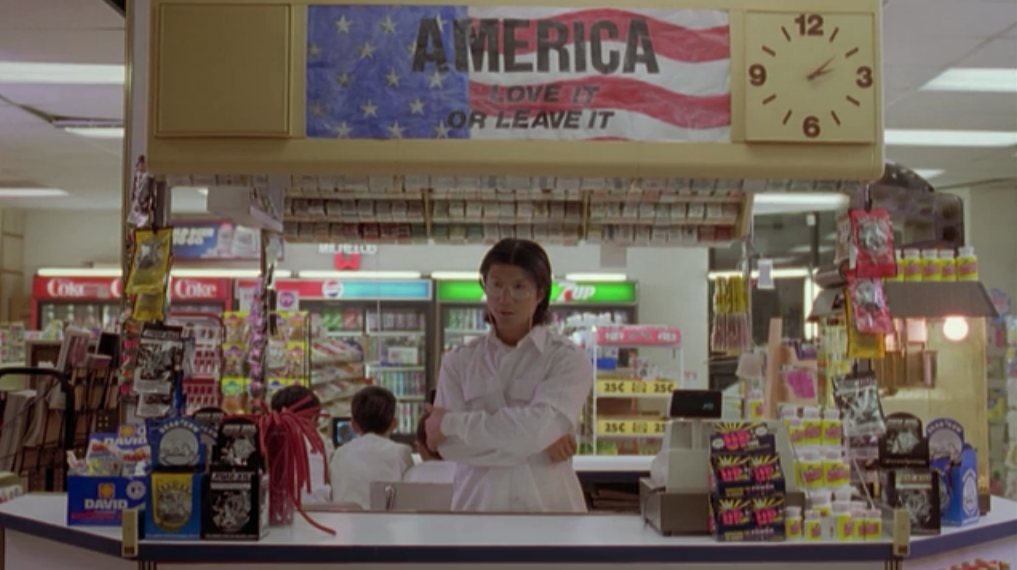
It is by virtue of the road, and to a broader extent, filmic narrative, that these films contextualize their characters to the socio-political world. And this is not accomplished with subtlety; our attention is demanded to it. However, this attention grab takes different shapes as these films’ throuples occupy different social stratifications. In typical Araki fashion, Doom Generation’s cast embody the purposeful others as teenagers deeply entrenched in Los Angeles’s 90s alternative culture. Between their macabre aesthetics, sexual fluidity, and crassness, these characters are the clear targets of rising evangelical traditionalism, demarcated on their journey via highway signs foreboding oncoming rapture and calling for salvation. Araki leaves no room for questioning who is responsible for the throuple’s violent demise; Amy is raped on an American flag, her rapist throwing out a proud salute before, signifying this defilement is a fascist duty.
Contrastingly, Y Tu Mamá También’s characters make up a social “ingroup”, focusing on the wealthy and middle class of Mexico, as well as a Spanish woman. Rather than punishing these characters, socio-political struggle exists as a narrative disruption to the road trip. The fantasy of escape on the road is therefore dually complicated, with an additional level of externality. To quote Ebert, this is a film depicting the “two Mexicos”. As Tenoch and Julio stumble through sexual awakenings, the narrator is quick to draw our attention to the dead construction worker holding up the traffic, which frustrates the boys, and the future displacement of the fisherman’s family who guides them on the beach. And it is the characters' ignorance that demands this narrative disruption, unlike Amy, Jordan, and Xavier, who must suffer the brute punishments of a fascist backdrop; the group's privilege consistently keeps the post-colonial landscape out of mind. Even as their story ends pessimistically, the trio is still allowed a narrative arc and a point of hope, while the lives of the less privileged around them remain in the stagnant backdrop. This tragic continuance creates a dimension of frivolity to the group's plight, demonstrating the surrounding struggle will continue, regardless of any resolution found in the privileged sphere.
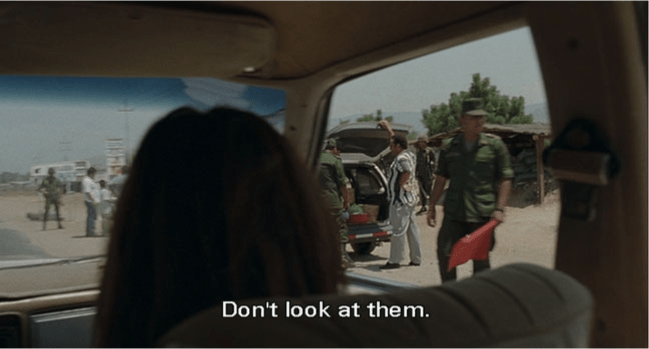
Y Tu Mamá También and The Doom Generation’s embrace of the road trip film’s paradoxical situating between traditionalism and progressivism, compounded with their glaring socio-political backdrop, makes their respective threesomes something special. Counterintuitive as it may sound, their sexual acts shine a wholesome light within the films’ depths of sardonic ire. Both inner-textually and metaphorically, the threesome edges us close to fully realized potential. It’s the moment when Tenoch and Julio mature from boyish competitions to “get the girl” to a recognition of their underlying homoerotic desires; when Xavier’s entrancement with Jordan blossoms from lingering stares and voyeuristic intrusions to a nearly tangible sexual connection. This on its own is narratively powerful, but when we consider the film's socio-political awareness, these shifting dynamics take on an additional level of depth.
Y Tu Mamá También is purposefully set in 1999 Mexico, where democracy is externally misconstrued into neo-liberal constructions and imperialist pursuits, and internally taunted through electoral fraud and corporate payouts. Policies of economic deregulation and privatization drove in foreign investments without sustainable returns, and as the public sector continued to decrease, there was little support for Mexican families and small businesses during the economic collapse of 1994. This leads to the crux of neoliberalism's inherent contradiction: Mexican banks were rescued out of bankruptcy with $552 billion in government funding, a debt that was later taken on by the public without any corporate contribution. Here we see that neoliberal government has no issue, in Parenti’s words, distributing “welfare for the rich,” and it is, in fact, impossible to simultaneously value individual liberty and self-actualization along with corporate co-dependency. How better for Cuarón to satirize this irrationality than through the shallow eroticism of a teenage boy? Tenoch and Julio form their own equally sacred governance, the laws of which involve getting high and jerking off every day, screwing morality, yet critically, not fucking the other's girlfriend. This is inherently ironic, as their manifesto lays out a moral framework– not fucking the other's girlfriend–while simultaneously rejecting morals and prioritizing unfettered sexual satisfaction. In his review “Y Tu Mamá También and the Confines of Machismo,” CoCo Trejos critiques the boys' relationship as one continuously wrapped up in the present, focused on the immediate satisfaction of desires. This causes a sharp disjunction between their words and their actions. They frame sleeping with the other’s girlfriend as the ultimate betrayal, yet both do so; they laud their sexual capability yet finish with comedic brevity that leaves Luisa unsatisfied. As the boys' source of reason and a catalyst for their maturation, Luisa is a symbol of democratic rationality. She is quick to identify the boys' homoerotic desires, the inauthenticity of their pact, and their utter lack of sexual prowess, providing a maternal-like guidance through it all. It is both her age and race that position her as the ultimate subject of the boys' desires, and this sexual fetishization translates to a broader romanticization of European democratic possibility. Within her essay “In the Shadow of NAFTA: Y tu mama tambien Revisits the National Allegory of Mexican Sovereignty”, Maria Josefina Saldana-Portillo describes Luisa as a political imaginary, the mestizaje, a breakage from a Mexico defined by social stratifications and imposing US imperialism. And when Luisa brings the boys together in bed, the imaginary is briefly temporal. Within the threesome, pleasure becomes equalized and serves as the final breakage of Julio and Tenoch’s machismo divide. Symbolically, the act suggests the neoliberal Mexican state can be tamed through democratic cooperation, through connecting to a unifying mestizaje identity. But ultimately this hope proves to be unfeasible; Tenoch and Julio wake next to the other with an awkward disgust, and it is established that night will go down as a drunken fluke rather than a queer awakening. The film’s final tragedy comes not through its narrative, but the limited perspective we view it through. Luisa is reduced to an Oedipus conception of maternal saviorism: in actuality, she does not exist to force these boys into maturation; their immaturity is simply a roadblock within her last push for life. While we are allotted glances into Luisa’s life outside the contexts of the road trip via tear-stricken phone calls with her cheating husband, her totality is really as hidden to us as it is to Tenoch and Julio. It is only after the fact, when Luisa is already dead from a cancer she was aware of throughout the entire trip, that her narrative is refocused. Many analyses of Y Tu Mamá También expand Luisa’s death to a symbolic end to a democratic future in Mexico, but I argue this is established from the moment Julio and Tenoch jump apart the morning after. By reducing Luisa to the male perspective in all its layers (the sexualization, the maternal draw, the catalyst for self-actualization), Cuarón presents something far more pessimistic: This gleaming model of European enlightened rationality and the societal unification of the mestizaje only exists in the minds of lost men who remain unable to actualize this future.
Araki attributes his filmic inspirations to queer sexuality/sex and punk music, and this jumps through the screen through The Doom Generation’s threesome. The existence of queerness in any capacity already comes as normative rebellion, subverting the very definitions of the film as “a heterosexual movie by Gregg Araki”. Though anyone familiar with Araki’s discography would view this statement as a paradoxical impossibility, the heterosexual framework came out of true budgetary necessity. Producer Jim Stark promised higher budgets if Araki could make a heterosexual film, and from there, Araki set out to make “the queerest heterosexual movie ever made.” Araki plays with a love triangle, bringing this historically heterosexual trope closer to the queerness the name would suggest. While Jordan and Amy develop a sexual relationship, Xavier and Jordan’s romance appears to be more palpable through it all. Each of their moments alone together is made up of painfully intense eye contact, sometimes appearing to be at the precipice of a kiss.

By pushing Xavier and Jordan’s lust to the forefront of our screens, Araki resists a filmic history of queer subtleties and establishes queerness as an undeniable reality. Further, through moving the love triangle towards a threesome rather than a chauvinistic competition for Amy’s affections, Araki suggests there is peace to queer openness. The film's grounding in a queer reality is what distinguishes its ultimate tragedy from Y Tu Mamá También. The potential for the throuple relationship to thrive is driven by a temporally existent queerness, whereas Tenoch and Julio cling to the feminine savior they have constructed. This is not to negate Tenoch and Julio’s attraction to one another; in fact, in a physical sense, their queerness is more actualized than Xavier and Jordan’s, but they themselves are incapable of embracing it. Araki has a rebellious determination to bring unabashed queerness to the screen, but he is far from an optimist, at least in the context of this film. Like Tenoch and Julio, the threesome provides a more heterosexually comfortable space for Jordan to fall into his queerness, and left naked by Jordan as Amy steps out to pee, it appears this could be the moment his sexuality bubbles out from its subtextual depth. Jordan inches closer to Xavier, and the two are allowed one more questioning glance before they are called a f*aggot and brutalized as such. Jordan’s simultaneous lack of physical homosexuality and violent death at the hands of the neo-Nazis demonstrates a deeper level of homophobia, and by extension, fascism’s devastation. They make inaccessible the self-actualization allotted to sexually “normative” bodies and punish queerness before it reaches the physical surface.
In a film that quite literally drives us to a threesome, each scene pulling together these characters’ tensions, the relief that comes at its arrival is so brief it's barely there. We expect the sex to go somewhere, the road trip to have a destination, but instead we are left in this weirdly liminal in-between. As Xavier and Amy drive off, unspeaking, into the sunset (to some Slowdive, obviously) and Julio and Tenoch awkwardly depart the diner, never to see each other again, we can feel their inability to fully move on from the events of their trip. By their finale, the threesome is transformed from an aspirational desire to a solemn reminder of what could have been as the characters exist in a modern, punishing reality.
If you enjoyed this article, please consider becoming a patron of Hyperreal Film Journal for as low as $3 a month!
Mei Yin Steadman is a student studying Comparative Literature at USC, but misses her home of Austin, Texas, dearly. She loves weird surrealist media, cooking, and trying food across the city. You can view her literal and metaphorical consumptions on Beli @yinnstead, Substack @meiyinsteadman, and Letterboxd @meiyin.