
Searching for Satyrus: A Tangible Legacy
Whenever Rena Effendi is asked who she’d most like to meet, she has an immediate response: her father. “I feel like I never met him,” she narrates. In her debut feature documentary Searching for Satyrus, which won the Documentary Feature Award at 2025’s Austin Film Festival, Effendi sets out to discover both the story of her father Rustam Effendi, an entomologist from Azerbaijan, and the rare butterfly named after him. What ensues is a story that gracefully threads together larger social issues like climate change and ethnic conflicts with a deeply resonant story of family and legacy.
Effendi paints her father’s story/character in broad strokes at the start of the documentary: a magnetic, larger-than-life man devoted more to his field/study than to Effendi and her mother, or to his string of marriages and extramarital affairs. He collected tens of thousands of butterflies, including rare and endangered specimens, while traveling between pre-war Azerbaijan and Armenia, and died in 1991—just before the dissolution of the Soviet Union and the start of conflict that broke out over the same mountainous region in which he once hunted.
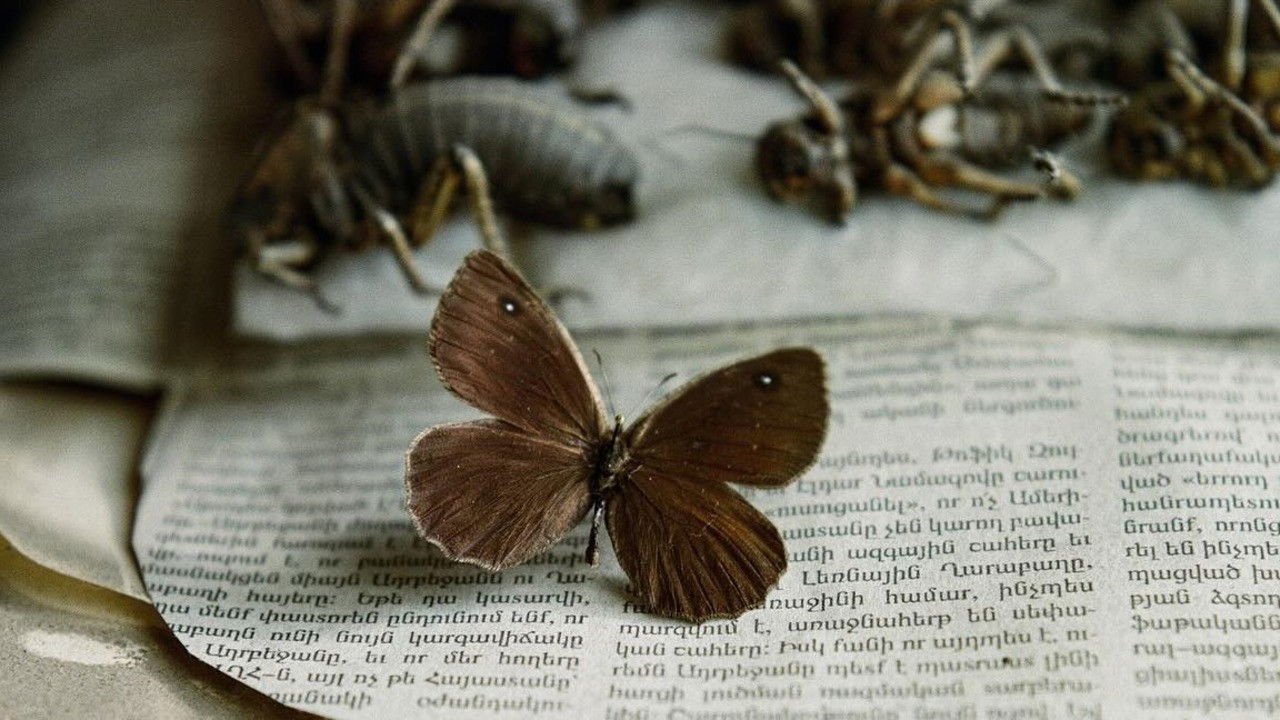
Effendi focuses her search, which she terms chasing her father’s ghost, at home through interviews with her mother, her father’s brother, and her two half-sisters—one of whom she only met as an adult—and her father’s letters and photographs, and by retracing his steps in her country of Azerbaijan and in Armenia. There’s a striking scene where she visits the dilapidated zoology institute in her hometown of Baku; in a cramped room she finds drawers upon drawers of the some 90,0000 specimens he collected throughout his lifetime, many now turned to dust. The region where he once traveled is also almost unrecognizably changed, and not simply through the passage of time. As Effendi travels to places her father hunted, she finds war-ravaged landscapes and whole villages abandoned, stepping into houses frozen in time over the decades.
This commentary on the conflict feels natural and instructive, never detracting from the main storyline of the documentary but instead adding a necessary dimension to this exploration of legacy and memory. Scenes of Effendi’s travels are intercut with archival footage from the war showing tanks rolling through the streets. When she enters Armenia for the first time, her mother tells her to be careful; while there, she visits a memorial for fallen Armenian soldiers and speaks to a mourner, himself a soldier, who says he can’t imagine the possibility of peaceful coexistence. The sense of the pure meaninglessness of war is emphasized when Effendi explores the region at the border of Armenia: where her father once freely traversed, the state borders are now defined through military posts and disputed lands.
The documentary succeeds in part because Effendi is such a natural storyteller, with a good-natured, curious manner that calls to mind Agnès Varda’s way of connecting with her documentary subjects. In one area Rustam visited and stayed in often, she meets villagers who, three or four decades later, happily share their memories of the charming butterfly hunter and show Rena around, suggesting further avenues for her search. This leads her to Pavlik, a former close friend of Rustam and an entomologist himself. He’s never met Effendi before, but he embraces her like a long-lost child—”Rustam’s Rena, my own blood,” he says to her. From these interactions comes the understanding that Rustam left an indelible mark on everyone he met, and the sense that—as Pavlik takes Effendi under his wing and joins her butterfly hunt in the mountains without question, following her lead as he did Rustam—there’s an intangible connection between father and daughter.
As Effendi’s journey takes her deeper into the areas her father once explored, we’re immersed in the natural world with stunning videography of the mountains of Vayot Dzar and up-close footage of butterflies darting around fields and cliffsides. Some of this is voiced over with her father’s own poetic words from letters he wrote. It’s a simple yet effective way of conveying Effendi’s exploration of not just the landscape but also her father’s legacy.
The documentary balances dual perspectives of time and history. There’s the decay wrought through both nature and human actions. Entire forests where Rena’s father once explored were burned down during wartime, and Effendi struggles to capture his namesake butterfly in the wake of a climate crisis affecting habitats and food sources and, consequently, migration and flight patterns. But Effendi’s search shows that while the tangible may change and disappear, it’s still possible to keep the past alive—whether that’s through retracing her father’s steps, or meeting people on whom he left an indelible mark, or connecting with the family she never knew, we watch her uncover and live her father’s legacy.
If you enjoyed this article, please consider becoming a patron of Hyperreal Film Journal for as low as $3 a month!
Alix is the editor-in-chief for Hyperreal Film Journal. You can find her on Letterboxd at @alixfth and on IG at @alixfm.