
AFF ‘26: Red Carpet Interview with Frank Marshall – Producer of Paper Moon
This year at the Austin Film Festival, one of the coolest screenings you could catch is a redux of Paper Moon, Peter Bogdanovich’s classic Depression-era comedy from 1973 about a young girl and her unlikely caretaker conning their way across Kansas. Part of their “On The Road” retrospective series, this film is representative of a feeling both distant and familiar, the idea of discovery on the open road and the total freedom that presents. It’s a bit of a forgone idea, but one that still appeals to the modern audience—an escape from reality and hard times exists, and all you have to do is hit the pavement.
Before the screening of the film, Hyperreal got a chance to speak to one of the film’s producers, the legendary Frank Marshall, on the red carpet. So, in between your regularly scheduled review, there will also be some quotes from Frank Marshall about how the film resonates with today’s audience, the significance of the roadtrip on screen, and what he would program if he had a free week at Hyperreal.
Hyperreal Film Club (HFC): I was interested in how your connection to the film has changed over time as you show it to newer and newer audiences?
Frank Marshall (FM): Well, I think what's great is Paper Moon seems to hold up. I have two daughters that are 28 and 30 now, and I showed it to them when they were 10, and I thought, “they're not going to sit here.” It's black and white, there's not a lot of action, but they were riveted by the characters and the story, and that's what is important about movies.
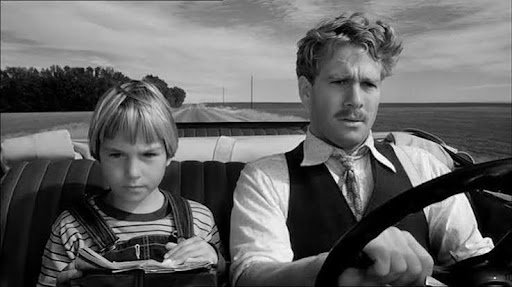
This is a statement that remains and will always remain true. The connective tissue of a film is the characters. They are both the mirrors that reflect our emotions and experiences and windows to an alternate perspective. In Paper Moon, the protagonists are an unlikely pairing that you fall in love with pretty much instantly. Ryan O’Neal plays Moses Pray, a “bible salesman” that cons his way into any sale he can while scheming his way into every dollar he owns. It’s a character that you understand immediately due to his perfect introduction. He skirts to a stop on a Kansas dirt road so he can get out and attend a funeral. At this funeral, the other protagonist is introduced, Tatum O’Neal’s Addie Loggins, a now orphaned nine-year-old who’s mourning her mother. The two are saddled together because she’s got nowhere to go and he’s heading toward her only kin, who live in a different state.
It’s that instant communication that makes the movie so special. This is not a film that needs title cards popping up to let you know what year it is, nor does it need ham-fisted exposition to say who a character is; you understand both immediately. When Moses steals those flowers while walking up to the funeral, you start to formulate everything you would need to know about this character. Then, later on when they are at a diner together, the first time Addie speaks is to blackmail Moses and get a sum of $200 that she feels she’s owed because of her role in acquiring the money. It’s those moments that spawn from character interaction that give you an insight into the world. The connection is instant, and it provides an understanding of how these two people can bond with each other.
FM: They love Tatum O'Neill, they love the relationship between her and her dad, so it's nice to see a new generation appreciating the film.
HFC: Sure, absolutely, I think Peter Bogdanovich is really good at those timeless comedies as well. What do you think is so timeless about both comedies like Peter Bogdanovich’s, but also road trip movies?
FM: I think what it does is show a period in time in our country. It was a time where there weren't a lot of stories told about it [the country], there weren't a lot of documentaries. So a road trip was very important – Route 66, a lot of people travel across the country from one side to the other… a road trip is an important part of our culture, and it's great to see it on the big screen.
The road trip can be a lot of things in terms of its cinematic scope. There’s the baseline idea of traveling from one destination to the other, the transformative experience of the odyssey and the physical manifestation of a journey. In Paper Moon, it’s something a little different. Filmed in the ’70s but taking place in the Depression-era ’30s, this trip, specifically, is more unending, and the road is long and winding. It’s a bit akin to having a cowboy or hippie character – those stereotypes are great for showcasing individual escapism. They don’t have to abide by societal rules because of their very nature. The road trip works in a similar way because it plays to those vagabond ideas. Times are hard, no one can afford to live, so it’s best to keep moving and get what you can. It’s this sort of outsider perspective that allows us to fall in love with Moses and Addie. They find home together despite being excluded from the world and their home is always moving as they move.
HFC: It's great that it's coming back, and it's getting a redux for a new audience. What other films do you think could get that kind of treatment? Maybe if you're curating a week at Hyperreal, what would you program?
FM: Oh well, Easy Rider, the movies from the ’50s and ’60s that I grew up on. I think they're kind of an important cultural moment for cinema, so I would curate the ’60s.
Questions of morality and ethics pop up as you watch the film. How can you root for these outlaws as they scheme and con everyone in sight? They are exploiting widows, every purchase at a store ends in a quick-change exchange, a scheme is seemingly always around the corner, and they enjoy that life. Counterculture has roots everywhere, but it’s easily defined in the ’50s and ’60s with the invention of the teenager or the rebel. Those decades had very clear snapshots of movements that bucked societal norms, and Paper Moon presents something very similar, just in different packaging.
Moses and Addie are cast out, be it by their lack of family, money, or of their own accord. There is no place for them in a complacent society because they are not complacent individuals. Addie has a line right before one of their bigger plans that leads to everything going topsy turvy. She says something to the extent of, “oh and with this money we can buy a big house with a piano.” Moses promises to buy “at least three pianos.” This idea, the house at the end of the road with two stories and a piano and none of the troubles of your life, it’s a fool’s paradise. Addie and Moses are two people who were destined for the neverending road; they aren’t ones who can settle down like everyone else and be content. It’s these counterculture ideas that feel so alluring to the audience.
Maybe the only thing that anyone needs out of life is someone to share it with, and maybe the struggle of a suffocating society can be eased by having someone you care about by your side. Paper Moon offers audiences a chance to believe that idea; to believe that all anyone needs is someone else. You can either take a road trip or a road trip can take you; either way, you’ll get there eventually.
If you enjoyed this article, please consider becoming a patron of Hyperreal Film Journal for as low as $3 a month!
Hello! My name is Eli and I am a film fanatic based out of Houston, Texas. I am currently working on becoming a filmmaker, while also working full time. Film is my hyper fixation turned passion. I simply adore the flicks! I love learning about the history of cinema and seeing how that history shapes what we watch today.
I talk about movies on my Instagram: @notelifischer, TikTok: @loads.of.lemons, and Letterboxd: @Loads_of_Lemons