
AFF ’26: The Stalemate
Like the inept gunfight that opens the film, The Stalemate (2026) does not shoot straight: a tonal misfire that overemphasizes absurd comedy versus dramatic telling in this Western chase film over stolen gold.
Comedy works best when it is not forced. Unfortunately director/writer Nicholas Arioli, in his feature film debut, stresses the absurd comic tone throughout the script, treating his story as laughable rather than dramatic. It is a shame because the story is a good one – the tale of rival immigrant cultures, here Irish and Chinese, attempting to elevate their status in the late 19th-century west. Why does this story reach for laughs when so much death is executed as punishment? The film’s humor does not land as the bodies begin to drop dead.
The story takes place in a small town run by the matriarch Mulligan (Fiona Shaw), whose operation includes the mining of gold by Chinese immigrants. Of course, gold is a currency whose true value is to further the dreams of those who control it. For Mulligan, she yearns for her operation to earn increased power by using her gold to bribe a U.S. Senator (Shea Whigham) to establish a telegram station in her town. However, co-lead “Coffee” (Manny Jacinto), a Chinese immigrant who is secretly collecting his own stash of gold, dreams of using his riches to purchase a coffeehouse in San Francisco. When Coffee’s stash is stolen, he quickly responds in kind, stealing the mine’s entire gold earnings before riding off on horseback, with the guards inexplicably choosing to comment upon his escape rather than proceeding into any action. This sets off the film’s main plot in which fellow co-lead Sheriff Mulligan (Ben Foster), the matriarch’s belittled son, gives chase in pursuit.
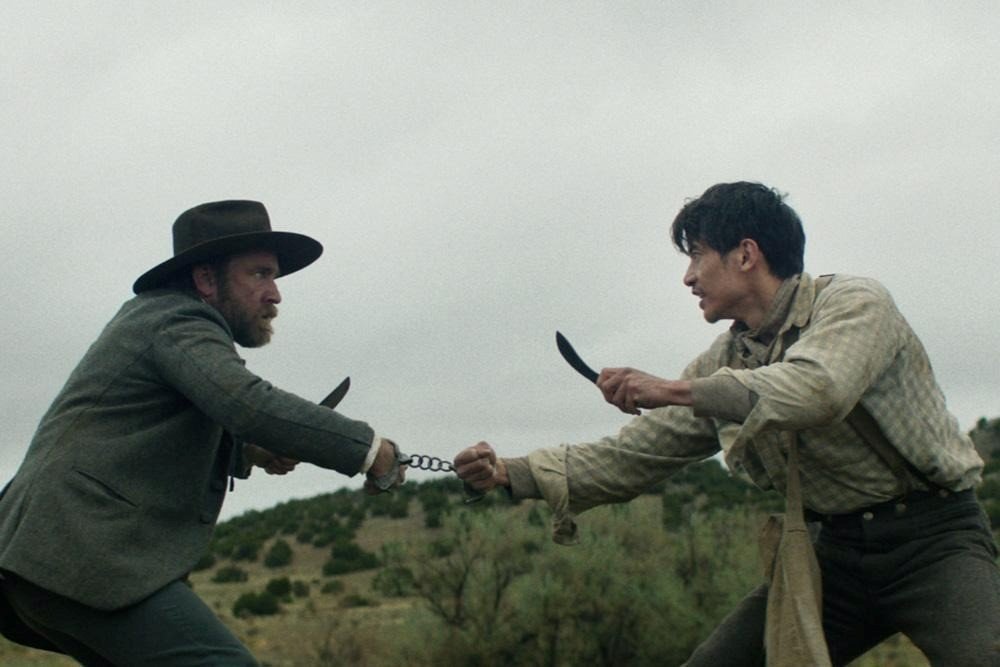
The actors are not to blame for the film’s comedic misfiring. Ultimately, they can only do so much from what they are given by Arioli’s script. And they do try, as the rivals-become-allies arc of Coffee and Sheriff Mulligan is likeable. In fact, that is one of the great appeals of the film – the mismatched pair of Coffee and Mulligan reminds of The Defiant Ones (1958). But even Paul Sparks and Anthony Carrigan, cast as a western posse-version of Rosencrantz and Guildenstern, are unable to breathe much life into their characters’ foolishness if they are not really given anything unwise to do. For instance, why does Arioli write them as incompetent when they are always on the right trail of Coffee and Mulligan? It is like Arioli did not know what dialogue to give his characters when plot situations unfolded other than a tonal “Welp, here we are now.” Some of the film’s best scenes occur when actors are allowed to lean into dramatic occurrence rather than comedic, especially when the matriarch Mulligan goes up against the Senator, only for her to find the politician more dirtily corrupt than she anticipated, no matter how long he sits in a bathtub while negotiating.
There are things to praise in The Stalemate, especially its cinematography by Conor Murphy and music score by David Baldwin. The film looks great with a riveting score. Those elements make the film worth seeing. But those hoping for treasure in this western comedy will find that The Stalemate is fools’ gold.
If you enjoyed this article, please consider becoming a patron of Hyperreal Film Journal for as low as $3 a month!
Paul Feinstein is an arts professional who has produced content in different mediums including film screenings, live music, radio, and theater. He is a native Austinite.