
Onslaught’s Grisly Fun Holds Together Despite its Shaky Script’s Bloody Body Blows
Twelve years ago, writer Simon Barrett and director Adam Wingard released The Guest, one of the 2010s’ great genre pictures. It’s stylish. It’s eerie. Its soundtrack is impeccable. Lead actor Dan Stevens’ work as a charming, merciless super soldier is a star turn if ever there was one. It rules. Following an ambitious Blair Witch project and a swipe at Godzilla, Wingard and Barrett return to the outskirts of Moriarty, New Mexico and the all-devouring military industrial complex for Onslaught. On its own, it’s an enjoyable, if flawed, watch. As a companion to The Guest, it’s a worthy expansion of Barrett and Wingard’s exploration of the ways the wicked seek to profit from war.
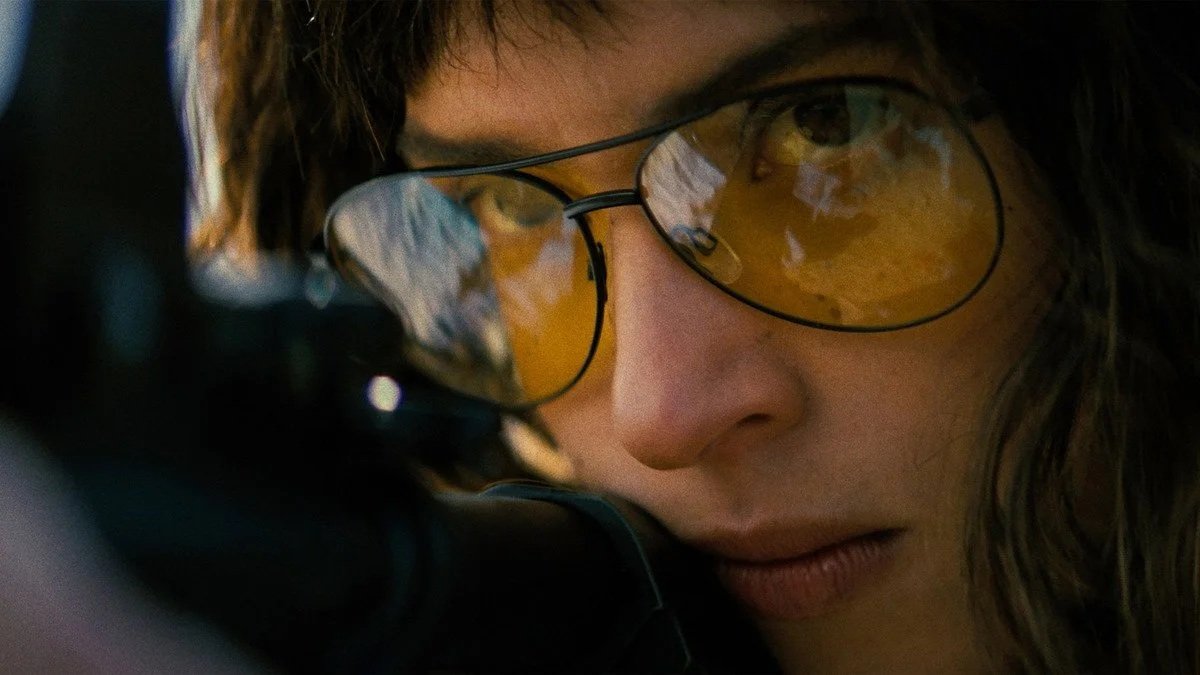
Deep in the New Mexico desert, former Army sniper Celeste (Adria Arjona, Hit Man) contents herself with isolation. She’s the manager of a small trailer park. She’s respected by the tenants (including Reginald VelJohnson and Eric Wareheim), and has the space she wants to practice target shooting and grapple with her ghosts. She and her ex share a daughter, Daisy (Blake Kennedy). Celeste loves Daisy, but isn’t particularly close to her, and when something comes up and her dad turns to Celeste to look after her on an unscheduled weekend, Celeste is left scrambling.
Deeper in the New Mexico desert, in a secret lab, eccentric Nazi scientist Hans Kammler (Dan Stevens) has almost completed his greatest work: a trio of super-soldiers. Kammler has stripped the men who served as the project’s base of pesky hindrances like consciences or memories. They have been rebuilt as ultra-lethal borderline-indestructible revenants who know nothing beyond dealing death. Kammler did his work well. As sure as Hitler is a dead loser, the super-soldiers escape the lab and embark on a murderous rampage. Their butchery leads them to Celeste’s trailer park. To protect Daisy, Celeste must face them.
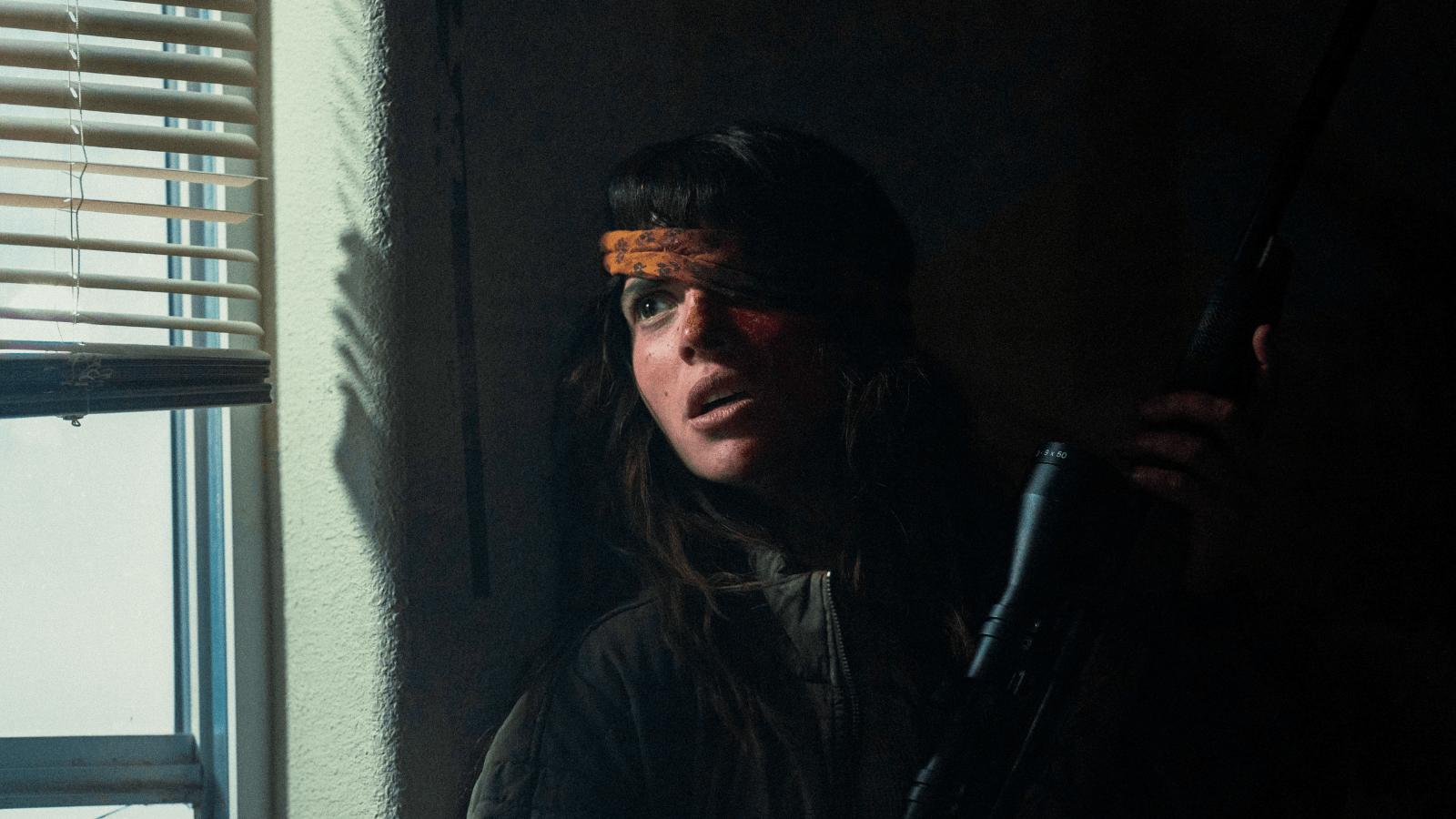
Technically, Onslaught is superb. Director of Photography Oren Soffer (The Creator) uses New Mexico’s vastness to his advantage. During the daytime sequences, the enormity of the land surrounding Celeste’s trailer park emphasizes her isolation and makes the few connections she does have stand out all the more. Come nightfall, and the super-soldiers’ attack, Soffer uses the space to raise tension. The super-soldiers are big men wearing big gear, but in the vastness of night they have cover and space to vanish. When they get the jump on someone, it speaks to their terrifying martial abilities, as opposed to the film bending to make them scary. The visual darkness that dominates the later parts of Onslaught creates space for sound designer Nick Interlandi (John Wick: Chapter 4) to work. Interlandi’s grody squelching is top notch, and his weapon sounds (firearms, blades, a chainsaw) punctuate the terror and action well. Likewise, composer Matthew Pusti’s pulsing score echoes the work that Steve Moore and company did for The Guest while carving out its own sonic space. It’s a cousin, not a clone.
Narratively, Onslaught struggles, and some of those struggles pass on to the cast. Arjona is solid as Celeste, particularly once the super-soldiers’ siege begins. Arjona skillfully balances Celeste’s bravery and skill with her bafflement and terror. She’s someone who can fight a superhuman killing machine, not someone immune to the terror of fighting a superhuman killing machine. When she screams in fear, it’s convincing. When she finds an angle to counterattack and steels herself, it rings true. Where Onslaught lets Arjona down is in the build-up to the siege. Celeste’s dynamics with the trailer park’s tenants feels thorny and lived in: She shares a reserved camaraderie with VelJohnson’s thoughtful Josiah, a fellow veteran, and cannot stand Wareheim’s foppish cop Kovacks. Her loving but distant relationship with Daisy is similarly intriguing. Unfortunately, those dynamics get precious little time to breathe.
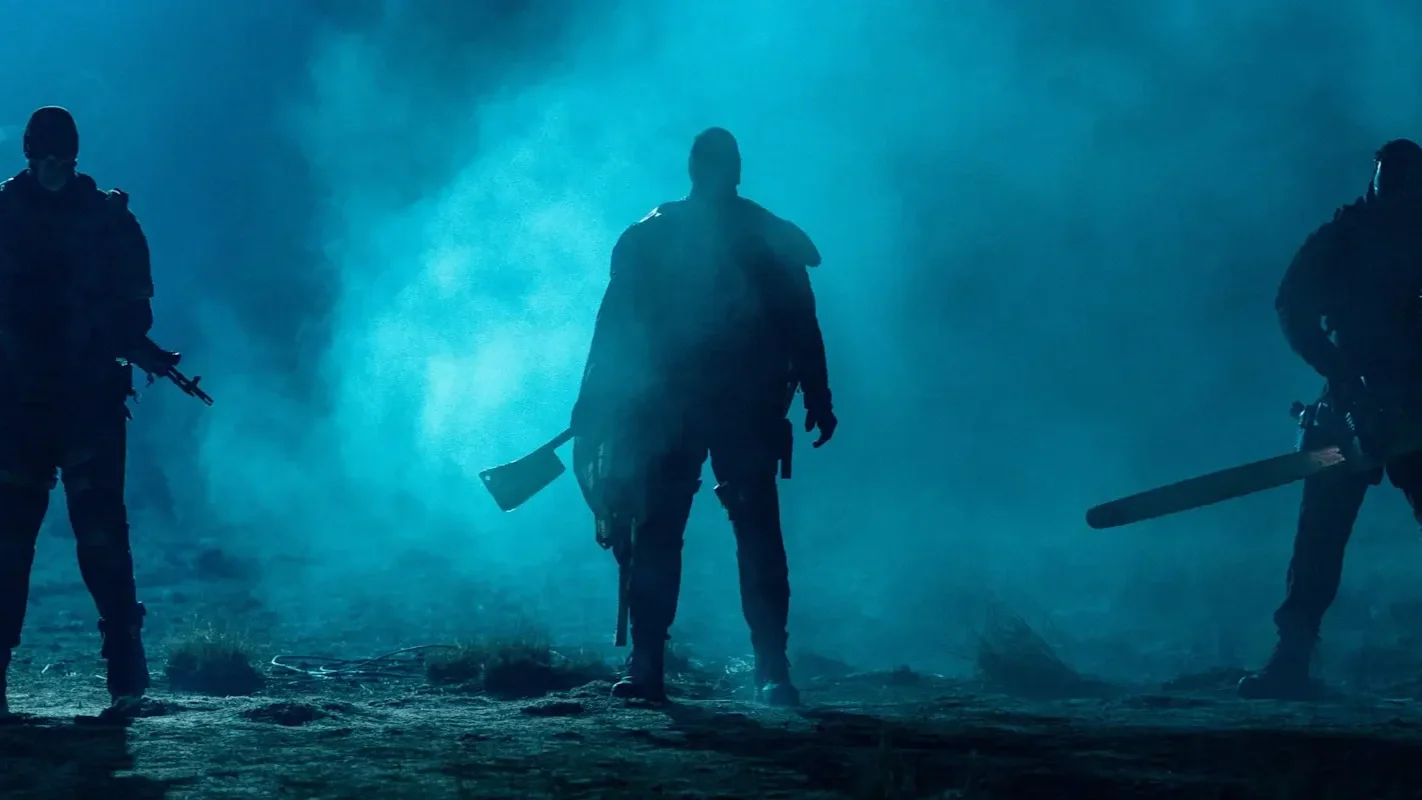
Onslaught clocks in at a swift 92 minutes. At its weakest it feels both overstuffed and undercooked. The super-soldiers get a large amount of screen time, but they are largely emotionless killing machines. They work as physical threats and embody the US military industrial complex at its most vicious. But between their silence and their having to share the villain role with Stevens’ charismatic, eccentric Kammler, they never quite succeed as villains instead of obstacles. Stevens is a hoot as Kammler, a malignant, goofy weirdo whose eccentricity goes hand in hand with his cruelty. The trick is that his screentime is comparatively limited, and his creations cannot match his character. It’s a shame.
With that said, as a piece of horror-action, Onslaught clicks. Trying to fight the super-soldiers directly is a great way to end up ripped to shreds. They’re superhumanly tough, frighteningly skilled, and do not know how to stop. They are not, however, invincible. Their monomaniacal need to kill anyone who crosses their path, for instance, can easily turn into tunnel vision. Celeste, meanwhile, is not fighting for the sake of killing, she is fighting to win. If an avenue gets closed off, she will find another one. If a tactic is not working, she will escalate until she finds one that does. As frustrating as Onslaught’s scriptwork can be on a granular level, its structure and framing are rock solid. Its narrative issues are significant, but from moment to moment it is consistently enjoyable.
Onslaught’s flaws are significant, but its successes are real. It may not have the staying power of The Guest, but it is a worthy companion piece and a fun watch on its own.
If you enjoyed this article, please consider becoming a patron of Hyperreal Film Journal for as low as $3 a month!
Justin Harrison is an essayist and critic based in Austin, Texas. He moved there for school and aims to stay for as long as he can afford it. Depending on the day you ask him, his favorite film is either Army of Shadows, Bring Me the Head of Alfredo Garcia, The Brothers Bloom, Green Room, or something else entirely. He’s a sucker for crime stories. His work, which includes film criticism, comics criticism, and some recent work on video games, can be found HERE.