
PINK CUTS: Love Me Hard, Love Me Deep
Pinku Eiga Club:
The thing no one prepares you for when you watch something salacious in a theater with an audience is the silence. It feels absolute in the moment, fills the auditorium, sinking into the cracks left between the gasps and incidental dialogue carried out by the soundtrack, creating the illusion of isolation. It’s a smokescreen that is instantly broken when you turn your head to find the fellow adventurous moviegoers sharing this experience with you, creating, like all trips to the movies do, a singular kind of kinship. Surprisingly, up until seeing Pink Cut: Love Me Hard, Love Me Deep, I had gone my whole life without seeing a pink film, Japan’s sub-genre of softcore films. Thanks to Austin Film Society’s latest series, Pink Cuts, I was able to dive in headfirst and discover the aesthetic surprises and artful pleasures of several pink films from directors such as Yoshimitsu Morita (The Family Game), Shinji Somai (Typhoon Club), and more.
Pink Cut: Love Me Hard, Love Me Deep, the first entry in the series, was definitely the most joyful. It is the story of Mami (Marumi Terashima), an enterprising college student who took over her deceased parents’ hair salon and populated it with her bouncy friends as a way to draw in clients. She’s immediately a heroine worth rooting for, approaching life and sex with a joie de vivre that is infectious. In a genre that can be notorious for women being passive objects, Mami takes charge and joy in her sexuality throughout the film, whether it’s a quick roll on the desk with her professor, or her later hook-ups with jobless fuckboy Akira (Katsunobu Ito). In her iconic fuzzy pink sweater, or in the white dress her and her coworkers at the salon wear, Mami’s sexual experiences on screen radiate with an exuberance that is laid out well through the aesthetic choices made throughout the film.
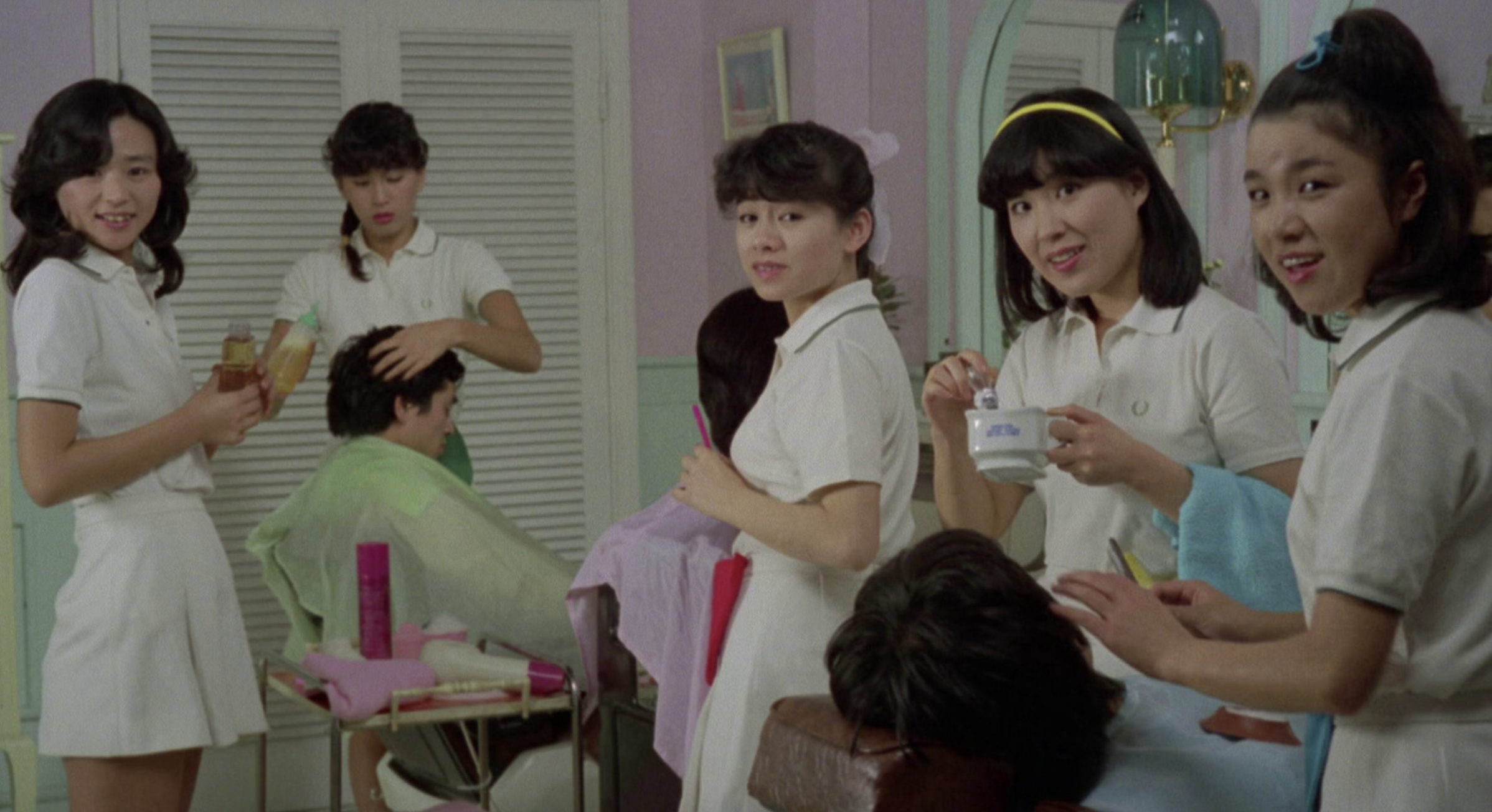
Indeed, all of the expressions of sexuality here feel joyous, even when they’re just an expansion of fantasy. Take, for instance, the fantasy sequence of one customer in Mami’s hair salon (literally credited as “Overly Excited Customer”) that the film shows us. In this customer’s mind, subtext falls away, and the salon becomes a rollicking orgy, effusive and colorful, with pink and mint green pastels blossoming out onto the screen amidst the action. It’s a fantasy that can't last forever. Suddenly, breaking through it all is a stream of white against a lavender background, evoking something more akin to the dreamy dance sequence between Gene Kelly and Cyd Charisse in Singin’ in the Rain than your average idea of what a climax can look like on screen. Director Yoshimitsu Morita channels moments of eroticism like this into ones of genuine beauty, always aligning the allure of the sensual with an aesthetic anchor. In another sequence, as Mami and her professor have a dalliance, the camera pans away from the action to focus on the girl’s panties, dangling from her ankle like ripe fruit hanging from a tree. This is only a small moment, but the effect is indelible. These aesthetics aren’t the only things that make Pink Cut stand apart from other films in the sub-genre.
Over the course of the film, though, there are thorny moments and characters to be reckoned with – handsy clients and bad boyfriends, but they never bog the movie down for too long. “You forget I have a razor,” one of the girls in the salon quips at a client who brushes up her skirt to see what’s underneath. The men who put a wrench in the film’s joyful presence are regularly depicted as pathetic, even when they are getting some. Take the aforementioned Akira. His girlfriend, Yuka (Mai Inoue), is impatient about his tough luck on the job market. She still sleeps with him, because she wants to, but as soon as she realizes he lacks the ambition she wants in a partner, she finds someone else. Even one of the workers at the salon decides to go into sex work because she finds it more rewarding, and Mami is supportive of her choice. There is scarcely any judgement in the way the film depicts these events; the women simply have agency and employ it as they will. The result is a pink film that escapes the darker and more tragic tropes the genre usually employs for greener, gleeful pastures. The film’s end in itself is a delightful punctuation on the whole affair: a dance party that wraps things up in a confetti-coated sheen. It made me yearn for something that’s been lost in the movies lately: presenting the whimsical and the erotic in one, singular package.
I left the theater that evening yearning for modern filmmaking to take a note from something like Pink Cut – a film brave enough to marry whimsy and eroticism perfectly.
If you enjoyed this article, please consider becoming a patron of Hyperreal Film Journal for as low as $3 a month!
Alejandra Martinez is a Tejana archivist, writer, and film lover in Austin, TX. She loves coffee, David Lynch, and tweeting about everything under the sun.
Twitter: @mtzxale.